#Game modes Current
The game has four modes: Survival (the long game: land, mine, build up to space), Battle Royale and Team Fight (fights in space between ships of one category), and Sandbox (free building, to try things).
Who hosts them (decided 2026-11-24; the plan is): Sandbox and Survival are hosted by a player's own game or by community servers that other people run.
Fights happen inside a world (decided 2026-11-26, replacing hosted
match servers for now): Battle Royale and Team Fight are opened in a
Survival or Sandbox world one is in (a player's own hosted game, a relay
room or a community server), from Esc, Battle Royale / Team Fight
(/arena). The main menu has no fight buttons, and the game offers no
matchmaker. Why: a matchmade mode needs many players online at once, and
empty queues make a game look dead; server worlds already have players
who know each other. The matchmaker, match-server mode and their tests
stay in the repo, parked (Phase 6).
What one flies (since 2026-11-26): the class's ready-made ship, a shipyard ship of the class, a blueprint of one's own (one scanned with a projector or sent up, kept in the save), or a ship of one's own standing in the world (one's own: the player who put down the most of its blocks by hand). An own ship is flown as a copy, taken in its cockpit's frame as one joins; the ship itself stays where it stood, and the copy is gone with the match, so a fight neither costs nor gives a ship. Another player's blueprint or ship cannot be flown. The panel's Your ship list comes from the server; what breaks the class's limits is greyed out with the reason.
- Sandbox ("Play Sandbox" in the menu, then a world of the list): building is free; the world starts on empty ground.
- Survival ("Play Survival", or
--host --survivalon the command line): a new world holds only the landing capsule, which comes down with the first player 8 m from a random start on the Earth's dry land (see The start). You build out of the crate you carry; what you take apart goes back into one. A player joining is told how to start. A saved world keeps its mode.
#The fight modes: Battle Royale and Team Fight Currentsince 2026-11-19
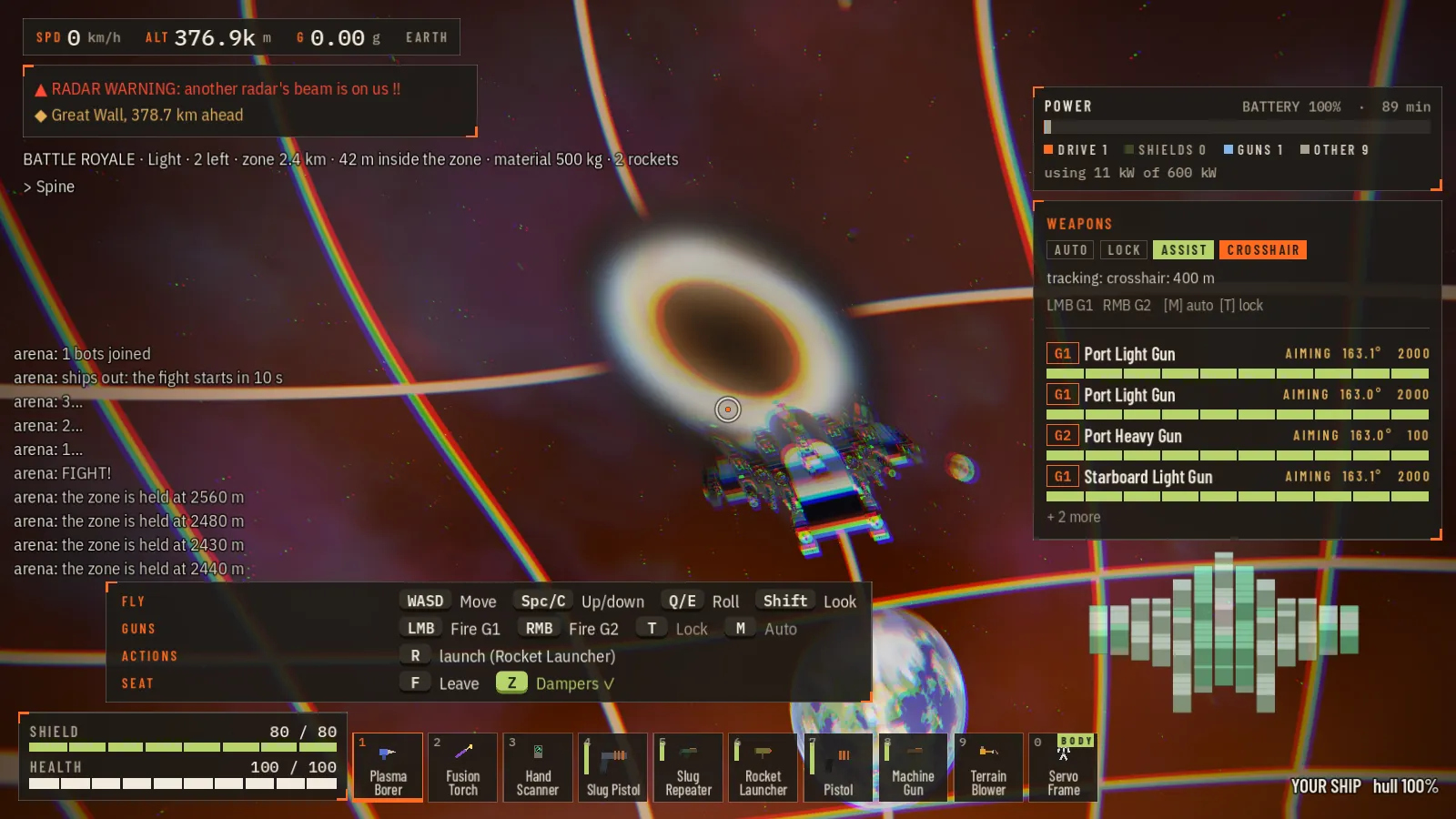
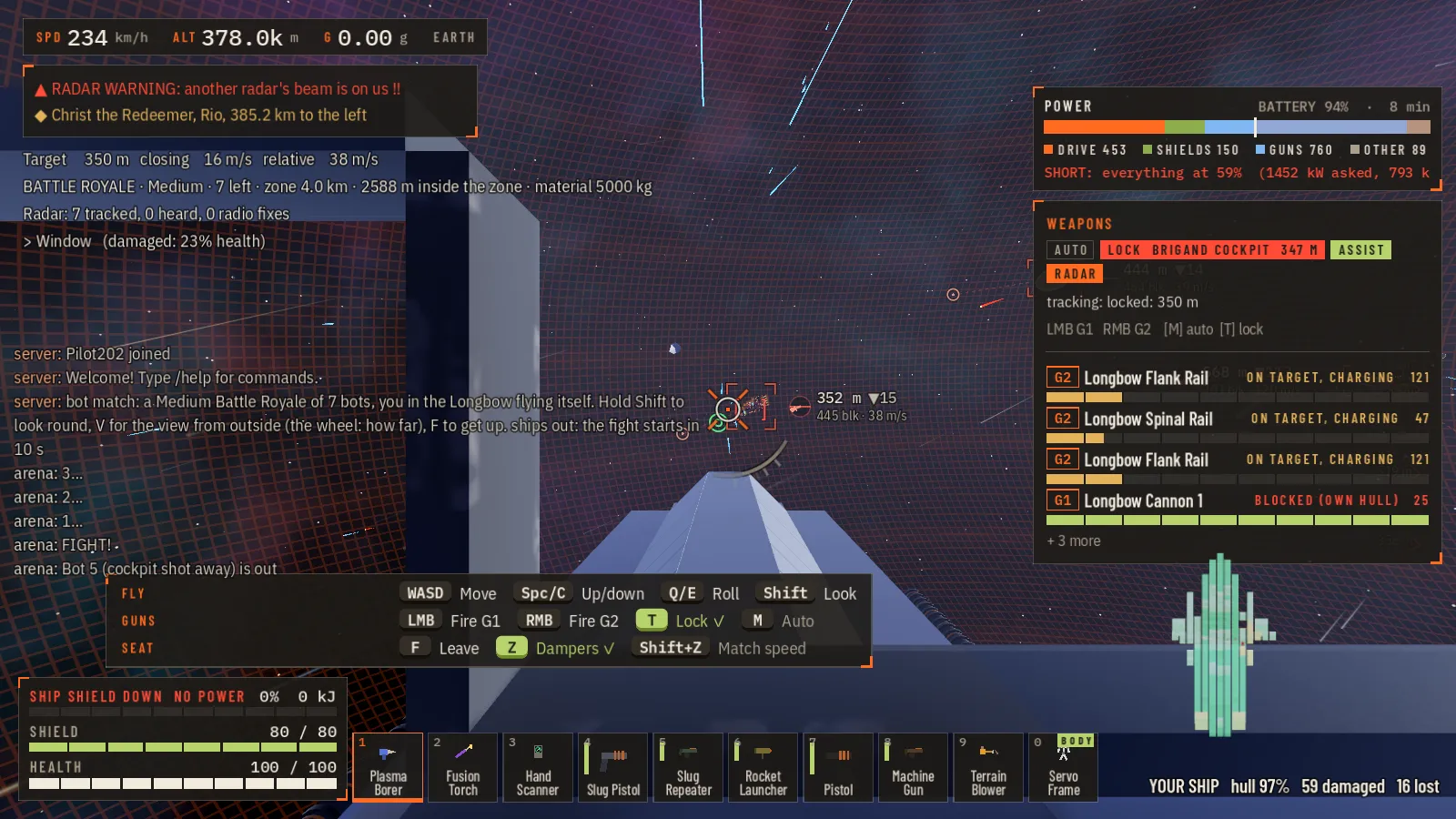
Fought out in empty space, 60 km beyond the Earth's pull (zero-g), in a
world of any mode (/arena).
-
Battle Royale: everyone for themselves. The ships go out on a ring at 80% of the zone, facing in. After 90 s the zone (a sphere round the middle) closes to 8% of its size, over 7 minutes (Light), 8.5 (Medium) or 10 (Heavy); then sudden death: it closes on to nothing over 90 s. A match is over by 10, 11.5 or 13 minutes at the most (since 2026-11-23, to the aim of 10 to 15 minutes; before, 3 to 6 minutes of closing and a minute of sudden death). Outside the zone a pilot loses 5 health a second, and every block of a ship that touches it is destroyed (once a second, as by a hit: a warhead or a loaded gun among them goes off), its debris too. There is always a winner (since 2026-11-23): the last one flying; if the last of them all go out in the same second, the one who held out best (the pilot's health, then the share of their ship left) wins.
-
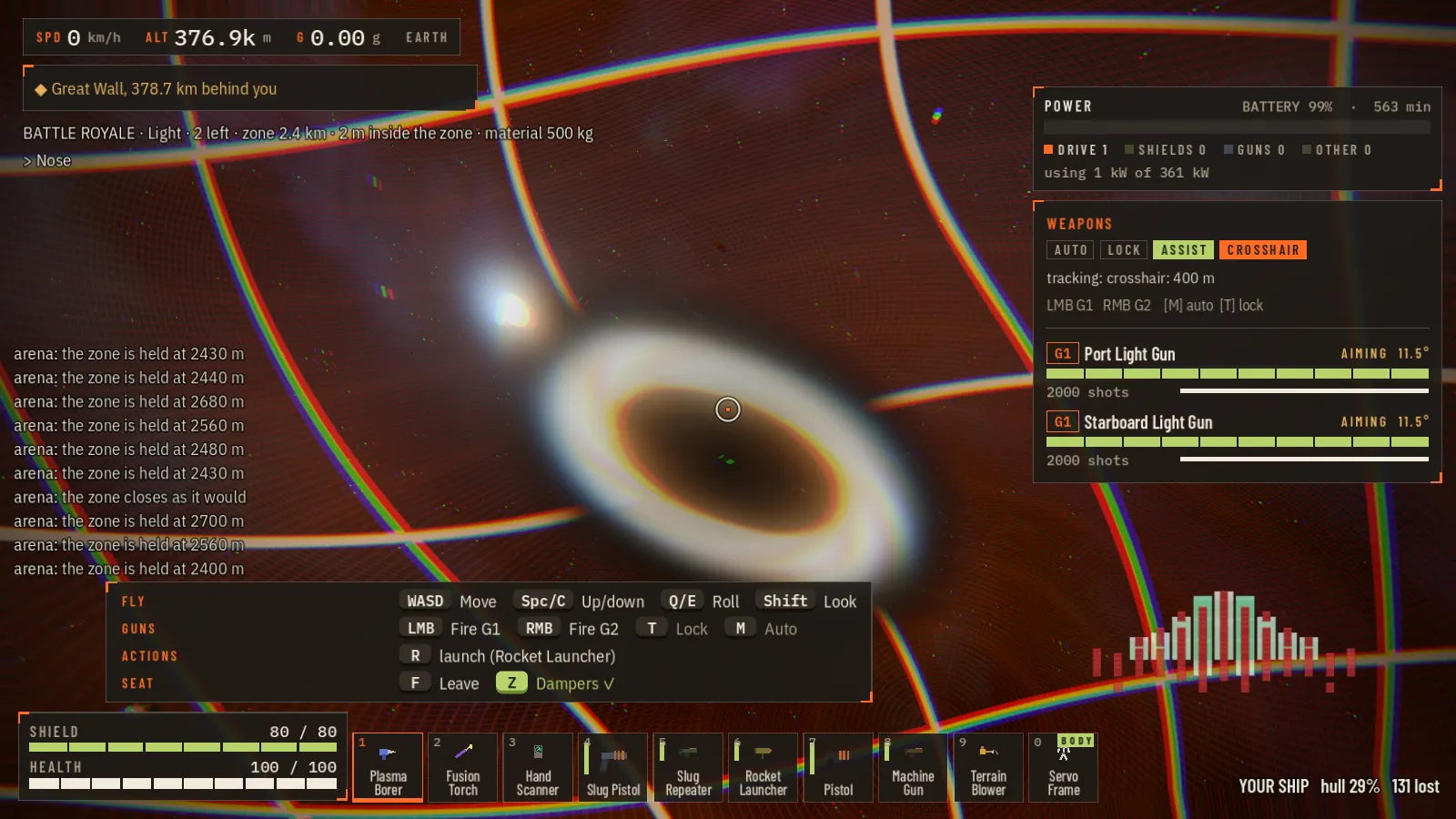
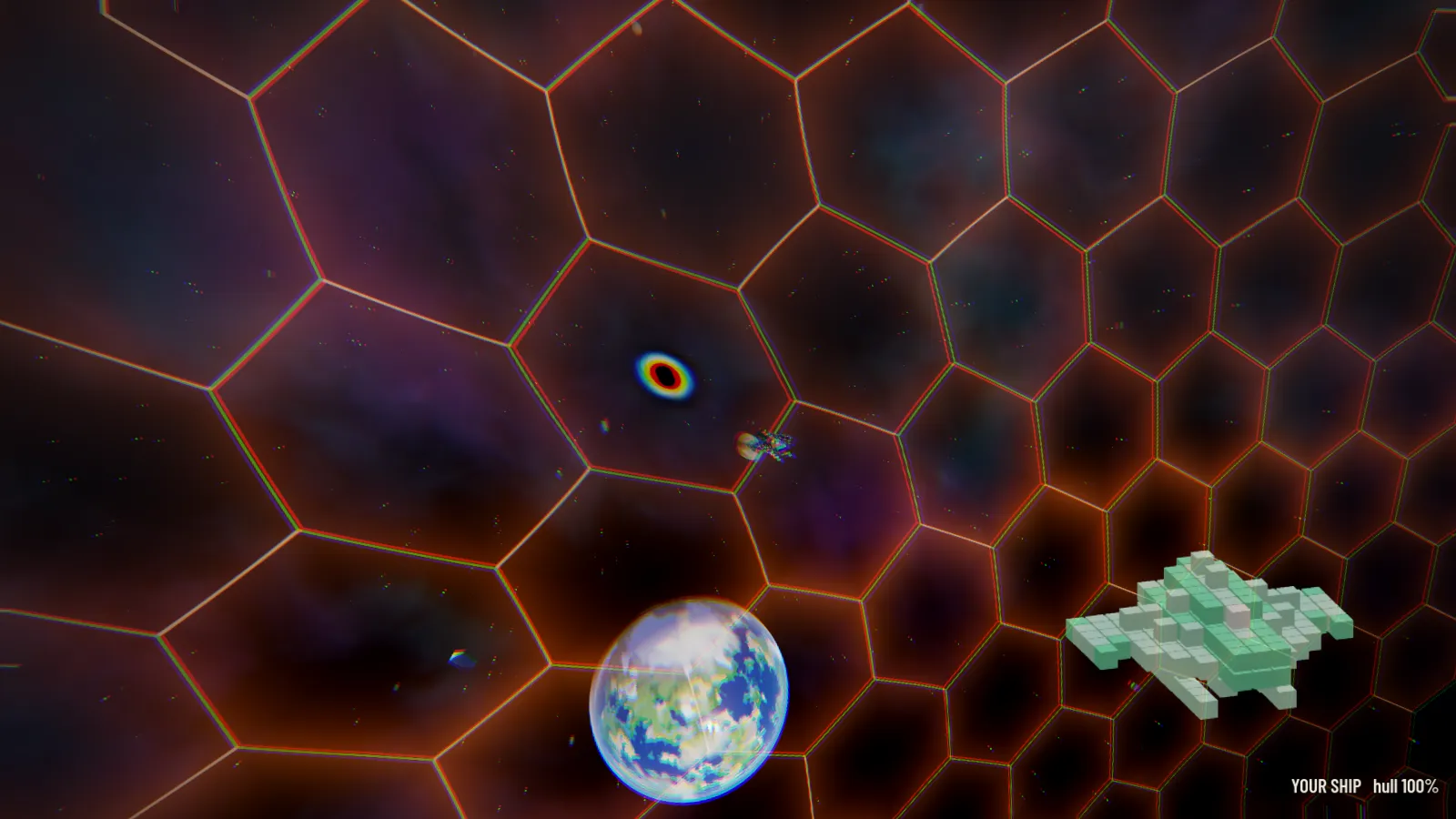
The zone seen (since 2026-11-23): its wall, a sphere glowing red-orange, a honeycomb of hexagons (since 2026-11-24; some 113 to 226 m across, the finer giving way to the coarser as it closes, with a short cross-fade; seamless, on a subdivided icosahedron) with bands of light running up it, brighter all round while one is outside it. When the zone first stands the wall builds up all over: cell after cell flashes in, a wave running out from its point nearest one over the rest (some 3 s), stands 4 s and fades cell by cell. From then on it is not drawn, but near it: within 500 m of it (or outside it), a patch of it round its point nearest one, 320 m out far off to 1,000 m at the wall, brighter the nearer, its rim ragged cell by cell. Where a ship comes within 300 m of it, a rift opens in the wall at its point nearest the ship: a black hole, its black core in a swirling ring of light, the view round it pulled and turned in, 8 m across far off to 50 m as the ship touches and comes apart. In one's own ship, the pull on the view: drawn and turned toward the rift, its colours split, its edges darkened, the stronger the nearer. On the radio map (F6) the zone is a red sphere where it is, bold where it cuts the disc, shrinking as it closes, its radius and one's distance to its wall over it in red.
/arena zone <m|off>holds it at a radius (to try it);--autotest --zoneshotsphotographs all of it. -
Each ship its own colour (since 2026-11-24): put out for a match, a ship's hull (the paint most of its blocks wear) is repainted, its trim and working parts left: in a Battle Royale each ship a colour of its own (16 to go round), in a Team Fight Red's in warm colours and Blue's in cool ones, each its own among them; so ships of the same design are told apart.
-
Out of the fight: a pilot is out when they die, their ship loses its last cockpit, they leave their seat, or their ship is disabled: shot to pieces (less than 40% of its mass left) or dead in space (no power for 15 s). (Since 2026-11-20: before, only the cockpit counted, and bot frigates were shot from 4,400 blocks to 2,000 between them with every death the zone's.)
-
Team Fight: Red against Blue, each team a line abreast half the space apart, facing the other. Each team has 3 tickets per player (5 until 2026-11-23); a ship lost costs one and the pilot gets a new ship 8 s later, while the team has tickets. A team with no tickets and nobody flying loses. The last stand (since 2026-11-23): after 10 minutes no more new ships, and the arena's bounds close in to nothing over 3 minutes, destroying what of a ship touches them as the royale's zone does: one team is wiped out by about 13 minutes. Both out in the same second: the one with more tickets left wins, then the one whose last ship held out best; never a draw (before, after 15 minutes the tickets decided, and even tickets were a draw).
-
Classes (three since 2026-11-23, Light, Medium and Heavy; before, four: fighter, corvette, frigate and capital; the old names still work, a fighter is light, a corvette or a frigate medium, a capital ship heavy): a match is fought in one class of ship, so that like fights like (the limits are checked on the ship as built, across its joints):
Class Blocks Mass Guns Warheads Shields Batteries Reactors Fuel cells Radar Space Players Ready-made ship Light 250 30 t 6 2 0 8 (120 MJ) 0 2 4 km 3 km 48 the Hornet Medium 1,400 150 t 16 8 2 64 (960 MJ) 1 4 10 km 4 km 16 the Bastion (the frigate) Heavy 3,500 350 t 32 12 4 160 (2.4 GJ) 2 8 16 km 5.5 km 8 the Leviathan (2,696 blocks, 261 t) A match holds some 12,000 to 28,000 blocks of ships at most (blocks times players), what a server keeps up with at 60 ticks a second. The shipyard's ships: Light, the Stiletto, Mantis and Kite; Medium, the Picket, Brigand, Harrier (corvettes) and the Longbow, Rampart and Talon (frigates); Heavy, the Leviathan, Citadel and Monolith. The Sovereign (7,089 blocks) is no class's any more. The batteries, reactors and fuel cells a class may carry steer it (since 2026-11-24; batteries 96 and 240 for Medium and Heavy before, of 6 MJ): see Power in a fight below. "Guns" are breeches of either gun, a shell gun counting as two (its rounds bring their own energy, which a coil gun draws from the batteries); "Batteries" caps the energy a ship stores (a battery weighs as an armour block: under the mass limit alone, a ship piled with them outlasted every other; both since 2026-11-20, the arena lab); "Space" is the zone's radius at the start of a Battle Royale (and how far apart the teams start): about a minute or two of closing in at the speed the class flies (it was 5, 8 and 12 km for corvettes, frigates and capitals: frigate bots took four minutes to come within range). Every ship needs a cockpit. A player flies the category's ready-made ship, or a blueprint of their own (made with a projector) that keeps to the limits:
/arena join [red|blue] [blueprint]turns one that does not away and says why. Every ship of a match goes out supplied (since 2026-11-20): its guns full of iron, its shell guns with a full magazine, its batteries charged (a blueprint keeps no contents: a player's own ship came out with empty breeches and never fired). In the match, radars are held to the category's range, and nobody builds onto or takes apart a ship in it. -
The warships (the space park,
/testspawn warden|bastion|sovereign): one builder for all three, from a spec: a hull of armour, an oval in cross-section tapering over its front to a third, hollow inside but for its machinery (gyroscopes, shield generators, batteries; decks of light armour every third layer in the big one), on pillars of light armour down to the keel (since 2026-11-20: in the Bastion, with no decks, it touched no hull, and the first hit that split the ship cut it loose, every battery with it: Bastions went dead in space, full, in 1 to 2 minutes); the bridge on the deck a third back (a cockpit up a step of armour, so that the pilot looks over the radar at the bow, since 2026-11-20; a fire control, an antenna), the radar at the bow; gun turrets in one or two rows along the deck (the Warden two autocannon on rotor and hinge, the Bastion six cannon on gimbals, the Sovereign twelve shell guns on gimbals); two to four fixed heavy guns either side of the bow (the nose assist aims them); large thrusters at the stern and in pods at the bow, small ones along every side.Since 2026-11-20 their shield holds the whole ship: a grid's field is one ellipsoid round its first generator (the others add their charge), so the generators sit in the middle of the hull and the field is drawn round every corner of every block, turrets and rockets under it included, half a metre to spare: the Warden's 6.6 × 8.9 × 15.5 m, the Bastion's 10.4 × 7.8 × 30.3 m, the Sovereign's 16.2 × 13.5 × 61.3 m (a field reaches up to 80 m now, 40 before). At the default 6 m they held a few metres of their hulls. A bigger field takes longer to stabilise once broken: the Sovereign's some 100 s.
And they are painted throughout: the hull, a stripe along its sides and on its bow, turrets (rotors, hinges, gimbals, masts) in the stripe, the guns dark, the engines black, the bridge and radar light. Warden: dark grey and orange; Bastion: white and blue; Sovereign: light grey and red.
/testspawn <fighter|corvette|frigate|capital> spacetakes you out to space to look at one, armed as the bots fly it.Ship Blocks Mass Guns Batteries Accel ahead / astern / up / sideways Warden (corvette) 448 50 t 4 24 41 / 41 / 3.1 / 2.5 m/s² Bastion (frigate) 1,203 127 t 8 70 33 / 33 / 3.2 / 2.7 m/s² Sovereign (capital) 7,089 553 t 16 200 22 / 15 / 1.5 / 1.4 m/s² Turrets stand far enough apart along the deck (the gun's length and 5) that a barrel clears the turret ahead of it: packed closer, the barrels pressed on the next turret, could not aim, and kept the whole ship awake (the idle Sovereign took 3.9 ms a tick; spaced, 0.3).
-
Bounds and wrecks: a Team Fight's arena reaches 1.2 times its space from the middle; a pilot further out (a ship dead in space, drifting off) is hurt as by the zone, so it costs a ticket and they come back in a new ship. Wrecks and pieces shot off are cleared away 30 s after they stop being part of a ship in the match: a long match leaves no graveyard to slow the world.
-
Bots (
/arena bots [n]): players flown by the game, through the same inputs a player has. A bot sets its radars active along its nose (35°, as far as the category lets it, up to 4 km), locks onto the nearest enemy it tracks precisely and leaves the aiming to weapons auto and the nose assist; it holds fire until within 2.5 times its fighting range (300 m plus 12 m for each square-root block of its category: 490 m for fighters); it closes no faster than it can brake (2 m/s²), heads for a point off the enemy's side so that the two circle rather than meet head on, weaves, and keeps clear of anything closing within 250 m. A drift its side thrusters cannot take out it turns its nose into and burns the main engines. With no target it heads for the middle and sweeps its radar all round; it gets back inside the zone or the bounds before anything else. Since 2026-11-20 it turns its nose onto an enemy more than 12° off it (the nose assist takes over only within 15°: a ship circling beside it was never turned on, and two such sat side by side to the end), and with nothing on its radars (shot away) it locks onto an enemy it sees within 1.2 km, as a player locks with T. A bot out of a Battle Royale leaves the world. It goes for the ships in the match only (not rockets, not wrecks). -
Rockets (since 2026-11-20): in a Battle Royale the players' ships and every other bot's carry homing rockets on rails under the hull (the category's ready-made ships: a blueprint of one's own flies as it was built; 2 a fighter, 4 a corvette, 6 a frigate, 8 a capital). With an enemy ahead of its nose between 150 and 900 m, now and then (one chance in three each time it could; 10 to 18 s between) a bot runs its ship's launcher with "launch" at it. A player launches with what the cockpit's action keys run (below): the ready-made ships have their Rocket Launcher on R. The fighter category allows 2 warheads for them (0 before).
-
A rocket seen (since 2026-11-20): let go, it drifts clear a third of a second, then lights with a burst of smoke and sparks from its nozzle; a rocket's engine (a thruster named "Rocket Engine") has a long bright flame (7 m at full) and a warm light on what is round it while it burns, and sheds a thick trail of smoke that lingers some 4 s (none in its first 6 m: it does not cloud the pilot's view). One's own rockets going away get no radar mark (small and opening); one coming at one does. Rocket parts leaving a mount are not counted as hull lost.
-
Action keys and the launcher (since 2026-11-20; nothing about rockets is in the code of the cockpit): a cockpit has three action keys, R, H and N, each bound on its panel (ACTION R/H/N) to a computer of the ship, by name, and an argument (kept in blueprints and saves). Pressing one runs that computer with the argument and what the pilot is on: "ARG | ship SHIP | view x y z dx dy dz | aim GRID x y z vx vy vz ox oy oz": where the view on the screen is and which way it looks (first person, the chase camera, or a camera looked through), and what that line meets (the middle of the block it strikes; else the cockpit's locked target, its centre), how that moves, and that point off its origin. Any script may use it. A ship with rockets has a computer "Rocket Launcher" (fitted with its rails and bays), bound to R where R was free: run with "launch" it lets one whole rocket go (its mount's merge block off) and tells the rocket's computer where to go; a bay takes hold again 2 s later and switches its welders on; with none ready it says why ("no rocket ready (1: 3/7, 2: 0/7 let go)"). A rocket sent at a block goes for that block (aimed at a Bastion's end it went off 4.7 m from it, 20 m from its middle). Scripts run another computer of their construction with
block:run(arg). The hotkey bar, seated, shows the bound keys in a row of their own (ACTIONS: "R launch (Rocket Launcher)"). -
Rocket makes and bays (since 2026-11-20): four makes, all flying one script (set for each), which finds its blocks by the start of their names each tick (on a mount they end in its number: "Warhead #2") and waits while its rail or bay holds it; it measures from its own gyroscope (let go of a ship, its grid keeps the ship's origin, tens of metres off on a big one):
Make Blocks kg Guidance Locks on homing radar, warhead, computer, gyro, battery, 2 engines 1,170 radar, proportional navigation (N 4) 30 blocks and more pursuit the same 1,170 radar, nose on the target (N 0) 30 and more swarm warhead, computer, gyro, battery, engine 900 no radar: flies at where the launcher said the target would be, reckoned on - torpedo radar, 2 warheads, computer, gyro, 2 batteries, 3 engines 1,620 radar, N 3, slower (150 m/s closing) 300 blocks and more The guidance spends the engines on the push across the line of sight first (that is what hits) and only what is left on closing speed (with the closing first, a rocket chased a crossing fighter from behind and missed it by 15 to 160 m). The launch message carries where the target is and how it goes: a rocket without a radar flies on that, one with a radar until it has a lock. On the rocket range (
arena_lab rocketrange, 800 m): every make hits a ship standing, and Wardens and Bastions however they move; a fighter crossing at 60 m/s only the homing rocket, the swarm and the torpedo (on the reckoning) hit, not the pursuit; a fighter jinking (a new heading every 3 s) the homing rocket one shot in four, the others none. One hit takes some 110 to 150 of a fighter's 177 blocks, 70 to 120 of a Warden's, 290 to 370 of a Bastion's. Rails (until 2026-11-20 landing gear clamps, which a script of the ship could not reach): a merge block on the underside, "Rail Merge Block N", the rocket's place under it (it touches the ship only there), as many as fit. Bays: a rail with welders beside its row every third cell ("Bay Welder N") and one projector, "Bay Projector", that has the ship with its rockets in its blueprint: the launcher lets the rocket go (the merge block off: the rocket is a craft of its own), 2 s later takes hold again and switches the welders on, and they print the next, block by block (a few seconds). The mounts' rockets count as the ship's: their warheads and batteries against the category's limits (a Warden takes 2 homing or torpedo bays, 4 swarm). counts the whole ones a mount holds. -
Point defence (since 2026-11-20): turrets that shoot at rockets only, the answer to them. Each is a light coil gun (0.1 kg shots, 600 rpm, 4 coils, up to 150 kW, in gun group 9: the pilot's triggers leave it alone) on a gimbal on a pedestal, on the hull's top or under it, with its capacitors, its own computer and a radar looking out from that side ("PD n Radar", 900 m, half-angle 90); and four more radars ("PD Radar") look out ahead, astern and to the sides (a top or a belly radar's half of the sky ends level with the hull, where most rockets come from). The script reads every radar of the ship named "PD...", keeps the small grids (20 blocks at most) that will pass within the ship's reach and 12 m of it within 8 s (rockets flying off, the ship's own, are no threat), takes the soonest, leads it with
ballistic, turns the gimbal by its own axes (top and belly turrets alike) and fires within 2.5° of the aim. A PD gun is a gun against the category's limit: the PD fighter gives its two heavy guns for two. On the range (arena_lab pdrange, a rocket from 800 m ahead, from the side, from above and from below): with 2 turrets a fighter or a Warden shoots down 3 of 4 homing rockets, 3 or 4 of 4 swarm rockets and torpedoes, 1 of 4 pursuit rockets (they come straight in: little to lead); a Bastion 1 or 2 of 4 (a big ship: a rocket is within reach of its hull before a turret on its far side has it). Four are no better than two yet. In fights (2026-11-20,arena_lab vs, 4 duels a pairing, and royales of 12 fighters, 8 corvettes, 6 frigates): a Warden with 4 PD turrets beats most gun Wardens (3 of 4 against the glass cannon, the racer, the battery pack, the armoured) but loses to homing bays 0 to 4 and torpedo bays 1 to 3: a bot launches at 150 to 900 m, close, and a bay sends another a few seconds after. A Warden with 2 homing bays and 2 PD turrets is the best corvette in duels (52 of 60); in royales of 8 it placed 6.5 on average (4 matches). The PD fighter (its heavy guns given up) and the Bastion with 6 PD turrets are mid to low in both. So far: PD stops single rockets from range, not a salvo from close by. (A sensor block was tried first: it reaches 50 m, no use against a rocket coming at 200 m/s.) -
Material (since 2026-11-20): a ship goes into a match with material for its welders: 500 kg a fighter, 2.5 t a corvette, 10 t a frigate, 40 t a capital. A weld costs the block's mass, a mend its share of that; gone, its welders weld and mend nothing more ("out of material"). A corvette's 2.5 t is two homing rockets printed again, or a lot of mending; out of a match welders work as anywhere. The arena line shows what is left ("material 1,330 kg · 2 rockets").
-
Menus (since 2026-11-20): the main menu's Battle Royale and Team Fight buttons, and Battle Royale / Team Fight in the Esc menu, open a panel: mode, class of ship, one's team (Team Fight), how many bots (up to the class's limit less one), Your ship, Start; in a game also Start the match now, Leave the match and End the match. From the main menu it hosts a sandbox first. It does no more than the chat commands below (one's own ship is uploaded, as online).
-
Signing up a ship (since 2026-11-25): Your ship lists the class's own ship, the shipyard's of the class, then one's own kept ships (
user://ships); those of one's own that break the class's limits are listed but cannot be chosen, why in their tooltip (blocks on rotors and hinges counted too, as/arena joinnow counts them). The choice is kept per mode and class (the settings'): one's signed-up ship for each, used by Start and by Find a match online. A Battle Royale started from the panel waits 60 s in its lobby (/arena start 60); a Team Fight starts at once. -
Flow:
/arena open <br|team> <category>, players/arena join(a shipyard ship of the category by name, a blueprint, or the category's own),/arena start(two players at least; both teams for a Team Fight): the ships go out, everyone seated, and the fight starts 10 s later. Chat tells everyone what happens (who is out, tickets, the zone, who won); the HUD shows the match (players left, the zone and where one is in it, or the tickets and the time)./arena endcloses it. -
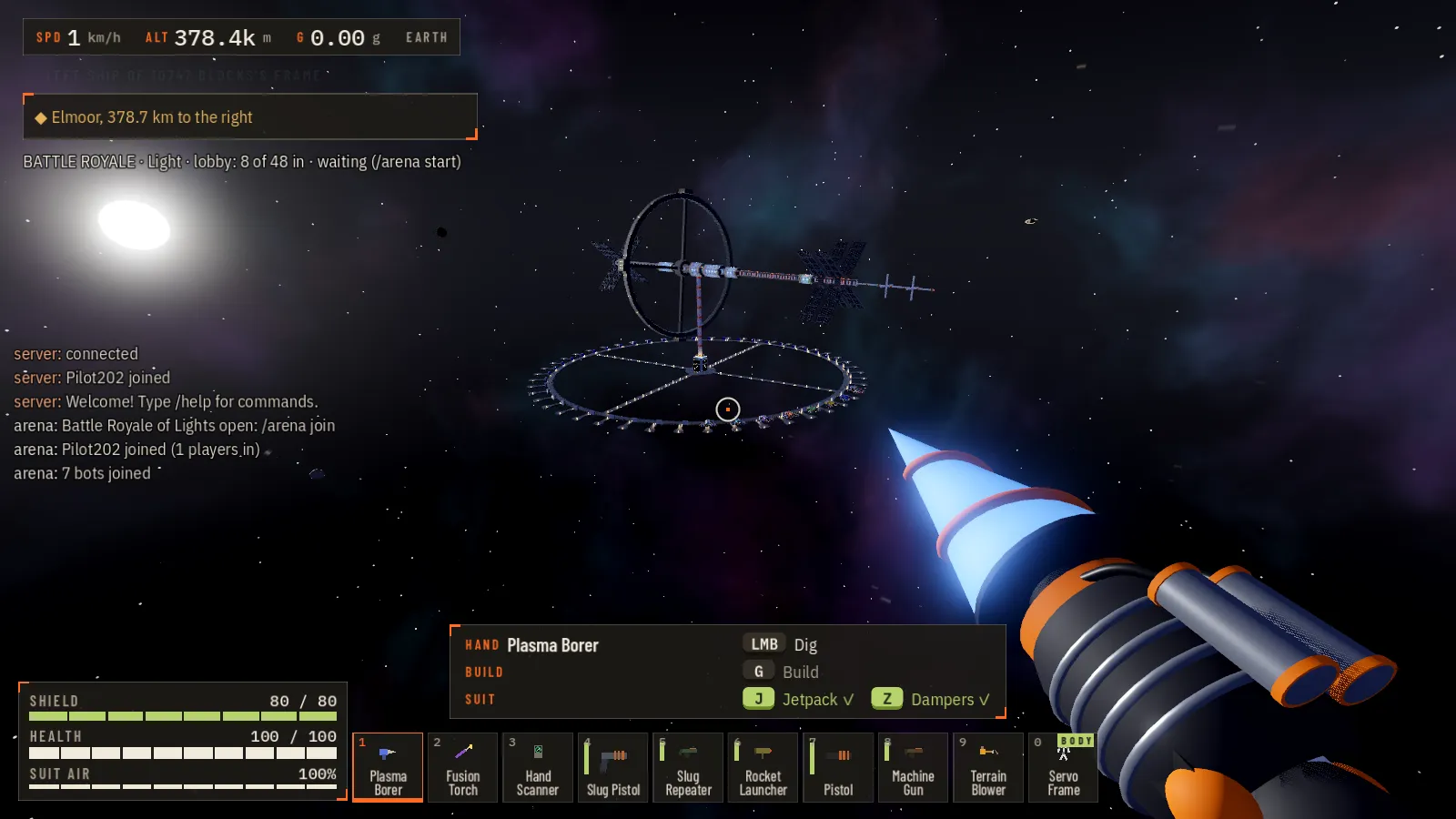
The lobby station (since 2026-11-25): a Battle Royale opened by
/arena open bror on a match server waits on a station built where the fight will be (not the bot match or the arena lab). After a ring-and-spine station: a spine (a truss with modules, an antenna boom with two crosses and a red beacon) 70 to 105 m over a platform, a column from its core module down to the platform's board tower; a great ring round the spine (a hollow tube 5 by 5, four pods, four spokes to a collar); four solar arrays, each four wings of panels in an X. Pearl, brushed steel and anodised titanium, gold leaf bands, orange trim, lamps in sky blue. Some 41,000 blocks for Light.- The platform: a hub (players and bots come out on it) round a board tower, on each face the match (class, pilots in of how many, when it starts) over the roster (each pilot, their ship, a swatch of its colour); four spokes to a walkway ring; round that a bay per pilot the class holds (48, 16, 8), each its own grid square to the ring: a pier to a plinth, the entrant's ship 4.5 m over it, bow to the middle, in its match colour, a sign at the pier's foot (who, the ship, its numbers against the class's limits). Bays 20, 30 and 42 m apart round the ring (its radius 153, 76 and 53 m), held to the shipyard's ships by a test.
- It turns: the platform once in 5 minutes, its bays and ships with it; the ring once in 15 minutes one way, the solar arrays once in 12 the other. Kinematic bodies moved every tick; one standing on the platform is carried as on any moving deck. (A turret head on its joint stays dynamic, carried by the joint: rapier lets only a joint's root be kinematic.)
- All of it warded; a ship on show has its shields off, computers stopped, batteries full, and its cockpit cannot be sat in. Joining again with another ship swaps it in the same bay; leaving frees the bay and sends one home; anyone gone from the world is taken out of it.
- Starting:
/arena startat once,/arena start <s>in so many seconds (the boards and the HUD count down); a match server sets the boards to its deadline and starts it when full or at that time. The station and its ships are taken away before the ships go out. --autotest --lobbyshots [light|medium|heavy]photographs it (with/goto <block name> @ x y zto stand off it).
-
Home again (since 2026-11-20): a player goes back to where they were before the match (in any mode: a survival player to their base), out of their ship of it, which is taken away with its rockets: when they are out of a Battle Royale (alive), when their team has no tickets left, when they leave, 15 s after the match is won, and when it is ended (then every ship and wreck of it goes, and the bots). Before, they sat on in their warship 60 km out in space, with no way back, and kept it: a free warship.
#The shipyard: three more ships a category Currentsince 2026-11-21
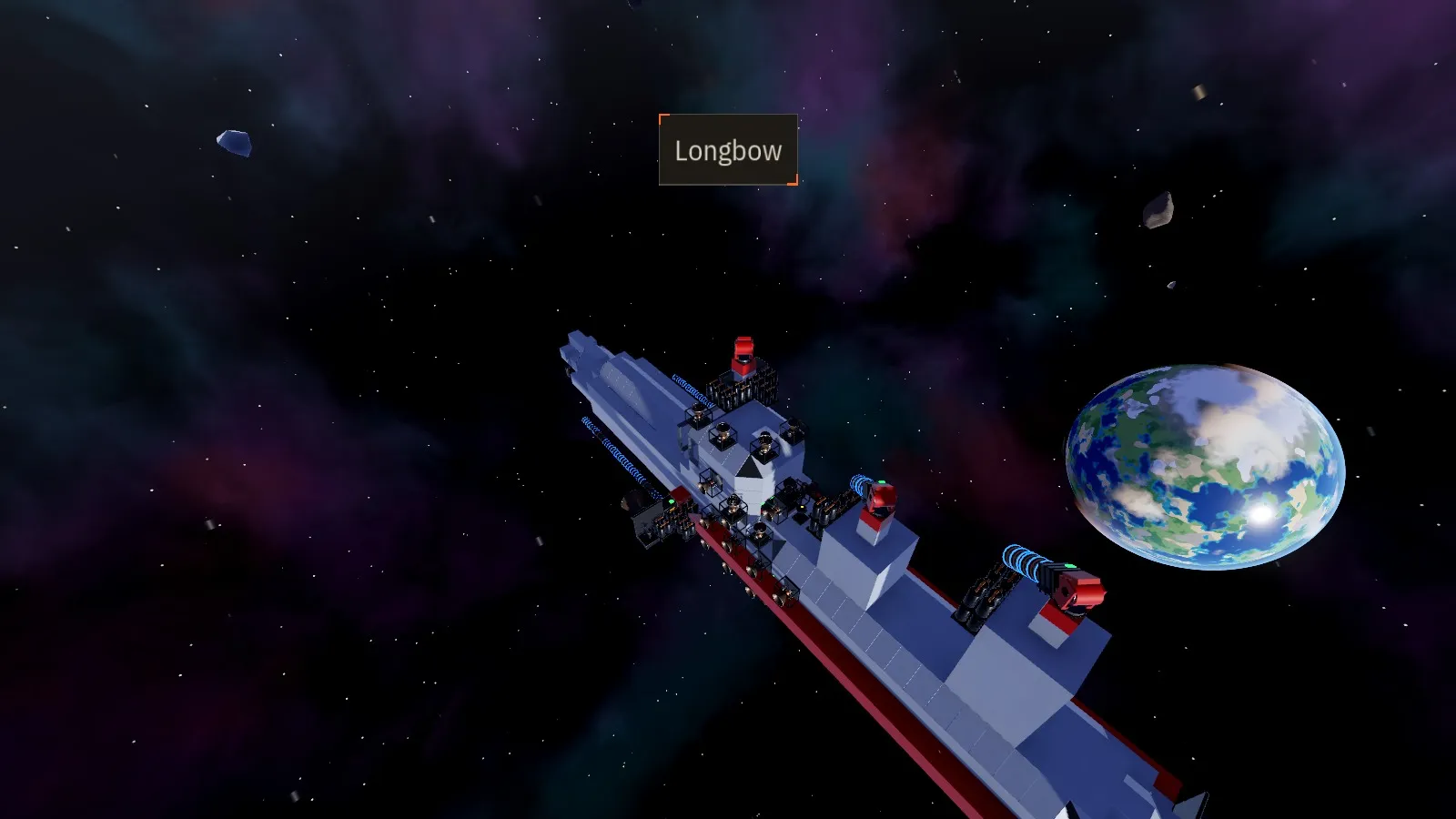
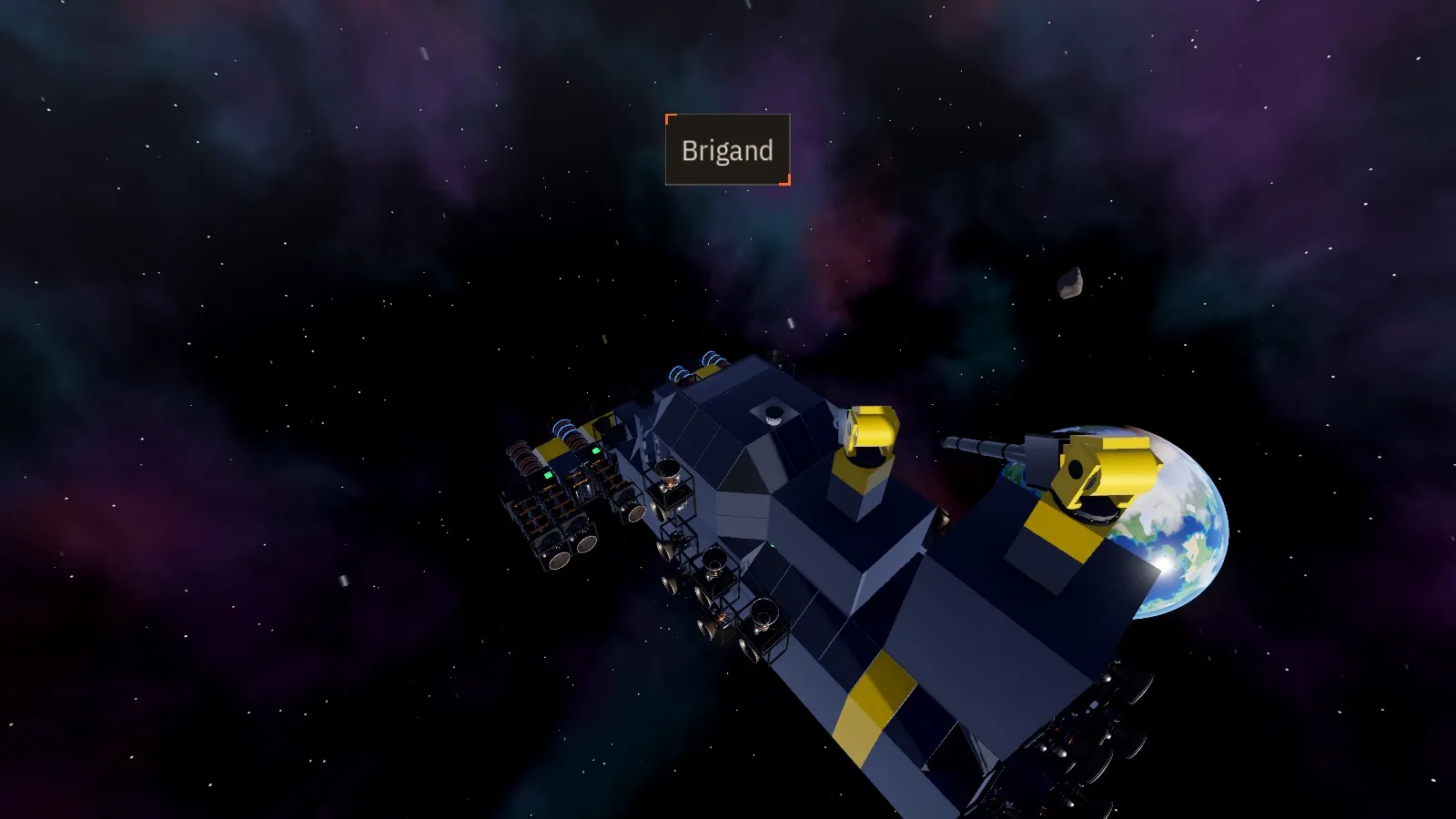
Twelve ships beside the categories' own (DESIGNS), three
to each, each another way to fight and each within its category's limits
(a test holds them to it). Every one is big enough to walk in: a cabin
(a sealed room, its air from an oxygen tank, gravity in its floor, a lamp)
with the cockpit at its front behind windows and nothing of the ship ahead
of them for 40 m, a hatch (doors) in its side, through a corridor in the
hull where the hull is wider; a bunk in the bigger ones. Where the cabin
stands over the hull it is a bridge on a tower (aft and high on the
Rampart and the Leviathan, so the pilot looks out over the turrets).
| Ship | Class | Finish | What it is | Blocks | Mass | Guns | Turrets | Computers | Accel ahead / astern / sides |
|---|---|---|---|---|---|---|---|---|---|
| Stiletto | fighter | round | interceptor: a needle, one large engine, 4 light guns, 2 homing rockets on rails; fragile | 200 | 20 t | 4 | 0 | 3 | 104 / 9 / 6 m/s² |
| Mantis | fighter | faceted | brawler: 2 shell guns in armoured claws, 2 heavy guns | 200 | 20 t | 6 | 0 | 0 | 9 / 6 / 6 |
| Kite | fighter | round | sniper: a flying wing, 2 ten-coil rail guns, 2 light guns; slides sideways fast | 198 | 23 t | 4 | 0 | 0 | 11 / 8 / 8 |
| Picket | corvette | round | escort: 2 point-defence turrets, 4 light guns, sponsons; sees 6 km | 447 | 48 t | 6 | 2 | 2 | 83 / 83 / 5 |
| Brigand | corvette | faceted | gunboat: 4 bow cannon in a hammerhead, 2 shell turrets; slow | 466 | 47 t | 8 | 2 | 0 | 12 / 8 / 4 |
| Harrier | corvette | round | torpedo boat: twin hulls, 2 torpedo bays that reload, 2 autocannon | 494 | 51 t | 2 | 0 | 3 | 82 / 9 / 3.5 |
| Longbow | frigate | faceted | a spinal rail gun out of the bow, 2 flank rails, 2 cannon turrets, 2 point-defence; sees 8 km | 905 | 89 t | 7 | 4 | 2 | 45 / 45 / 3.4 |
| Rampart | frigate | faceted | 4 shell turrets ahead of a tall bridge, 2 shields, casemates | 988 | 94 t | 8 | 4 | 0 | 43 / 43 / 2.6 |
| Talon | frigate | round | strike: forward prongs, 2 torpedo bays that reload, 2 autocannon turrets, 2 point-defence | 1,005 | 101 t | 4 | 4 | 5 | 42 / 40 / 3 |
| Leviathan | capital | faceted | battleship: 6 shell turrets, 4 bow cannon, 2 point-defence, 4 shields | 2,696 | 261 t | 18 | 8 | 2 | 31 / 31 / 1.6 |
| Citadel | capital | round | carrier: a hangar the length of its after half (hangar doors astern), 4 homing bays that reload, 2 point-defence, 2 autocannon turrets | 2,731 | 280 t | 4 | 4 | 7 | 30 / 29 / 1.5 |
| Monolith | capital | faceted | dreadnought: twin hulls on a spine, 3 spinal rail guns, 6 cannon turrets, 2 point-defence; every battery it may carry | 2,925 | 281 t | 11 | 8 | 2 | 50 / 29 / 1.5 |
- A budget of parts a class (since 2026-11-21, held by a test): fighters 200 blocks, no turrets, 3 computers; corvettes 500, 2, 4; frigates 1,200, 4, 6; capitals 3,000, 8, 10 (turrets: bodies on joints, point defence among them; computers: rockets' and launchers' among them). The first designs were near the match limits (the Leviathan 6,460 blocks, 18 turrets); twelve of them with their computers running took 70 ms a tick, four times what a tick may, and a park of them froze the game. Now 4.3 ms (13,255 blocks, 26 computers). Autocannon turrets are on gimbals: one body on a joint, where a rotor and a hinge are two.
- Finish: every edge of the skin (two open faces at a right angle) a slope (faceted ships) or a round edge (round ones), every outer corner (three) a corner piece, a thin wing's edge a slope or round edge; where the hull steps down a cell every two, a slope tip and a half slope, a slope of one in two rather than stairs.
- What made it cheap (engine, since 2026-11-21): a computer's view of its
ship (every block, every tick) is built once a tick for a grid and shared
by its computers, indexed by id
and by name in sorted arrays (
grid:block(name)once went through every block), its blocks' kind-specific parts boxed (960 bytes a block, 544 now); and the armour shapes (slopes, corners, round edges...) share colliders a chunk as cubes do, their boxes one compound and their walk shapes one mesh: 2,000 slopes on a moving hull took 0.56 ms of physics a tick, 0.036 now.
("Guns" as the limits count them: a shell gun two, point-defence guns too. A mount's rockets bring their own batteries and warheads, counted.)
- One builder (from a
Design): the hull lofted from parts (an oval, box, diamond or hexagon drawn through stations along the ship, mirrored or not), its skin armour (light armour for wings and fins, two layers for the heavy ones), its edges bevelled with slopes, hollow inside; the machinery grows from the walls nearest the middle into the hollow, every block touching one before it; a piece the skin left hanging (where a hull widens by more than a cell at a step, the skin there touched only the hollow: bow tips and fin roots) is joined back through light armour. Fixed guns' barrels and the pilot's view stay clear of the ship; point defence and its radars keep out of them too. - Thrusters: the big engines a design asks for, only where they push within 1 m of the centre of mass (else small ones make up 8 m/s² ahead); then small thrusters, as many as the design's accelerations need, in pairs, each where it leaves the least turn about the centre of mass and not crowding another, never in front of the windows, a gun, a turret's swing or the rockets' way out. What turn is left is under a quarter of what the gyroscopes hold.
- Painted flat (a metallic paint mirrors black space and the hull is lost): the hull, its stripe, the bevels as the hull, guns dark, engines black, turrets and doors in the stripe, the rooms' walls light inside.
- The shipyard park (Demo parks menu: Shipyard): on open ground near the Earth landing point (trees felled), all twelve on show in four rows, a class a row, fighters nearest, bows toward the onlooker. Each is held where it stands (a static grid), its batteries full and its shields off, its hatch open, a gangway (a grid of its own) from it down to the ground: a deck level with the cabin's floor out over the hull, then a ramp of slopes, two wide. The Mantis, its hatch in its roof, has none (the jetpack). A sign at each bow: its name, class and role. Their computers are stopped (scripts kept): point defence and rocket computers scanning their radars every tick made the park run at 86 ms a tick, five times too slow, and the game stopped answering; 10 ms without. The Fleet in space park stops them too. A walkway out of every hatch is kept clear of thrusters and point defence in every build of the ships (they had put thrusters against the hatches).
- Every gun fires ahead (since 2026-11-24): turrets are mounted from
the bow aft, each on a pedestal of armour (three by three) high enough
that its barrel clears everything nearer the bow in its line by a cell:
the hull, the bridge, the turrets ahead (superfiring, as a battleship's
turrets step up toward the bridge); their line of fire ahead is kept
free of later fittings. Point-defence turrets on top go first where
their line ahead is clear. Before, turrets sat on the deck one behind
another and fired into each other or the bridge: of the guns a fire
control drives, the Talon could fire 2 of 4 ahead, the Leviathan 8 of
12, the Monolith 8 of 11, the Longbow 5 of 7, the Brigand, Picket and
Citadel one fewer than all; now every ship all of them (
arena_lab arcs: each ship's guns that can fire at a target ahead, 15 and 45 degrees off, abeam, above and astern). Astern some see less (the Rampart none, the Leviathan 4 of 12): the turrets face the way one flies at the enemy, and the stern is guarded by point defence (it fires by itself at rockets and what comes close): the Rampart has two now and the Brigand one (none before; the Rampart could fire nothing astern), so every ship with turrets has some. The Picket has a fifth gyroscope (its point defence moved aft). - Where: the Demo parks menu's Fleet in space (out in space: all
twelve, a row to a category),
/testspawn <ship> [space [seated]], and in a match/arena join [red|blue] <ship>flies one of the match's category (one of another is turned away, the category's three named);/arena categorieslists them. Bots still fly the categories' own ships. The arena lab has them in its roster (arena_lab gallery --only Stiletto...renders them).
#Power in a fight, and what counters what Currentsince 2026-11-24
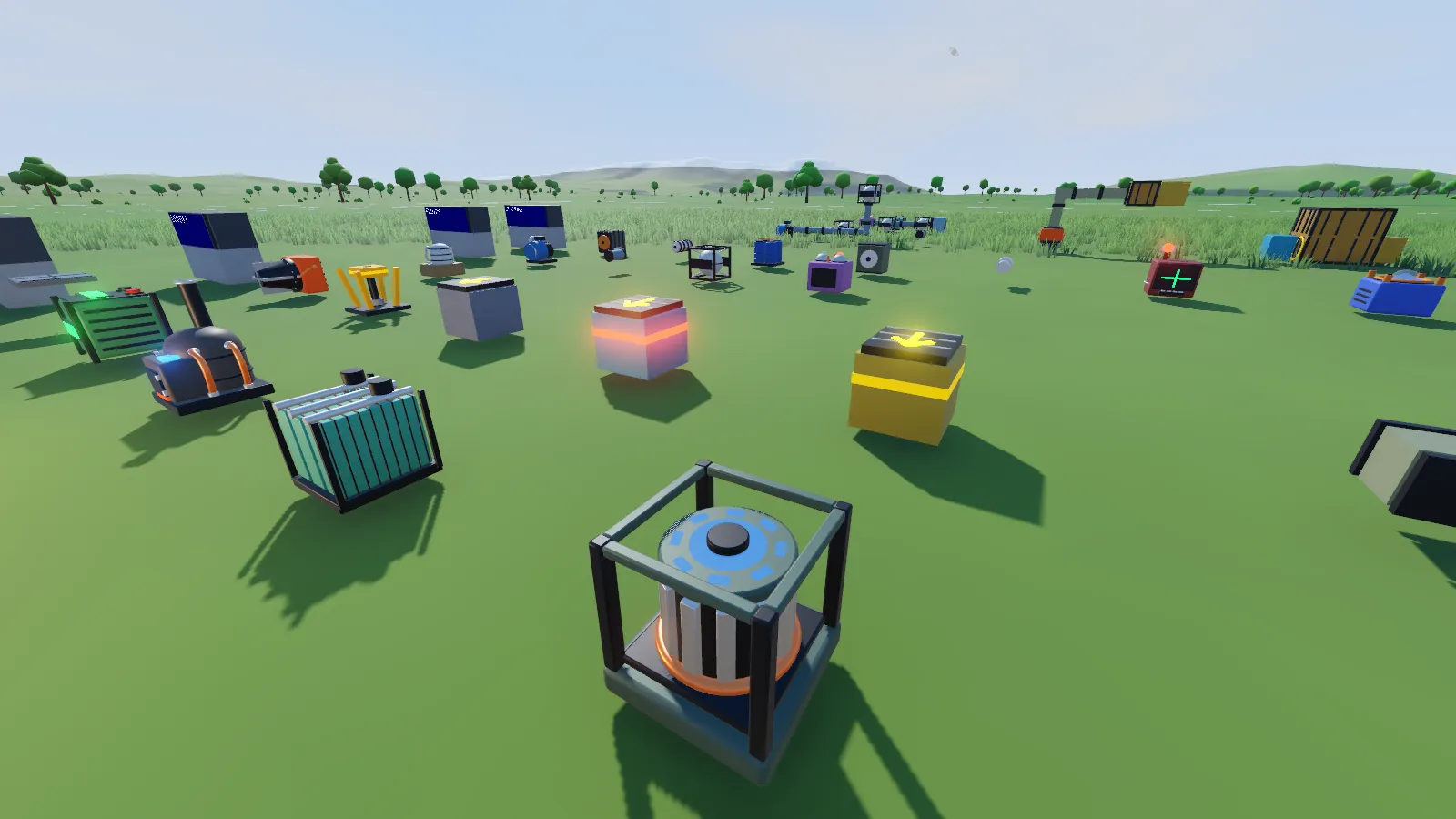
The numbers are the same in survival and the arena (one set for both).
Measured on the arena lab's balance bench (arena_lab bench: 23
hand-picked games, the royales of each class with every archetype of it,
team fights, and duels of one thing against another; telemetry per ship:
when it went out and why, its energy's low and when it went under a
quarter, shots, seconds overheated, shield breaks, energy dealt and taken).
- Batteries hold 15 MJ (6 before). With 6 MJ the light ships ran flat 2.5 to 3.5 minutes into a fight, most of them whole (15 of the bench's outs were "dead in space, no power"; a Hornet draws some 90 kW in a fight, half thrust and half charging guns; an armoured fighter twice that). With 15 MJ none ran flat; the energy's low is 30 to 95% for most ships. The Mantis (heavy, brawling) still goes under a quarter in most of its games: badly managed, it runs out, as meant.
- The class caps steer what a ship may store and make: Medium 64 batteries and Heavy 160 (96 and 240 before; the shipyard's frigates and capitals were cut to fit: the Longbow 56, Rampart 60, Talon 56, Bastion 56, Leviathan 150, Citadel 140, Monolith 156).
- The reactor (new block, stage 3): (100 kW) day and night from nothing, never off; 3 t; a ship carrying one is seen on radar as if it were 3,000 blocks bigger (from much further off); broken, it bursts (10 m, 700 kJ). Power beyond the batteries' cap, for a long fight, at the cost of being found and of a weak point. None on a Light ship, one on a Medium, two on a Heavy. In survival, a late base's steady power.
- Fuel cells stay a store, not a source (15 kW): a full tank of hydrogen gives one some 0.64 MJ, a battery holds 15, and a fuel cell cannot give more than the electrolyser put in. Capped (2, 4, 8) so that a class's power is batteries and reactors.
- Guns are held back by power, not heat: no bot's gun overheated in any bench game; charging is slower than the barrels heat.
- What counters what (the same in every bench run so far):
- Light is a triangle: the Kite (rail-gun sniper) kills the Stiletto (interceptor) in some 30 s, 3 of 3; the Mantis (brawler) beats the Kite, 3 of 3; Stilettos beat Mantises as teams, 2 of 2. The Kite wins most royales (an open start suits a sniper).
- Turrets beat a nose-only ship: the Rampart (shell turrets, two shields) beats a Longbow with only its fixed rails, 3 of 3.
- Shields count: a Rampart beats one without its shields, 3 of 3; a Longbow with a second shield beats one without, 2 of 3.
- Point defence beats homing rockets: a Leviathan without shields beats the Citadel (homing-rocket carrier), 2 of 2.
- Point defence does not save a ship at point blank: the Harrier (torpedo boat) beats the Picket (point-defence escort) at some 20 m, the bots closing before they fire (3 of 3).
- Reactors (bench 3): a ship with one beat its plain twin in 1 of 3 duels. Duels end in 2 to 6 minutes with 80 to 90% of the batteries left, so a reactor's power has not counted yet while its costs (seen further off, a weak point) have: it pays in long fights only. Its output is the next thing to tune.
- How long: light royales 4 to 9 minutes, medium and heavy up to the zone's end (11 to 13), team fights mostly decided in the last stand (11).
- Two crashes found and fixed by the bench: a bot asked after a ship the zone had taken apart that tick (of a grid gone, now empty); and a gimbal whose base had been shot off its ship, floating as a one-block root under its four-block head, spun up to 8,000 and then NaN in the physics (now let go and stopped when a joint goes past 1,000).
#Shield, thrust and guns pull on each other Currentsince 2026-11-24
The rule: a ship cannot have its energy shield at full strength while it shoots and flies flat out. What it spends on other things weakens its field.
- Coil guns weaken the shield most: charging a breech strains the field.
- Thrusters weaken it too, but much less. Flying about is the natural thing to do in a fight and is not to be punished hard.
- Shell guns do not strain the shield at all. Their downside is ammunition: fewer rounds ready than a coil gun has shots in its iron (already so: a 20-round magazine against 500 kg of iron; bench 4: every Rampart ran dry at 1.8 to 4.4 min, no Light coil ship but one did).
- A projector in use (and its welders building) draws energy and weakens the shield as well: rebuilding under fire costs protection.
How: the shield gets its power last (since 2026-11-24, the user's idea: a ship wants more power in a fight than it can give at once). A ship's batteries give out together as one bank, at most (110 kW) times the square root of how many there are (one battery still 60 kW at most): Light 310 kW for its eight, Medium 880 for sixty-four, Heavy 1,390 for a hundred and sixty, reactors, fuel cells and panels on top. Measured on the bench, a ship asks about one and a half times that at the height of a fight (coil guns charging, a hard burn). So something gives, and the shield gives first: guns, thrusters and everything else get their share, the shields what is left. Once cut, what a shield may have climbs back over (2.5 s): after a long burst or a hard burn the field takes a moment before it fills again. A shield refills at up (150 kW; 40 before) when the power is there.
- Coil guns charging take the most, so they starve the shield most; thrusters take what they need to fly, more at a full burn; shell guns take nothing (their rounds bring their energy); a projector draws (50 kW) while its blueprint is being built (its welders welding in its ghosts), 0.5 kW while it only holds one.
- The HUD's SHIP SHIELD bar shows the field's energy (kJ, MJ for a big
one) and what flows into it now:
+120 kW, or NO POWER (blinking) while guns and thrusters take it all. The POWER card shows what each asks for. - Ships of a match go out with their shields full (they had gone out empty, some 37 s to fill).
- The shield demo's bunker and the shield range's second one have one battery each (60 kW), so their guns still wear the shield down.
(Tried first the same day: a strain that drained the field in proportion to what the guns and thrusters drew, with a pause in the refill. Bench 6 and 7: coil ships broke their own shields 7 to 9 times a fight, a heavy's 32 guns emptying its four generators in seconds; the shieldless Leviathan won every heavy royale. Draining by draw does not scale between a fighter and a battleship; a power budget does.)
Bots mind their shields as players would: under 50% of its field a bot holds fire till it is back over 80% (30 and 70 at first: its guns recharging after the last shot drained the rest) (bursts, not a held trigger), unless the enemy's field is down (it presses the attack) or the enemy is very near; with its own field down it backs off to further than it likes to fight and closes again once it is up.
Bot match (Demo parks menu): a Battle Royale of seven bots in the class's every ship by turns, and the player in one of their own (a Longbow; Kite for Light, Leviathan for Heavy) flown by a bot's brain (the stick, thrust and dampeners are the bot's; where one looks stays one's own). Shift looks round, V shows it from outside, F gets up (and ends the ride).
Bench 4 (2026-11-24, counters fixed, before the strain) for where this started from: shields break 1 to 17 times a fight and take 4 to 25% of what hits a ship; light ships never run out of coil-gun iron.
#Buoys: places worth going to in a match Currentsince 2026-11-24
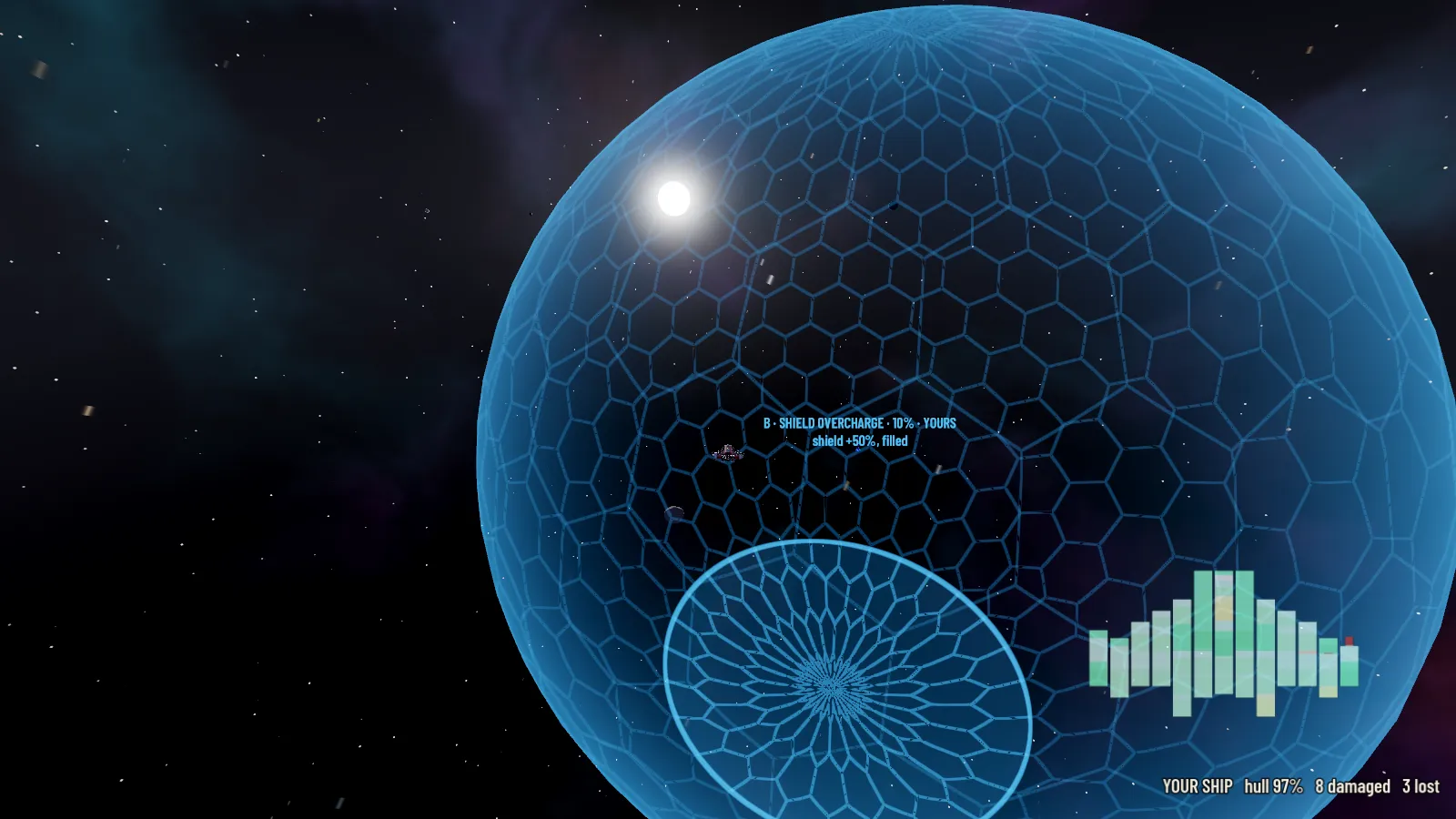
The user's idea: power-ups that give players a reason to go somewhere, an area one has to stay in long enough for something to happen that strengthens the ship for a while.
-
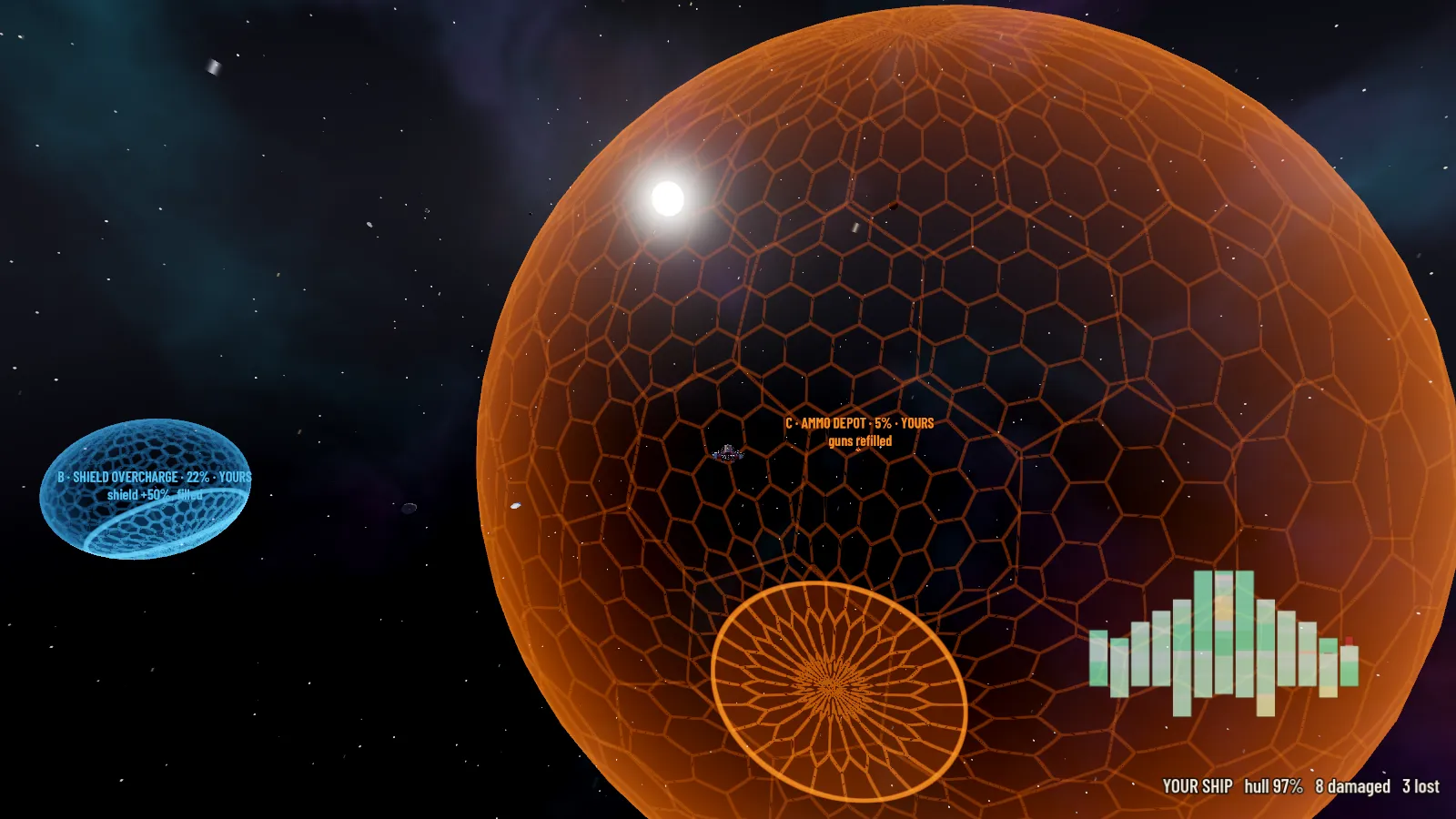
A buoy: a mast of seven blocks (light armour, a reactor to light it, its kind's block in the middle painted its colour, four lamps each end facing out), warded: no gun takes it down. Round it a field, 2.5% of the class's space in radius (75 m Light, 100 Medium, 138 Heavy; 5% at first, 150 to 275 m, which the user found too big), drawn as a sphere of big hexagons in its colour (the zone wall's seamless honeycomb, some 90 cells), faint while one is inside it, with its label (letter, kind, what it gives, how far charged) seen through everything.
-
Disorder to order (since 2026-11-24, the user's wish; it filled from the bottom at first): uncharged, its cells are in disorder, each a smaller hexagon, tilted, off its place, drifting and flickering; as it is charged they fall into place one at a time (each at its own share of the charge, with a flash), turning, moving and growing till they meet as a whole honeycomb at full. Dark, it is scattered again and dim.
-
Charging: a ship in the field going under 15 m/s against it charges it, full in 20 s: sitting still, a mark for every gun near by (a Kite's chance). Two sides in the field (two players in a Battle Royale, two teams in a Team Fight): contested, red and flickering, it charges for nobody. A side coming into a field another charged first takes that charge down (twice as fast) before charging it for itself; left alone a charge drains away over 40 s. Full, it gives its boon to every ship of that side in the field and goes dark for 90 s.
-
Everyone knows: at a quarter charged the match is told who charges it; every buoy is on every HUD (its label), the compass and the radio map (F6) with its state; the HUD's match line says whose field one is in and how far charged (or "too fast to charge", "CONTESTED", "dark"), and the boons on one's ship with the seconds each has left.
-
Where: seven a match, one of each kind, shuffled. In a Battle Royale six on a ring at half the zone, between the spawns (on theirs at 80%), up and down by turns; in a Team Fight six across the middle between the two lines. The seventh comes up by the middle halfway through (in a royale halfway through the zone's closing; in a Team Fight at 5 min), to pull out those who wait. The zone takes those it passes (the mast blows up): the outer ones count early, gone later.
-
The boons (one of each kind at a time; another of the same kind starts its time again):
Buoy Boon Lasts Power Relay the battery bank gives 1.5 times as much at once 45 s Shield Overcharge the shield holds 1.5 times as much, and is filled to it; after, back to its size 60 s Ammo Depot the coil guns' iron and the shell guns' magazines filled, the welders' material back to what it brought at once Sensor Mast every ship of the match on one's radar, precisely, wherever it is; and one on every radar 30 s Ghost radars see one as a tenth of its size (from a tenth as far, about) 60 s Welder Swarm each second, 3 blocks shot off the ship's own grid welded back where they touch what is there (as it went out, loaded guns half full), and the 8 most damaged blocks mended by 40% 45 s Cold Rails the coil guns' charge comes with them: it takes nothing from the batteries, so it no longer starves the shield 45 s The power relay and cold rails are the shield-last rule's way out (Shield, thrust and guns pull on each other); the ammo depot is the shell-gun ship's (a Rampart ran dry at 2 to 4 minutes); the sensor mast and the ghost are information, both ways.
-
Bots go for one while no enemy is near (within 2.5 times their fighting range): of those ready, well inside the zone (70% of it) and within 80% of the space, the best for what their ship lacks over how far (guns under 40%: the ammo depot; under 80% of its mass: the welder swarm; no shield: never the overcharge; no coil guns: never cold rails), not one whose boon they have; they stop in its field, the radar sweeping round, and fight whoever comes. In a royale of four Light bots the first buoy is charged some 15 s into the fight and taken 30 s in.
-
To try it:
/arena buoys off(before the start) fights a match without them;/arena boon <kind>puts a boon on one's ship;/arena goto <letter> [m]parks one's ship in a buoy's field;/arena bots still(andgo) holds the bots still, guns quiet, for pictures.--autotest --host --buoyshotsphotographs them (the field from inside and out, every mast from round about, the compass, the map, the boons on the HUD). -
The buoy park (Demo parks: Buoys,
/spawn buoypark): a Light match out in space, one's Hornet 350 m before a row of the seven buoys 240 m apart, one bot far off held still, the zone held open. Buoys nobody holds charge themselves and empty, round and round (dark 6 s between rounds), each at its own point, so the hexagons are seen scattered, falling into order and scattering again; held, one charges as in a match and gives its boon. The client eases each buoy's charge (the server sends it once a second) so the cells fall in smoothly. -
Not yet weighed on the balance bench: the next bench run is with them.
#What wins: the arena lab (findings, 2026-11-20; not decisions)
cargo run -p sim --release --bin arena_lab -- <probe|duels|royale|limits|vs|team|connected>...
fights bot matches headless, in builds of the categories' own ships, spec
variants of the warships, ships stripped, rearmed, piled with batteries or
armour, under the categories' limits or tighter and looser ones. About
1,600 matches, some 90 hours of fighting, were fought on 2026-11-20.
- Energy decides. Coil guns (breeches with coils and capacitors) take two thirds of a ship's power (a fighter draws ~260 kW, ~170 of it the guns, from 36 MJ: 2 to 3 minutes). Two fights in three among fighters end "dead in space"; most royales of 10 reach sudden death. A battery is 100 kg, as an armour block, so a ship piled with them to the mass limit (the "battery pack" fighter: 79 batteries) outlasts all: it won 29 of 35 duels and placed first in every set of limits. Fewer coil guns do better than more (the fighter with only its four light guns beat the stock one).
- Shell guns win outright. They draw no power and their HE takes off cockpits: a fighter with its six guns made shell guns won 59 of 60 duels against every other fighter build, the battery pack too, in 50 s on average (coil fights: 150 to 250 s); the Warden with shell turrets won 28 of 32 against the other corvettes, and with a cap on batteries won every royale; the Sovereign (shell batteries) beat its slug variant and its 40-fixed-gun one 8 to 0.
- Little use: armour piled on (no better than none), rockets (4 under a fighter: no better; they killed about once in three matches), more speed (the Warden racer, the Bastion fast: mid to low), fixed guns on big ships (the nose assist turns a big ship too slowly: the Bastion and Sovereign "fixed" placed last), the Gunship (10 t, 3 guns, 7 batteries: last but the half-battery fighter).
- Bigger beats smaller under the same limits (a royale of fighters, Wardens and Bastions in the capital limits: Bastions and Wardens first, a battery-pack fighter won once in six), and the defensive builds first (the Bastion with 90 batteries, the Warden brick).
- Team Fights always go to the clock: a team lost 4 to 18 ships in 15 minutes against 15 to 20 tickets (5 a player): no team ran out.
- First answer (2026-11-20, decided): a cap on batteries a category (fighter 8, corvette 32, frigate 96, capital 240); a shell gun counts as two guns; its charge and magazine halved (300 kJ, 20 rounds), its HE smaller (3 m, 180 kJ), its shells straying 0.5°; a blast hurts a seated pilot only through what of the hull stands between. (Heavier batteries were tried first, 350 kg: the Pelican no longer took off, and every aircraft in survival would have changed; the cap is the arena's alone.) After it, 312 duels and 5 royales of 10: the best fighter builds win 75 to 78% of their duels (the shell fighter, the battery pack, the heavy guns only and the light guns only, side by side; before, the shell fighter 98%); the best Wardens 69% (shells and gimbals; before, shells 88%). The shell fighter still places best in royales of fighters (2.0 of 10 on average). Still of little use: armour, rockets, the racer, half batteries. Open: armour that matters, rockets with a job, turret traverse, shields; 2 or 3 tickets a player in Team Fights.
- With the dampeners the ships' own (2026-11-20, 556 duels, 14 royales; new builds: retro thrusters, every make of rocket, rocket bays): the best fighters win 82 to 87% of their decided duels (shells, light guns only, the battery pack), more duels end undecided; retro thrusters do not pay (Fighter retro 9 of 32). Rockets now decide: Wardens with 2 homing or 2 torpedo bays win 24 of 26 duels, a Bastion with homing bays 11 of 12; swarm bays (4, cheaper, no radar) are no better than none (10 of 26): a ship turning in a fight is not where it was said to be. In royales of 8 corvettes the plain Warden places as well as the bays (2.6). Open: an answer to rockets (point defence, a flak make), and whether 2.5 t of material (two rockets again) is too much for a corvette.
#Match speed Current2026-11-20
Seated with a target locked (T), Shift+Z matches its speed: the
dampeners hold the ship still against the target instead of against space
(its velocity taken off ours, and the pull it falls by too, so a shared
orbit is not braked out of). It is still the ship's own thrusters that do
it, as hard as they point the way: a ship with little thrust astern takes long to
match a target pulling away. The dampeners come on with it; letting go of
the lock ends it. Not saved with the world. The HUD's target line gives
the range, the closing speed (negative: opening), the speed against it
and MATCHED; the key bar shows Shift+Z while a target is locked. In the
test: a Hornet matches a fighter crossing at 30 m/s within 15 s, and in
the game (/spawn flightpark) one flying 126 m/s within 12 s.