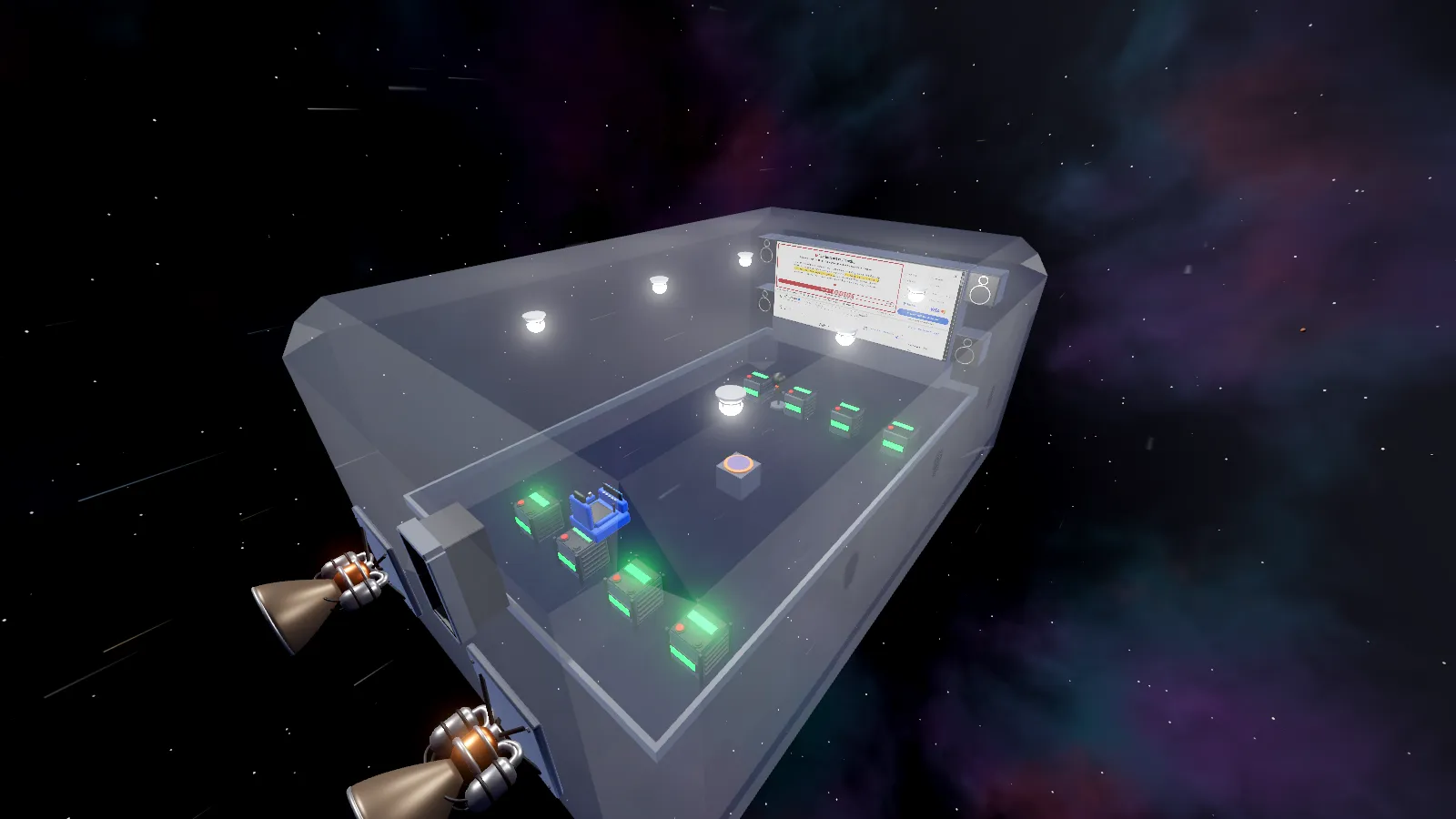
#Colliders: a grid's plain blocks share one per chunk Currentsince 2026-11-20
A grid's plain blocks collide as before, each as its box, but the boxes of every 8x8x8 cells are one compound collider (4x4x4 until 2026-11-27): a moving ship costs the physics four to six times less, and a match holds more ships (the categories' limits above). (Rapier is patched too, a fast body's sweep against what is in its way is set up only once something is; a plane in empty air set it up for every box of it, every step: 100 planes in the air, 17 ms of physics a tick before, 7.4 after.) Nothing a player sees changes: contacts, shots, blasts and damage still find the block they meet.
- Blocks keep a collider of their own when they collide otherwise: blocks a player meets as shaped (walk shapes, below), belts, doors (switched off when open), cargo containers (their weight changes with what they hold) and blocks bigger than a cell.
- A block put in has a box of its own until the end of the step; its chunk then takes it in. A block broken or moved has its chunk built anew at the end of the step: until then a shot passes where it was.
- The world has no contact clusters (Rapier's merging of a compound's
contacts into 4 points a plane): a chunk landing flat would put its
whole weight on 4 blocks, which broke. Each block's contact is booked as
its own (
damage), so crashes break what they broke before.
#Collision shapes: the player walks on what is drawn Currentsince 2026-11-19
A player meets a block that is clearly not a cube as it is drawn: one stands on a lamp's base and dome, on a slope's slant, on a bed's mattress, in a cockpit's footwell. Everything else meets every block as its box, as before: grids (ships against ships, docking, landing), the ground, shots, loose ore and items. So a hull's contacts stay one cheap box per block.
- Each such block has a second collider, its walk shape: the surfaces of a few convex hulls, as one triangle mesh (since 2026-11-20: as a compound of hulls, a sliver of one set a whole ship's continuous-collision thickness, and rovers and ships were treated as "fast" all the time). It weighs nothing, and only players touch it (collision groups, plus a pair filter). The box of such a block lets players through.
- Shapes: armour shapes from their corners (the
inverse corner, not convex, stays a box). Machines from their models:
blender -b --python tools/blender/blocks.py -- --hullswrites the hulls of each model's bigger parts, for the models that are clearly not cubes (35 of them; boxy machines keep their box). Run it again when a model's shape changes. What the game draws itself on top is added by hand (a lamp's dome). - The client's prediction (in a ship's frame) meets blocks as whole cubes, except those met as shaped, which it meets as the boxes round their walk shape's pieces, turned as the block is (a half block or a panel exactly, a bed its frame, mattress and headboard; a slope's one piece fills its cell, still a cube), and open doors, which it passes through as the server does (since 2026-11-22: on half-block steps, on a bed and in an open doorway the prediction and the server disagreed and the figure was pulled back and forth). The third-person camera looks through open doors too.
- The third-person camera looks through such blocks' boxes, since one may stand inside their cells.
- The player is a capsule the figure's size: 0.28 m round, from the feet to the top of the head (1.8 m; 1.3 m crouching), standing along its up. It was a ball 0.9 m across round the feet, which held the figure out over edges and let its body through overhangs. It slides along walls (no friction on what it touches with its side), walks only with a floor underfoot (on a steep side alone, pushing on would drive it up), and stands still on a slope (gravity along the floor is cancelled while it does not walk). What one carries does not knock against one. The server tells the client "grounded" only with a floor underfoot, as the sim walks.
- F4 draws what players collide with over the world: the walk shapes
(magenta), the player's capsule where the client predicts it (yellow)
and where the server has it (cyan). The walk park (
/walkpark, or--scene walkparkwith--walkshots) is for walking about on it: a course (a ramp of slopes up to a platform, half-block stairs, a tunnel 2 m high and one 1.5 m high to crouch through, a beam to walk along), and every shaped block in a row on an armour floor and again on the bare ground; slopes lead up onto the floor./approach <block>stands one on the floor in front of a block. - Footing: walking pushes with a floor underfoot, and for a quarter of a second after losing it in the air (not jumping, not leaning on a steep side), so one runs on over a bump and walks up steps. Half-block stairs (0.5 m steps) are walked up; the step-up takes up to 0.6 m.
- Crouching (C): one stays put (C is also "down", but on foot up and down are not ways to walk; turned by a view looking down, down leaned backward); and under something lower than standing height one stays crouched, C let go, until there is room over one to stand up in (which the server sends). The capsule is made anew to crouch or stand (changed in place, the contacts went on with the old shape), and weighs nothing: the mass is on the body at its centre (a capsule's own would move the centre of mass as it shrank, and the body with it, 0.25 m up).
- Walking does not push into a wall one touches (its steep side): pushed into its foot, the wall lifted one off one's feet and dropped one again.
- Out of bed, the view is level, facing away from the bed, the camera behind one (it was the pillow's view, up, and swung round as one looked about lying there).
- Block seams: running over a floor of blocks, the feet came down on the next box's edge, whose normal leans back, and hopped and slowed seam after seam. Against a block's box whose top is level with the feet, the contact is the level floor (straight up), and a side contact there is dropped.
- Client prediction follows the ground down only when no block is under the feet: standing on a block lower than a metre (a half block, a bed, a slope), it used to pull the figure down into it, while the server had it on top.
#Cargo containers, injectors and ejectors Current
A cargo block holds things: cargo blocks touching face to face on one grid are one container, 12 slots a block (stacks as in the inventory: cubes up to 20 a slot, crates of blocks, gear). Each block keeps its own share of the slots, so a container that is cut in two keeps what each part held, and one that grows keeps what it had; a destroyed cargo block loses what it held.
-
In: an injector (new block) touching the container takes in the loose cubes, crates and gear arriving in front of its intake, ten times a second, while all of it fits (what does not fit stays where it is). A player puts in what is in hand (E on the container or its injector) or anything from the inventory (its panel: PUT 1, PUT ALL).
-
Out: an ejector touching the container puts things out of its face only when told: its panel (EJECT 1 / ALL for each thing, EJECT ANYTHING, STOP) or a script (
eject(key, count)), one cube or one whole crate every tenth of a second, pushed out at 2 m/s; gear stays in. A player takes things into the inventory from its panel (TAKE 1, TAKE ALL). -
Scripts read
.contents,.slots,.used,.freeon any of its blocks and on its injectors and ejectors. -
Ducts end in a container as they end in an ejector: a drill's ore goes straight into a cargo block its ducts reach (while it has a free slot).
-
Connectors join containers: a connector touching one, docked to a connector touching another, moves things across when told (
send(key, count)/fetch(key, count)in a script), a slot's worth a tenth of a second. That is how ships and trucks load and unload. -
What a container holds weighs: a cargo block's mass is its own and that of what it holds (a cube as much as the cube, a crate its block and its blocks), so a loaded truck is heavier to drive and to stop, a full drone needs more thrust (a full truck: 9 t of ore).
The cargo bay (/testspawn cargo_bay, and in the demo parks) is a six-block
container with an injector, an ejector, a screen listing what it holds and
a button that has it put five things out.
#Logistics: drones, trucks and belts between drill sites and a base Current
/logistics (and in the demo parks): a base with four drill sites round it
(130-140 m off) and three drills beside it.
- The drill sites: a drill tower each (the start's old mining rig), turned so its arm leaves the store side alone; its ore ejector drops cubes onto an injector of the site's store, a line of cargo blocks out to a platform with a drone pad on top or the truck's port at its end. They start stocked: the drone sites with copper, silver and gold, the truck sites with iron, stone and coal.
- Two drones, one a site (north-west, north-east), fly the light, dear ores (copper, silver, gold, 6 of each a trip): each docks by the connector under its hold on its pad on the base, sends everything over, flies at 22 m to its site's pad, fetches, and flies back (the pads' positions are in its own start frame, so it does not care where on the planet it is).
- Two trucks, one a site, haul the heavy ones (iron, stone, coal, 30 of each), down a straight road each (north, east): nose first to the site's port, fetch, back all the way to their port on the base, send (the drill rover's line steering).
- Three belt drills beside the base put their ore on their own belts, which end level with the base's main belt: a 21-block belt running east into the injector on the west side of the base's store. The north and south drills' belts end beside it, so their ore slides onto it sideways and turns east with it (the last two blocks of a drill's belt run at 0.8 m/s, slow enough to take the corner; rails opposite stop it going over); the west drill's ends behind its start. The drills stand level with the base for that (half a block sunk into the ground): ore dropped from a belt half a block higher tips and wedges between the two belts.
- The base's screen shows the base's stock by who brings it and how many
cubes the belts brought (injectors count what they take in:
.taken). - Trees on the roads and round everything are felled when it is set up: the terrain's edit chunks keep a list of felled trees, which goes to the players and into saves with the dug ground, so a felled tree is gone for good.
#Rooms, air, hangar doors and airlocks Current
- Rooms: the empty cells of a grid that cannot be reached from outside it (its blocks are walls; an open door or hangar door is a hole) are its sealed rooms (worked out again when its blocks or doors change, for grids with an air vent).
- Air vent (block): fills the room in front of it with air, 15 m³ a
second, from the oxygen in the tanks it is piped to (0.2 l a m³; 2 kW
while it fills). A room opened to the outside loses its air at once; shut
again, it fills again. Scripts read a vent's
.air(0..1). - Hangar door (block): hangar door blocks side by side in one plane are one door, opened and shut together (E on any of them); open, the panels slide away and nothing collides with them.
- Door (block): so are door blocks side by side in one plane, facing the same way (a doorway two high, a bay of them): E on any of them, or its panel, opens or shuts the whole door (since 2026-11-22). A script moves one door block at a time, so that a computer can slide a door open column by column (the dreadnought's bay door).
- Suit air (survival): a player breathes the open air (thick enough), a room with air (half full and more), or sits in a seat; anywhere else the suit's 3 minutes of air run down, and then health (5 a second). The HUD shows the suit's air while it is not full. E on a tank fills the suit from the oxygen of the tanks piped to it (9 l from empty), as it fills a jetpack with hydrogen: the electrolyser's oxygen is what one breathes on the Moon. (Since 2026-11-18: the playthrough bot died of air boring for rare ore on the Moon, with no way to fill its suit but to go back to its seat.)
- Airlock: two doors with a small room between and a vent in it; the habitat's computer never has both open: out, the inner door shuts and the outer opens; in, the outer shuts, it fills, the inner opens.
/airlock(and the demo parks): a habitat on the Moon with a hangar (hangar door, vent, oxygen tank) and an airlock, the player inside.
#Armour shapes Current
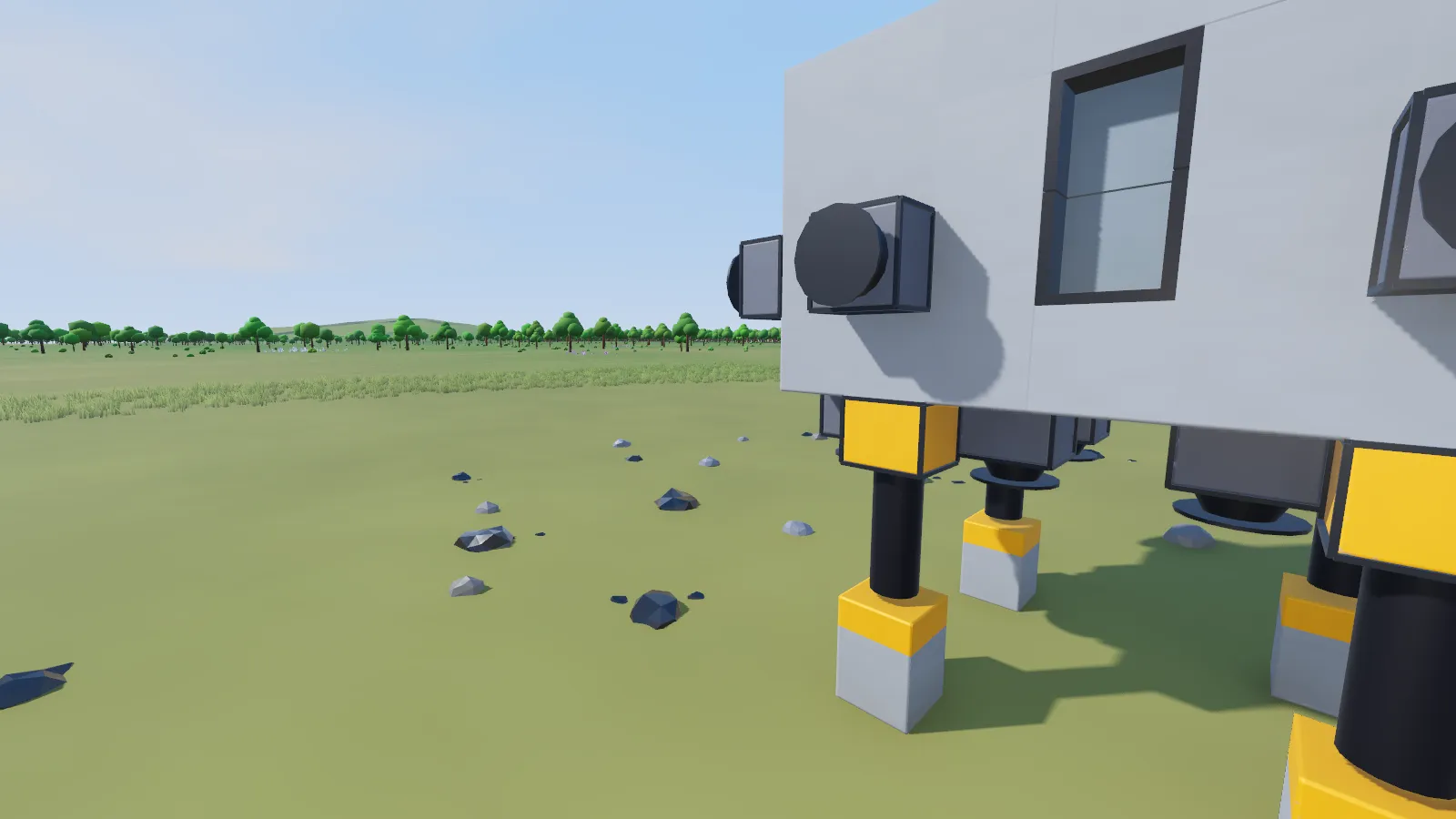
Hulls are built of armour in many shapes, all made of steel plate in the assembler (as much as there is of them), all paintable, and all colliding as the cube they are cut from (one box a block keeps a big hull's contacts cheap): the armour block, slope and corner; the half block (the lower half of a cube); the half slope and slope tip (the low and high halves of a long slope, half a block up over one: put them end to end); the inverted corner (a cube with a corner cut off); the panel (a plate an eighth of a block thick); the beam (0.4 m square); the pillar (round, 0.9 m across); the rounded edge (a quarter of a round pillar a block in radius); the window (glass in a frame; windows side by side are one pane); the angled window (glass on a slope's face, since 2026-11-26: angled windows side by side or stacked into a longer slope are one pane, and so are they with the window at either end, an upright one under the low edge and a roof window, or an upright one facing back, at the high edge: a canopy framed only round its outside; a side with nothing by it is glazed, a wedge of glass; walked on as a slope); the angled window corner (where three edges of angled windows meet at a box's corner: the cube cut by all three slopes, glass in three triangles meeting at its middle, going on from all three); and the large armour block, large slope and large corner, 2 blocks on a side. Their health and mass go by how much steel is in them; shots glance off their slanted faces as off a slope's.
/ships (and Demo parks) shows what they make, three ships in three
styles, each flyable (/testspawn lancer, mule, halcyon): the Lancer, a
corvette, hard and angular (dark grey and red; a long 2:1 nose of half
slopes and slope tips, a raised cockpit behind a window, panel wings with
beam rails, a fin); the Mule, a freighter, chunky and industrial
(yellow with black bands; a hull of large armour, a cab with a wall of
windows, cargo holds between pillars along its sides, rounded shoulders,
two large engines); the Halcyon, a yacht, smooth and rounded (white and
cyan; a hull rounded at its long edges, a glass nose, swept panel wings,
pillar engine pods).
#Fluid goes through the hull Currentsince 2026-11-23
Fluid passes through pipes, the blocks that use it, and, on anything that moves, the hull: armour of every shape, light armour, heat shield, windows and wings (a wing is a wet wing, as an airliner's is). Tanks, engines, fuel cells, air vents, pumps and machines joined by such touching blocks (or across joints and locked connectors, as before) make one network. So a jet under a wing burns from tanks in the fuselage, an air vent from the oxygen tank across the room; a design puts its tanks where its balance and room want them. A pipe is for where there is no hull between (a rig of machines, a pump on a stilt). A base (a static grid) is plumbed by its pipes alone: its floor joins nothing, so its tanks of water and of fuel stay apart.
Why this rule: before, fuel reached an engine only through pipes and the blocks that use fluid, so a plane had to carry tanks in every engine pod, or a pipe run along the outside of its wing. Wiring for power was never asked for (power is shared through a construction); fluids now nearly are, but not quite: two parts of a craft joined by nothing but a non-hull block (a gyro, a seat, a cargo box) are not joined, and a separate grid needs a joint or connector. Each grid's parts are worked out once for each change to it, so a big hull costs nothing a run. Ore keeps its ducts: through the hull a drill would skip a factory's sorters (ducts are where the logistics is).
#Blueprints Current
A blueprint projector (Control) saves the construction it stands on: SCAN with a name stores every block of its grid (kind, where, which way, paint, name) in the projector's own frame, as a blueprint in the world's library (kept in the save). Any projector can LOAD one, standing any way round: what of it is missing on its grid shows as blue ghosts.
PROJECT ITSELF (since 2026-11-21; a setting on its panel): the
projector projects its own construction as it is when it is switched on
(kept as its own blueprint, own:<block id>, in the save but out of the
LOAD list). Nothing shows while the construction is whole; whatever is
destroyed after (shot off, blown up) shows as a ghost in its place, to be
welded back in as any other: a ship with a self-projecting projector and
welders round its hull mends itself from its hold, or a player mends it
with the torch. UPDATE TO HOW IT IS NOW takes in what was changed on
purpose; off (or LOAD of another blueprint) forgets it. (Damaged blocks
that still stand are mended, not projected: welders and the torch mend
them where they are.)
The projector does not build. Ghosts are welded in by a welder: a welder block (Control; steel plate, a motor, copper wire), while it runs and has power (3 kW while it welds), welds the nearest ghost of any projector in the ball it works in, as a drill cuts: 1.6 m round, its centre 1.4 m in front of it (shown faintly while it is on; warm, with sparks, while it works). It welds in the ghost there nearest the middle, and mends every damaged block there by 40 kJ/s, on any construction (since 2026-11-22 also puts back the top of a piston, hinge, rotor or gimbal that lost it, at rest, if its cell is free; so does the torch held on such a block: a top is never built or picked on its own): welders have to face what they build or mend, from the construction, a scaffold round it, or an arm that moves them along. Or a player's torch: holding the left button with the ghosts in sight, within the torch's reach, it welds the nearest of them on the line of sight that can go on. Either welds two blocks a second, and only where a block touches what is already there, so a construction grows out from the projector. In survival each block takes a crate of its kind: the torch's from the player's inventory first, else (and a welder block's always) from the containers (cargo blocks) of the projector's construction; while none is there the projector says which it needs. So a damaged ship is repaired from stock by the welders on its base, a wreck rebuilt with a torch and an armful of crates, or a copy grown off a second projector on a fresh pad with welders round it. (Computers come back with the scripts they had when it was scanned (kept with the blueprint, in the save.) Since 2026-11-22 a blueprint keeps what is on moving parts too: the blocks on the top of a piston, hinge, rotor or gimbal, and on a top on that (the chain of joints it hangs on, its cell with every top at rest, its settings and script; kept in the save). Their ghosts go on the top's own grid, turning with it; a block whose joint or top is not there waits for it (the projector counts it missing), and a lost top comes back from a welder (above). A ship built whole from a blueprint (a match's) has its tops and what is on them. Since 2026-11-20 every block comes back as it was set, too (kept with the blueprint and in the save): a gun's shot, rate, power and group, a radar's beam, a sensor's or scanner's range and mode, a cockpit's bindings and flight mode, a light's brightness, an antenna's channel, a shield's size, a computer's frequency; not what it holds (charge, rounds, cargo, fuel). Before, a ship built from a blueprint (in the arena too) had its guns in no group, which the cockpit never fires, and all of the default make.
/projector (and Demo parks) shows it: three pavilions (a floor, pillars,
a roof of solar panels; some 110 blocks) in a row on open ground. Left, the
original, scanned as the blueprint "Pavilion"; middle, a battered copy with
welder blocks fixed round its gaps (fourteen, facing them, so that every
gap is in one's ball), welding the missing blocks back in; right,
a bare projector with the blueprint, for the player to build out with the
torch. On the player's right stands a rocket pad: a projector with the
blueprint "Pad Rocket" (the pad with a rocket standing on its merge block:
an engine, a battery, a gyroscope, a computer, a warhead and a radar, nose
up), two welder blocks on a pillar beside the rocket's column, a button and
a screen. Pressed, the pad's computer switches the welders on and they
print the rocket, block by block from the merge block up (the screen
counts them); whole, it switches them off and, a second later, the merge
block off: the rocket comes away as a craft of its own and its computer
(its script printed with it) flies it: straight up clear of the pad, then
at the highest grid its radar sees, leading it; its warhead goes off
within 6 m of it, or as it starts to go past. 140 m ahead and 70 m up a
target drone hovers and sways, and one shot down is put up again 5 s
later. Then the button prints the next.
#Sorters and splitters Current
Two belt blocks that run like belts (on, speed, F turns them) and send some of what rides on them off to their side (left or right, ASIDE TO on the panel; in scripts), onto a belt put there:
- Sorter: what its filter names (
iron; TURNS ASIDE on the panel,set_filter(key)in scripts) turns aside, the rest goes straight on. - Splitter: one aside, the next on, in turn.
A belt switched off is a gate. Belts running into another from the side merge (at a drill's belt end speed, 0.8 m/s, they take the corner cleanly).
#Lights: lamps and spotlights Current
Two blocks (stage 1: steel plate, glass, copper wire):
- Lamp: a glass dome on a squat housing; lights all round it, 14 m (0.06 kW).
- Spotlight: a can on a yoke; a cone of light (22 degrees from its axis) the way it faces, 50 m, with shadows (0.25 kW).
Both shine in their paint's colour (warm white unpainted), while on and
while their grid has power; set to AUTO (their panel), only when it is
dark there (night, or a thick dust storm). F switches one on and off;
scripts. The bulb or lens glows while it shines. /spawn lights puts down a row of lamps in five colours and two spotlights, to
look at at night.
Brightness (since 2026-11-18): BRIGHTNESS on the panel, 25% to 400%
(scripts set_brightness(x), .brightness): a light set
brighter takes that much more power (a lamp at 400% 0.24 kW, a spotlight
1 kW) and shines that much brighter and further (its reach with the
square root: twice as far at 400%). Power is what a bright yard costs.
#The merge block's docking plate Current
Its forward face is one big steel docking plate (the magnet face that meets the other block's), seated on a copper coil that shows as a band round it, in a dark frame with alignment pins in two corners; the light strip (blue on, yellow aligning, green merged) runs across the plate.
#The gimbal mount Currentsince 2026-11-18
A rotor and a hinge in one block: its head (on its forward face, as a rotor's) turns about the block's forward axis all the way round (yaw, as a rotor) and tilts about its side axis, -90..90 degrees (pitch, as a hinge), each with its own motor, as strong and as free as a rotor and a hinge (no weaker motor, no narrower tilt). Its only price is its cost: stage 3, 3 steel plate, 2 strong motors and a processor.
- How it holds together: a yoke (a body of its own, with no blocks, 25 kg) turns on the base, the head on the yoke about its trunnions (the head's middle); two plain revolute joints, so it is as stiff as a rotor and a hinge. Base and head never collide (they turn against each other).
- Mounts either gun: the fire control sees one joint with two axes
(yaw first, then pitch), turned as any rotor and hinge; Aim with lists
it once. Its panel: YAW and PITCH, each a speed or a held target angle;
FREE. Scripts: act on its yaw,
set_target_angles(yaw, pitch [, speed]); it readsyaw,pitch. drives a gimbal if the turret has one. - Drawn: a squat housing with a slewing ring; on it the yoke (turning with the yaw) reaches up either side of the head, a drum on trunnions.
- On the gunnery range the cannon and the shell gun stand on gimbals (on a one-block pedestal: the head as high as a hinge's on its mast); the others keep the rotor and hinge, to compare.
#Window glass Currentsince 2026-11-21
A window's pane is clear glass, no tint, no glow of its own. Painted, the pane takes on the paint's colour as a tint (still see-through), and so does its frame. Since 2026-11-27 the glass reflects by the Fresnel equations (glass n = 1.5, the mean of the two polarisations, both faces of the pane): looked at head-on it is all but clear (8% reflected), at a grazing angle a mirror of the sky; what it reflects shuts out as much of what is behind, and the reflection itself is added whole, as on real glass. (Other glass, a lamp's or a model's, still glows warm at night.)