#Guns: the mass driver Partly current
No made-up bullets: a gun throws a real ball of iron, and everything it does
follows from the physics the game has already. Players build their own guns
and turrets out of blocks; nothing aims for them unless they script it.
Built: the electric breech, the coils, iron as ammunition, the settings and
their limits, real shots with damage, penetration and recoil, armour
thresholds for shots, the ballistic() script helper, the control panel,
and the gunnery range demo.
- Blocks (Current): a Mass Driver Breech holds the iron, charges from its grid's power and fires out of its forward face; Accelerator Coils in a straight line in front of it (lying along the same axis) are the barrel. The cell in front of the last coil has to be free. Capacitors are its firepower: each feeds the nearest breech of its construction (the grids joined by pistons, hinges and rotors); they need not touch it, so a turret's stand on its base, off the part that turns. Survival recipes (stage 1): breech 4 steel plate, an aluminium frame, a motor and 6 copper wire; coil 2 steel plate, 12 copper wire and glass; capacitor 2 steel plate, 8 copper wire and 2 glass.
- The barrel's look follows its shot (Current): the coils of a gun are drawn for the shot it fires, morphing from a slim rail-gun barrel (light, fast shots: a steel tube on two copper rails, thin rings every half metre, fins on top; the muzzle a flash hider) to a fat cannon (heavy shots: a steel jacket held by heavy rings, narrow copper windings between them; the muzzle a slotted brake), smoothly between; the rings take the gun's paint.
- Barrel = speed, capacitors = firepower (Current, since 2026-11-16):
- the barrel caps the speed (and so the range): 100 m/s and 100 more a coil (10 coils count, 1100 m/s);
- the capacitors cap the power the breech may draw and the energy of one shot: a breech alone 20 kW and 100 kJ, each capacitor 25 kW and 125 kJ more (8 count: 220 kW, 1100 kJ). The rate of fire follows: energy a shot times shots a second is at most half the power. (Before, the coils gave the power as well, so most guns had long barrels only for their power. The demo guns now have the fewest of both they need for what they do.)
- Ammunition is raw iron (Current): the breech holds up to 500 kg; F with iron ore puts it in by hand, and iron cubes that arrive at its back are taken in (a cube is 100 kg). It cuts each shot off that stock: nothing to craft.
- Settings (Current): the shot mass m (0.1 to 50 kg), the rate of
fire f (1 to 600 rpm) and a cap on the power it may draw. What follows:
- Power P (what reaches the shots: half of what it draws) is the damage per second, whatever the settings.
- Iron flow
ṁ = m·fsets the muzzle speed,v = sqrt(2P/ṁ), and with it the range (aboutv²/gon flat ground), the flight time and how flat the shot flies. - How the flow is split sets the energy of a shot (
E = P/f) against the rate of fire: a few heavy shots or many light ones. It charges at its full allowed draw and fires when charged and its cycle (60/f s) is up; short of power it fires less often, at the same speed.
- What the build limits (Current): with free settings the least iron
flow would always be best, so each limit comes from a block choice:
- the barrel caps the speed (above);
- the capacitors cap the power and the energy of a shot (above);
- the breech cycles at 600 rpm at most;
- the grid's supply (a battery gives 60 kW at most) caps P, and its batteries how long it can fire that hard. The panel (F) shows the muzzle speed, range, energy of a shot, what armour it goes through, iron a minute, recoil, shots left in the iron and what holds it back ("speed: barrel (more coils)", "power: more capacitors").
- The energy of a shot matters (Current, for shots): each block lets the first so many kJ of every hit go by (armour, slopes and corners 30, light armour 5, everything else 0). Many weak shots tear up machinery and light hulls; armour takes heavy ones. Collisions do not use the thresholds (yet): their damage is as before.
- The shot (Current): a ball of iron (diameter from its mass: 1 kg is 6 cm, 50 kg 23 cm), spawned just out of the barrel with the gun's velocity added. It is no rigid body: it flies under gravity alone, a tick at a time, and a ray cast along each tick's stretch finds what it hits, however fast it goes. On a block it loses the threshold, then the block's health; if that breaks the block it goes on through, slower, with what is left (600 kJ goes through four armour blocks), and the block gets the momentum it lost as a push. Into the ground, a shot of 40 kJ or more digs a pit; a player takes 8 health a kJ. It does not hit the gun's own grids in its first 15 ticks. A shot lives 20 s at most (enough for the mortar's high lob), a hand weapon's slug 3 s (some 1.4 km), a rocket 4 s (it bursts then); 512 fly at once at most. Drawn, a shot is never less than some 4 pixels across, its tracer a solid orange streak (the last 1/20 s of its way) with a glowing head, so it shows in full daylight; the tracer burns out from 400 m to 900 m from where it was fired (the round flies on), but shows again as it comes near the onlooker (since 2026-11-24: from 1,200 m, in full within 350 m), so fire from far off is seen arriving, not only its hit.
- Recoil (Current): the grid that fires is pushed back by the shot's momentum. A free-floating gun and its shots keep their total momentum.
- Scatter (Current): ±0.5% speed and ±0.1° direction; less with better tiers (Planned).
- Aiming (Current): there is no air drag, so a shot's path can be worked
out exactly. Scripts read a breech's
muzzle(in the grid frame),ready,iron,limit... and setfire().ballistic(to, target_velocity, speed, gravity)gives the direction and flight time of the low arc and of the high arc onto a target (radar gives position and velocity), with the shooter's own velocity taken off. A turret is a rotor and a hinge (or a gimbal) driven by a script. - Network (Current): one message a shot (where, velocity, tick; again when it goes through a block), one when it stops; each client flies it itself with the same steps and draws it as a glowing ball with a short trail, and sparks where it hits.
- The gunnery range (Current):
/gunnery(or--scene gunnery) builds six turrets in a row and their targets: a machine gun (0.2 kg, 400 rpm, 245 m/s, 6 kJ) at a drone that sways 18 m up (radar), an autocannon (2 kg, 60 rpm, 50 kJ) at a light-armour wall 90 m off, a mortar (50 kg, 10 rpm, 85 m/s, high arc) at an ammunition store 200 m off over the walls, a cannon (20 kg, 6 rpm, 600 kJ) at a two-thick armour wall, and a rail gun (1 kg at 1100 m/s, 600 kJ) at a watch tower 350 m off; and a sixth, a shell gun on a gimbal, HE at a yard of machinery (see "Guns: the shell gun"; the cannon stands on a gimbal too). Each turret stands idle until the button at the back of its base is switched on (E on it); switched off, it stops. Against fixed targets the fire control walks its aim a few metres about (a shot goes through the hole the last made). - Breech tiers (Planned): gas (stage 2: burns hydrogen and oxygen from the pipes, much more energy a shot, no charging wait), a large 2x2x2 breech for more than 600 kJ a shot, neodym coils (stage 4: more of the power reaches the shot). (The explosive gun is built: the shell gun, below.)
- Planned: the thresholds for collisions too, heavy armour (100 kJ).
#Heat: a rail gun cannot fire for ever Currentsince 2026-11-20
Each shot of a mass driver leaves some of its energy in the barrel as heat, the more the faster the shot (5% of a slow shot's energy, 70% at 1,100 m/s). The barrel holds 600 kJ of heat and 150 more a coil before it is too hot, and gives off 10 kW and 2 more a coil. Too hot, the gun stops and vents three times as fast till it is down to 30%, then fires again.
- A rail gun (1 kg at 1,050 m/s, ten coils, eight capacitors, 12 rpm) gets ten shots off, then cools some 16 s: 24 shots in 150 s instead of 30.
- A machine gun (0.2 kg at 300 m/s) or point defence never gets warm; a cannon (heavy, slow) hardly.
- Why: a rail gun's long reach and armour-piercing shots out-traded every other gun at range; now they come in bursts, and a ship that leans on one has a gap to fill.
- Seen: the barrel's coils glow dull red from 40% heat, orange from 80%; too hot they flicker and the muzzle smokes. The gun's panel has a HEAT row (and OVERHEATED: COOLING); the pilot's weapons card shows HEAT n% and OVERHEATED. (The breech's value sent to clients carries the heat in tenths.)
#Guns: the shell gun Currentsince 2026-11-18
The second gun: the shot is pushed by its own propellant charge, not by power. Both guns do much the same damage a second, but each is held back by something else, so a ship is built round one or the other:
| Mass driver | Shell gun | |
|---|---|---|
| Held back by | power: generators, batteries, capacitors | rounds: made in the assembler, carried in |
| Ammunition | raw iron, nothing to make | shells (solid or HE) out of propellant |
| Ready to fire | charges first | at once, as fast as its loader cycles |
| What it does | fast and far (up to 1100 m/s), goes through armour | slower (190-300 m/s), HE wrecks machinery and light hulls |
| Its risk | short of power, it is silent | hit while it holds rounds, it cooks off |
Code: (constants) (the breech is a Breech with shell set) (cook-off).
- Blocks: the Shell Breech (stage 2: 6 steel plate, a girder, a motor) holds 20 rounds and fires out of its forward face through the Gun Barrel blocks lined up in front of it (3 steel plate each). No power, no capacitors.
- Rounds (stage 2, the assembler): Propellant (a piece of plastic and a cube of coal make 4), Shell (a steel plate and 2 propellant make 2: solid shot), HE Shell (a shell, 2 propellant and a copper wire fuse). F puts them in from the inventory; shell cubes arriving at its back go in too.
- The numbers: a shell is 10 kg with a 300 kJ charge; the barrel decides how much reaches it: 30% with no barrel, 7.5% more a barrel block, up to six (75%): 90 to 225 kJ, 134 to 212 m/s. It strays 0.5° (a coil gun's slug 0.1°): some 4 m at 500 m. (Halved from 600 kJ and 40 rounds, 2026-11-20: its rounds bring their own energy, and six shell guns put some 540 kW into their shots against a coil fighter's 85 kW from its batteries; a magazine now holds about what a coil gun would draw from them. See the arena lab.) The loader: 1 to 30 rounds a minute (RATE). Recoil from the shell's momentum, as any gun.
- HE: the same flight; it goes off where it first strikes a block (or the ground, or at the end of its flight): 3 m, 180 kJ, as a small warhead. A pilot in a seat is hurt through the hull only as much as gets past what stands between: each block on the line from the blast to the seat lets 30% through, on top of the seat's own shelter (40%). (Anything with a charge, a hand rocket too, is contact fused: it bursts on the first block it strikes.) Solid shot goes through armour as any shot of its energy. LOAD picks: SOLID, HE, or HE FIRST (then solid).
- Cook-off: a shell breech broken while it holds rounds blows up: 3 m plus 0.1 m an HE round, 80 kJ plus 15 an HE round and 3 a solid one, at most a warhead's (9 m, 600 kJ); a full magazine of HE: 5 m, 380 kJ. Taken apart by hand it is safe. Keep the magazine behind armour.
- Fire control and scripts: as a mass driver's (groups, aim, lead);
states say "out of shells". Scripts: the same
fire(),muzzle; andshells,rounds,load,set_load("solid"|"he"|"auto"). - Drawn: a heavy housing with a breech ring, a sliding wedge and the loader's tray with a brass round in it (green light: rounds in it); the barrel a steel tube, thickest at the breech, collars where the blocks join, a muzzle brake on the last.
- Firing, seen (client only): a shell gun's barrel kicks back as it
fires and eases out again, the muzzle most (0.45 m), so the barrel
contracts; an orange flame jets from the muzzle with a flash of light,
a spray of small sparks, and a small puff of smoke that comes out
red-hot, cools to black within a third of a second and thins away in
about 1.5 s (since 2026-11-20; a big white cloud before). The hand
Rocket Launcher fires with the same blast at its mouth (flash, light,
red-hot smoke, sparks) and puffs the same smoke out of the back of its
tube (the ends of the tube as drawn, first or third person:
--autotest --launcherfx [--first]). A coil gun, charged, glows a steady blue in its rings and bore; as it fires, a band of blue light runs up its barrel from the breech to the muzzle, coil by coil (0.16 s: the shot being accelerated), and as it reaches the muzzle comes a short blue-white flash. (The client finds the gun a new shot left by its muzzle; the effects grow with the shot's energy.)--gunfxtakes the pictures (--frames N --gap S: so many, so far apart). - Demos: on the gunnery range the sixth turret, a shell gun on a gimbal (6 barrels, HE), shoots at a yard of machinery (generators, batteries, cargo, tanks, a refinery) 140 m off; the block park's gun showcase ends with two shell guns, 2 and 6 barrels.
#Fire control: the pilot aims, the guns follow Current
What wires a ship's guns to its pilot.
- The Fire Control block: a computer on the ship (stage 3: circuit boards). With one (and power) the guns in groups aim and fire for the pilot; without one they only fire straight ahead on the trigger. Shot away, the turrets go dumb. Its panel lists every gun it drives: group, mount, and state (aiming, on target, blocked by your own hull, out of arc, out of reach, manual).
- Turrets are found, not registered: a breech's grid hangs on a joint, that joint's grid on another, down to the ship. Those hinges and rotors (pistons never) are the gun's mount, whatever shape it has: rotor and hinge, hinge only, two hinges, a turret on a turret. A breech on the ship itself is a fixed gun.
- Generic aiming: every tick, from the joint nearest the gun inward,
each joint turns as far as its limits let it to bring the barrel onto the
firing solution (
ballistic, low arc, with the ship's own velocity taken off). A joint's axis and angle are read from the joint itself. - Breech panel: Control: Manual (default: panel and scripts only) or group 1-4. Aim with: the joints the gun hangs on, all ticked to begin with; untick one (a carousel, a crane arm) and the fire control leaves it alone. Lead: where guns share joints (twin guns, a coaxial machine gun), one drives them: the one marked lead, else the first built. The others fire whenever their own aim is within tolerance.
- Cockpit panel: which groups the left and the right mouse button fire (left: group 1, right: group 2 to begin with); targeting: Crosshair (what the pilot looks at), Lock (T locks onto the grid under the crosshair, or the ship nearest it within 3°; the guns lead it even while the pilot looks elsewhere) or Auto (the nearest ship the ship's radar sees); Nose assist: the ship's built-in gyroscope turns it onto the firing solution of its fixed guns while the pilot does not steer.
- When a gun fires: in free aim (the crosshair: no lock, not auto) the moment its group's button is held, wherever it points, on target or not. On a tracked target (locked, radar, auto) only once its barrel is within tolerance of the solution (1.5 m off the target; 0.1° to 2°), so no shot is wasted. Either way never while a ray along where it points meets one of the ship's own grids.
- Scripts: a joint a script commanded in the last second is left
alone. Zoomed in (the edge under 10 km), the constructions
round one too: each grid within reach (the nearest first, 40 000 boxes at
the most), its blocks as glowing boxes
where they are, turned as its grid is; the further the map reaches, the
coarser: blocks gathered into cubes some 1/400th of the reach across (1 m
up to 400 m, 25 m at 10 km), so a town stays a few thousand. One
MultiMesh, rebuilt four times a second while shown. A cockpit tells scripts
.trigger(the two buttons),.aim(the aim point) and.target(position and velocity), in the grid frame. - Aiming from the seat: seated, the mouse steers the ship, so the crosshair is the nose; holding Shift looks round instead (first and third person), and the turrets follow the look. T locks onto the grid under the crosshair.
- The aim is the camera's: the guns aim along the camera's line of sight from the camera (in third person behind the ship), so what is under the crosshair on screen is what they aim at. Each turret then solves its own shot from its own muzzle to that point: they converge on it.
- Nose assist acts only on a tracked target (locked, or in auto): onto the point under the crosshair it would chase it (turning the ship turns the camera, and the point runs away).
- HUD: a bracket on the locked target and, for fixed guns, the lead marker: where to point the nose.
- The gunship (Current): in the space park (
/testspawn gunship), and one parked at the gunnery range (off the end of the row of turrets, so its lines of fire pass none of them) with its own target drones further out. All its guns point forward: a fixed gun at the tip of each of its two prongs (group 1, left button), a heavy one under the bow (group 2, right button); a fire control and a radar. Lock (T) and the nose assist turns it onto their aim. (Its guns are fixed: in the fire control's AUTO they fire only as a target crosses their line; auto is for turrets.) - Fixed guns side by side: a fixed gun shoots parallel to the line of sight, as far beside it as it sits on the ship; it counts as on target when its shots pass the aim point within that (and the usual 0.75 or 1.5 m) — the prong guns land either side of what the crosshair is on.
#Weapons auto, the piloting HUD, gunner seats, cameras Current
Aiming turrets through a camera (since 2026-11-19). Seated, V turns from the seat's view through every camera of the ship and of what is joined to it (turret heads on rotors, hinges and gimbals, what is docked: sent with the player's state), then to the chase camera. Through a camera the view is from its lens but keeps to the ship's frame, starting where the camera looks: on a turret head it would turn as the guns do, and the aim would chase itself. The mouse aims without Shift (the keys fly); the fire control turns the guns onto the crosshair. The wheel zooms down to an 8° view (×9.4), the mouse finer as it does; the HUD names the camera and the zoom.
- Auto is the fire control's (since 2026-11-26; it was the pilot's, B
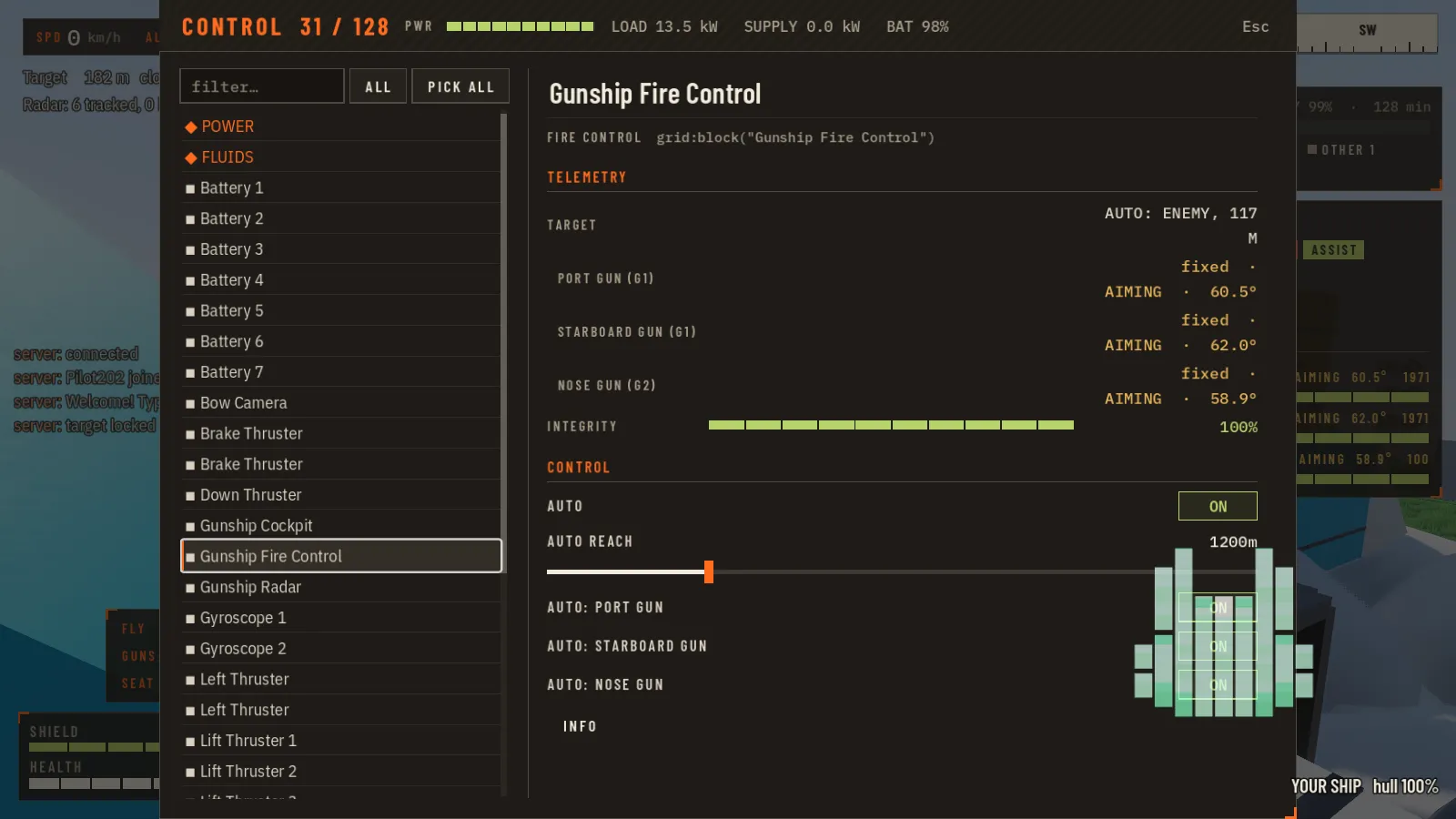
seated): on the fire control's panel, AUTO on, a reach (AUTO REACH,
1200 m unless set, 50..5000) and the guns picked (AUTO:
, one toggle a gun). The guns picked, with the hinges, rotors and gimbals they hang on (AIM WITH on the breech), aim and fire at the nearest enemy craft within the reach by themselves, nobody in a seat: a raider, a meteor, a practice target (the gunnery range's drones) or a craft of a player not on the fire control's owner's side. A gun picked is the fire control's: a pilot drives the others. A gun on no joint is not turned: it fires only as an enemy crosses its line. What a fire control drives is kept awake (a ship resting on the ground may sleep). The setting is kept in the save and in blueprints. The bots' own weapons auto ( pilot: the locked target, else what the radar tracks) stays theirs from a player or an old blueprint comes to nothing. - Piloting HUD: under the controls, the view (
[V]), the weapons mode ([B]: auto, or which groups the buttons fire), what is tracked (locked target and distance, radar, crosshair), nose assist, and each gun's state (aiming, on target, on target but charging, blocked, out of arc, out of reach, out of iron). - Every gun keeps itself charged while it has iron (it draws its full power until charged, then only stands by), so the first shot goes the moment it is told to fire; the demo guns are built charged. After a shot it charges again: a full 600 kJ at 60 kW to the shot takes 10 s.
- Capacitors go to the nearest breech: every capacitor of a construction (grids joined by pistons, hinges and rotors; not docked ships) feeds the breech nearest to it, up to 8 a breech. They need not touch it: the gunnery turrets have theirs on the base in front of the rotor, so the head that turns carries only the breech and its barrel.
- Turrets come round from anywhere: the joints are turned from the ship outward (a rotor sees the barrel's bearing before the hinge raises it), and a hinge pinned at its limit with the aim still out of reach eases back toward level, so a barrel left straight up still finds its bearing.
- Gunner seats: a cockpit on a static grid steers nothing: there the mouse always looks round, and the turrets aim where the gunner looks. Each gunnery turret has one (and a fire control) beside its button: with the button off, the gunner takes the turret over.
- Camera block: seated, V goes from the seat's view to each camera of the seat's grid (first person out of its lens), then to the chase camera, and back. The guns aim along the view one looks through. The gunship has one on its bow.
- The crosshair meets the ground too: the aim point is the nearest of what the crosshair ray meets of the grids and of the ground, the ground found by the terrain itself (its collision is built only near what moves), out to 3 km; meeting nothing, a point 1.5 km along it.
- Barrels look like their shots: a breech's mouth and the coils of its barrel are drawn to fit the ball of iron it fires (the bore as wide as the shot, the windings round it as thick as that calls for): a machine gun's barrel slim, a mortar's fat. Changing the shot mass redraws them. Only the look: every block still fills its cell.
- The gunship's looks: teal and white: a hull white down the middle and teal at the sides, two teal prongs reaching forward with white tips and yellow lights, the cockpit at the front between teal cheeks, a row of batteries down its spine, side pods with yellow fronts, a dark engine block at the stern.
- The gunship's prong guns are set to fast fire: 0.25 kg at 300 rpm (10 kJ, 283 m/s), for drones and machinery.
- Drones at the range: three near ones for the machine gun (within its 110 m radar) and four far ones for the gunship, each swaying out of step. The mortar's target is an ammunition dump 9 by 9 with warheads across its floor.
#The weapons HUD Current
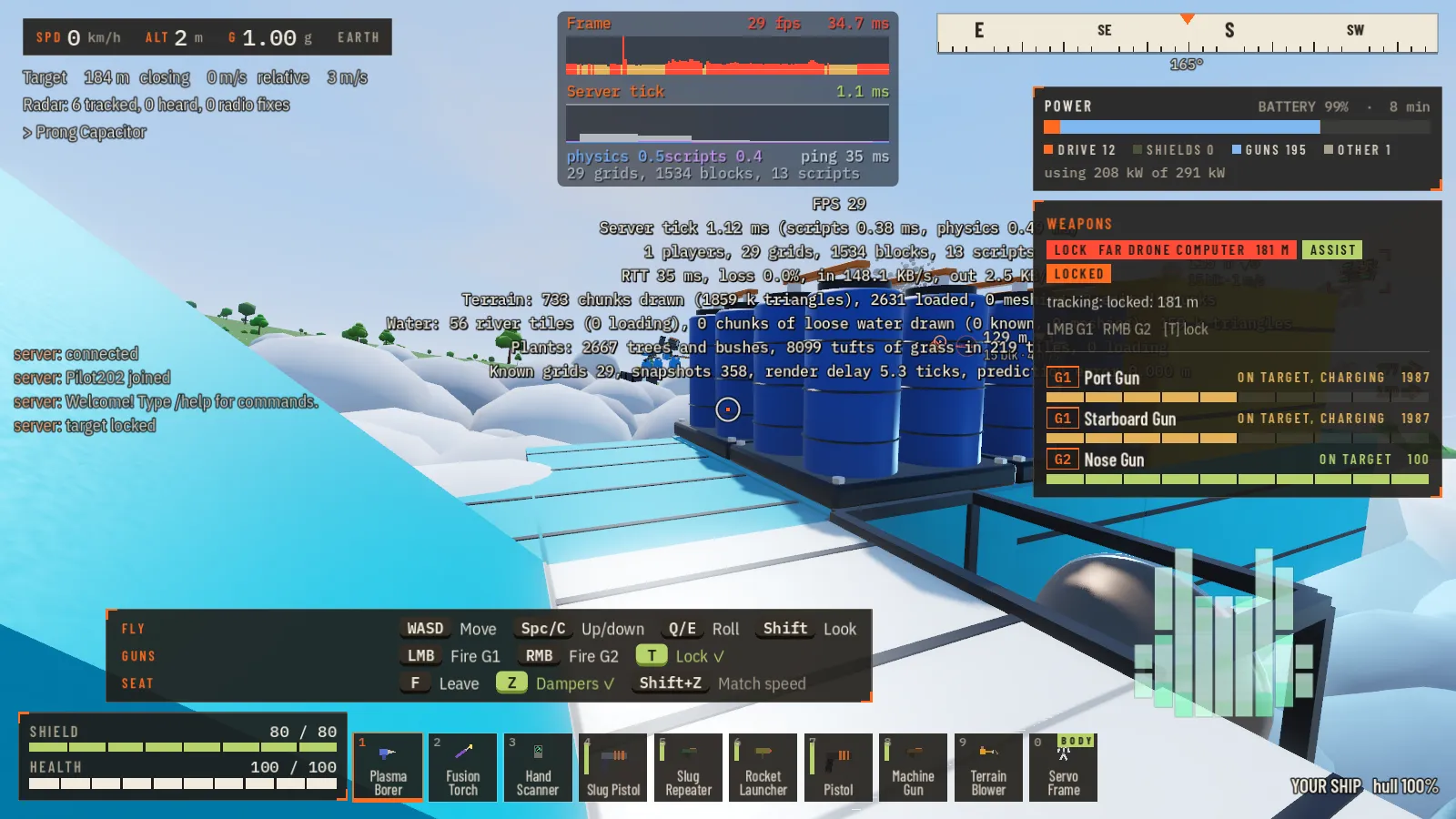
Seated in a ship with guns in groups, a panel at the top right (under the
statistics): the modes as toggles, lit or dim (AUTO, LOCK with the target's
name and distance, ASSIST, and what the guns aim by: crosshair, locked,
radar, auto track), what is tracked, which groups the buttons fire; and a
row for every gun: its group and name, its state (on target, aiming and
how far off, charging, blocked, out of arc, out of reach, out of iron),
a bar of its charge (yellow while it charges, green when it is ready) and
the shots its iron has left with a small ammo bar. (game.weapons_hud(); the fire control reports each gun's charge in steps
of a twentieth and its shots left.)
#Breech settings stay within what it can do Current
A breech's settings never ask for what its build cannot give: the power it draws is its power cap as far as it can use it: what its capacitors let it draw, and no more than its shots can carry at its rate of fire (each shot held to what the capacitors give one and to what the barrel's top speed puts into one of its mass). So nothing but the power ever holds a gun back (never "barrel" or "capacitors": that would be power drawn for nothing). The panel's power slider reaches only that far, and follows as the shot mass, the rate or the build change; the cap one set is kept, so a gun given a higher rate again draws up to it again.
#How shots look Currentsince 2026-11-20
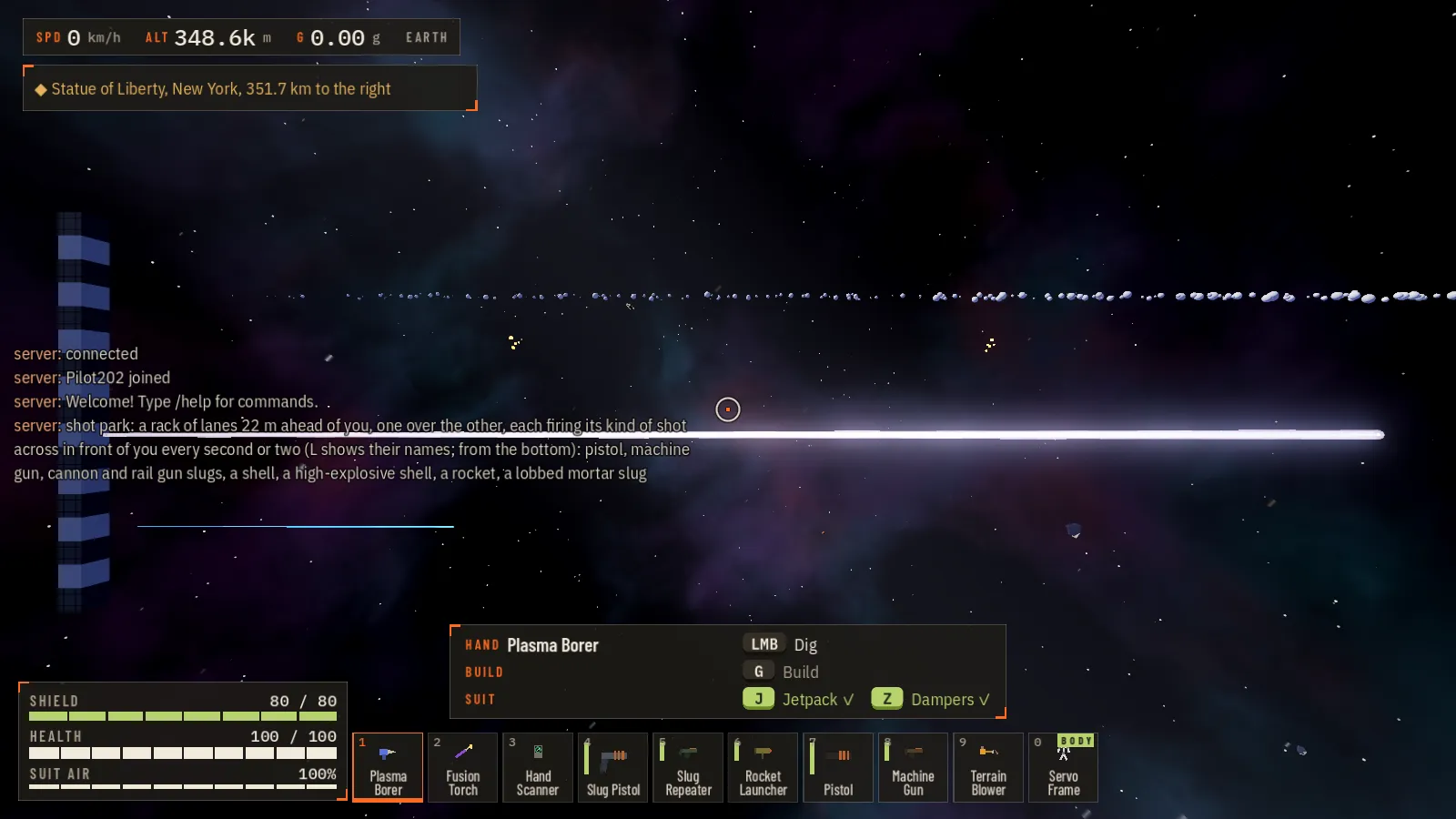
Each kind of shot is drawn its own way (the server tells the clients the kind: with each shot): a ball for the round, its real size (no longer 1.4x) and never thinner than some 2.5 px (was 4), and a streak behind it, widest at the round and narrowing to a point (was a solid bar of one width), as long as it flies in 1/30 s (40 m at most; was 1/20 s, 60 m).
- Slug (coil guns, the Slug Pistol and Repeater): blue-white, its streak blue and slim, as a coil gun's flash.
- Shell (a shell gun's solid round): orange-hot.
- High-explosive shell: red, a little fatter, a shorter streak, and it sheds glowing sparks as it flies.
- Rocket (the Rocket Launcher): a dark body, a flickering flame behind
it, its trail of smoke (only rockets now: a mortar's heavy, slow shell
trailed smoke too, taken for a rocket).
--autotest --shotlooks [--side D] [--turrets A,B]takes pictures. A rocket's smoke is laid along the way it flew each frame, puffs some 0.35 m apart running together (it put out one puff every 0.05 s, beads metres apart).
In the frame of the one who sees it (since 2026-11-24): a shot's streak, and its wake, point and stretch the way it moves against the one looking (the ship they sit in, else themselves), as motion blurs to the eye; never back past the mouth it left, carried on with the observer. (In the world's frame one's own rounds streaked askew of one's guns at speed, and ships flying together saw each other's fire sweep sideways.) Seated in a fight, one's own fire leaves the guns in straight lines.
Drops (since 2026-11-24): a round is drawn 2.2 times its real size, never under some 4 px, its streak as wide as the round
where it leaves it and fading away toward its tail (the wake's shader with
a steep falloff, 2.5): a glowing drop with a tail, not a bar of one
colour to a point. (A rocket keeps its flame.)
Wakes, and each weapon its look (since 2026-11-24): behind every ship's round a soft glowing wake, brightest at the round and fading toward its tail, as far back as the round went in a moment; when the round is gone (hit, burnt out) its wake stays where it was in the observer's frame and fades. Its look comes from the weapon's numbers, the round's mass and speed:
- A coil gun's slug: the faster, the whiter and more violet, the wider and the longer its wake hangs (0.1 s for slow slugs, 0.5 s at 1,100 m/s); the more energy (mass and speed), the brighter and wider: a light gun's slugs thin cyan lines, a cannon's 20 kg at 260 m/s a thick cyan bolt, a rail gun's 1 kg at 1,100 m/s a long, sharp violet-white line across the sky.
- A shell: a short, hot wake, orange; HE redder; heavier, wider.
- Rockets keep their smoke; hand weapons' rounds have no wake (a close fight on foot stays clear).
The shot park (/spawn shots, /spawn shots space; Esc, Demo parks:
"Shot park" "Shot park in space"): a rack of eight
lanes 22 m ahead of you, one over the other 2 m apart, at the left a tower
with each lane's post, named for what it fires (L shows the names); each
fires its shot across in front of you, left to right, every 0.25-4 s: from
the bottom, a Slug Pistol slug, a machine gun's, a cannon's, a rail gun's,
a shell, a high-explosive shell, a rocket, a mortar slug lobbed 35 degrees
up. The shots are the guns' (mass and speed) but harmless (no burst, from
no gun). On the ground the rack stands level as you look; in space (past
the Earth's pull, where /testspawn <ship> space shows ships; it takes you there) it is
built a second after you arrive, as you then look, and the shots fly
straight. Spawned again, it replaces the last. --autotest --shotpark [--where ground|space] takes pictures.
#Ricochets and sloped armour Current
A shot meeting armour (armour, light armour, slopes, corner pieces) more than 60 degrees off square bounces off, unless the energy it presses into the face (its energy times the cosine squared of that angle) is over 4 times the armour's threshold: it flies on mirrored off the face with 80% of its speed, and leaves a scratch. Armour struck at a slant is thicker the way the shot goes: its threshold is divided by the cosine of the angle. A slope's or corner piece's slanted face is where it would be (what strikes the faces it is cut from strikes it), so sloped armour takes level fire at 45 degrees: 42 kJ to get through where flat armour takes 30, and grazing fire bounces off it.
#Radar and sensors: seeing in space Currentsince 2026-11-19
Space fights are about who sees whom first. A sensor sees round itself, a sphere of up to 50 m (20 by default): who is at a door, what docks, a drone at a wreck. Everything further off is the radar's.
A radar is a beam along its dish (the block's forward), a cone of a half-angle of 2° to 90° (BEAM), out to 100 m to 20 km (RANGE). It points where its block does: on a rotor's or hinge's head it sweeps and turns with it, so a radar on a turret looks where the guns do. It is one of:
- Active (it sends): it sees every construction in its beam, out to its range times the target's size factor (the radar equation's fourth root of the cross-section: a 27-block ship at the range, a lone block at 0.6 of it, a 5000-block dreadnought at 2.4), and not through a planet. What it sees it tracks precisely (where, how fast), good enough for the guns: fire control's RADAR targeting (and a bot's weapons auto) shoot at the nearest craft an active radar of the ship tracks. Power goes as the range squared times the beam's width: 2 km at 45° takes 4 kW, 10 km at 9° about the same, 10 km at 45° 88 kW. So a ship chooses: a wide search beam near by, or a narrow one that reaches far but must be pointed (on a rotor, by a script, or with the ship's nose).
- Passive (it listens, 0.3 kW): it hears every active radar whose beam lies on it, from up to twice that beam's range, if that radar lies in its own cone and range: the direction well, the distance to a tenth (a hollow amber marker, "~"). Not good enough to shoot at; enough to turn toward. A ship that sends is seen from twice as far as it sees. It also hears radio in its cone (antennas of other constructions, up to twice their 3 km): every message a script sends, and every antenna's beacon to its network every 10 s. That gives a snapshot of where the sender was as it sent (a grey ring), which does not move and is kept 15 s: talking gives one away.
- Every radar, active or passive, warns while another's beam lies on
its ship: "RADAR WARNING" on the pilot's HUD and
radar.warning.
Only working craft are seen (since 2026-11-20): a construction with energy (its batteries holding some, or its solar panels and turbines giving some; with power free, all) and something that runs it (a cockpit, a computer or an antenna). Pieces broken off and dead wrecks are no contacts: a fight left dozens of one-block marks on the screen. A rocket (a computer and a battery) is one. Tracks are kept 4 s once lost (coasting on their last velocity), so a sweeping beam keeps its picture. A ship's picture is all its radars' (across joints and docking), the best of each contact. Seated, the pilot sees the contacts on the HUD (fed; since 2026-11-20 drawn on the screen, quiet: thin lines, small type, no plates):
- far off, a small diamond where it is (filled red: tracked by an active radar; open amber: only heard; grey: a radio fix);
- near enough to see (its box on the screen 26 px or more), no mark on it: thin corners round where it is drawn, so that the ship itself shows;
- off the screen or behind, a small chevron in from the edge the way to it, with its distance;
- beside each: its distance, ▼ how fast it closes or ▲ opens along the line to us, its blocks and its speed against us; and a small orb whose ring lies level with one's own ship (the half toward us bright) and whose arrow points the way it goes against us (bright: coming closer; a dot at its tip: toward us out of the screen);
- the lead: for a tracked ship a shot would reach within 6 s, a small ring where to aim the guns the cockpit fires first (group 1, else its lowest; not point defence) so that a shot meets it if it holds its course (gravity too), a faint dashed line from the ship to it;
- the labels keep clear of one another and of the ships seen, nearest first: one pushed off its contact draws a faint line with an arrowhead back to where it really is. The contacts carry their velocity for it. A sensor only reaches 50 m.
Scripts: radar.ships (each with position, velocity, distance,
blocks, precise, snapshot, age), radar.active, radar.angle,
radar.range, radar.warning; radar:set_range(m), set_angle(deg),
set_active(bool). sensor.ships lists the grids in a sensor's sphere.
The homing rockets' seekers look 90° wide at 2.5 km, the nose kept within
35° of the target so that it stays in the beam.
#Homing rockets Currentsince 2026-11-20
A rocket of seven blocks along its nose: a radar, a warhead, a computer,
a gyroscope, a battery and two thrusters at the tail (some 1.3 t, 60 kN:
4.6 g). Its computer flies it by
proportional navigation: it pushes across its line of sight to the
target by 4 times the closing speed times how fast that line turns (which
cancels the target's drift across it), and along the line up to a
closing speed of 220 m/s, no further (so it keeps the push to turn
with); its nose goes along the push, the engines as hard as the push
asks. It goes off within 6 m, or as it passes its nearest within 25 m,
or 30 s after it lit. Before its radar locks it flies at a point it was
given. Started with a delay it lights then (/rockets: eight of them at a
dreadnought 420 m off, each striking within 4-6.5 s); started clamped
under a ship it waits for launch [target [launcher]], lets go its clamp
and lights. It replaced the spiral rocket, which swung out round its line
for show and took 9-11 s for the same 420 m.
Tried and left: steering by thrust vectoring (the engine on a gimbal). A gimballed engine turns the rocket with at most some 90 kN m (60 kN on a 3 m lever, turned right across), and only by taking thrust from its speed; the gyroscope gives 2,000 kN m, and the gimbal weighs about as much (250 kg and a 25 kg yoke against 300). Turning was never what limited it.
Why: with an all-round sphere every ship saw every other at once, and there was nothing to do about it. A beam to point, power to pay for range, the choice of sending (and being heard from twice as far) or listening, and radio that gives one away make seeing a craft of its own: scouts that listen, pickets that shine, a fleet that keeps quiet until it is close.
#Hit feedback in the pilot's seat Current2026-11-20
The sim tells every shot that strikes: the construction that fired it (the root grid of the gun's; none for a hand weapon), the one struck, how (damage, no harm (glanced off or too weak for the armour), a shield, a block broken, a player) and with what. The server sends it to the pilot of the ship that fired and, as incoming, to the pilot of the ship struck (not one's own shots on one's own ship).
- Ours: four short ticks flash on the diagonals just outside the crosshair's ring, cut like it (light on a dark outline): cream for damage, dim and short for no harm, the shields' olive for a shield, the signal orange springing out for a block broken, red for a person. A burst ranks its hits (a block broken shows over damage) and holds the mark a little longer. With it a short bright tick in the ear, higher for a block broken, lower for no harm (one in 70 ms at most: a machine gun).
- On us: a short arc on a wider ring (58 px) round the crosshair
points to where the ship was struck, against the view as it turns now;
red, olive for the shield, dim for no harm; it flashes and fades over
1.2 s; hits close together merge. With it a dull low tock.
--hitshots(with--host) photographs the marks.