#Boats: floating, flooding, propellers in water Current
Water pushes up on what pushes it aside:
- What blocks are made of is a little denser than water (1100 kg/m³): a block on its own sinks, slowly.
- A hull floats on the air it holds. Every empty cell of a grid has the height the water outside must reach to get to it (its lowest way in, over the highest point of that way). A sealed room can never be reached; an open boat keeps its air while the water stays below its side; a hole below the waterline lets the water in and the boat sinks (a 6 x 3 x 6 box of armour floats with 0.2 m to spare; holed in its floor it is 9 m down 25 s later). Open doors are holes.
- A float (block; steel plate and graphite, stage 1): orange foam, a cubic metre of it light all through: it holds up nearly a tonne. Rafts and pontoons.
- Each part is pushed up where it is, so the shape decides how it floats: wide and low rights itself, tall and narrow rolls over.
- Drag: on the hull's area across each axis, as much of it as is wet; along its length (its narrowest axis) a third of that. A part of the drag grows in proportion to the speed (the waves a hull makes): it stills bobbing and rolling. In a river the water carries a boat along.
- Ship propellers (block; steel plate, motors, copper wire): a bronze screw on a shaft that pushes only under water (21 kN at a standstill, none at 18 m/s through the water; in air nothing). Air propellers push nothing under water (since 2026-11-22: a boat needs ship propellers). Since 2026-11-22 also a large (2 x 2 x 2, 45 kN) and a huge (3 x 3 x 3, 105 kN) ship propeller, grown as the air propellers are (14, 30, 70 kN): drawn the same, n times the size; their wash comes off their whole face, the disc times the size squared.
- Rudders: a wing under water meets the water (some 800 times as dense as air): a fin on edge under a stern is a rudder, a wing flat under a hull a hydrofoil. Steered, a rudder turns whole (up to 0.35 rad), not on a flap. A boat with a rudder in the water steers by it alone: A/D (or the mouse) turn it, its cockpit has no steering of its own, and it turns only as fast as the water past its rudders lets it. A ship propeller's wash runs straight back: a rudder one or two blocks behind it gets the water faster (momentum theory: the wash over the boat's own speed), so a boat turns at a standstill with its throttle on. A hull turning about its own up meets half the water's turning drag that rolling or pitching does.
- Worked out per grid only near water; the hull again when its blocks or doors change or it tilts some 10 degrees.
/harbour (and Demo parks) goes to the nearest sandy beach. Afloat off
it (each also by /spawn):
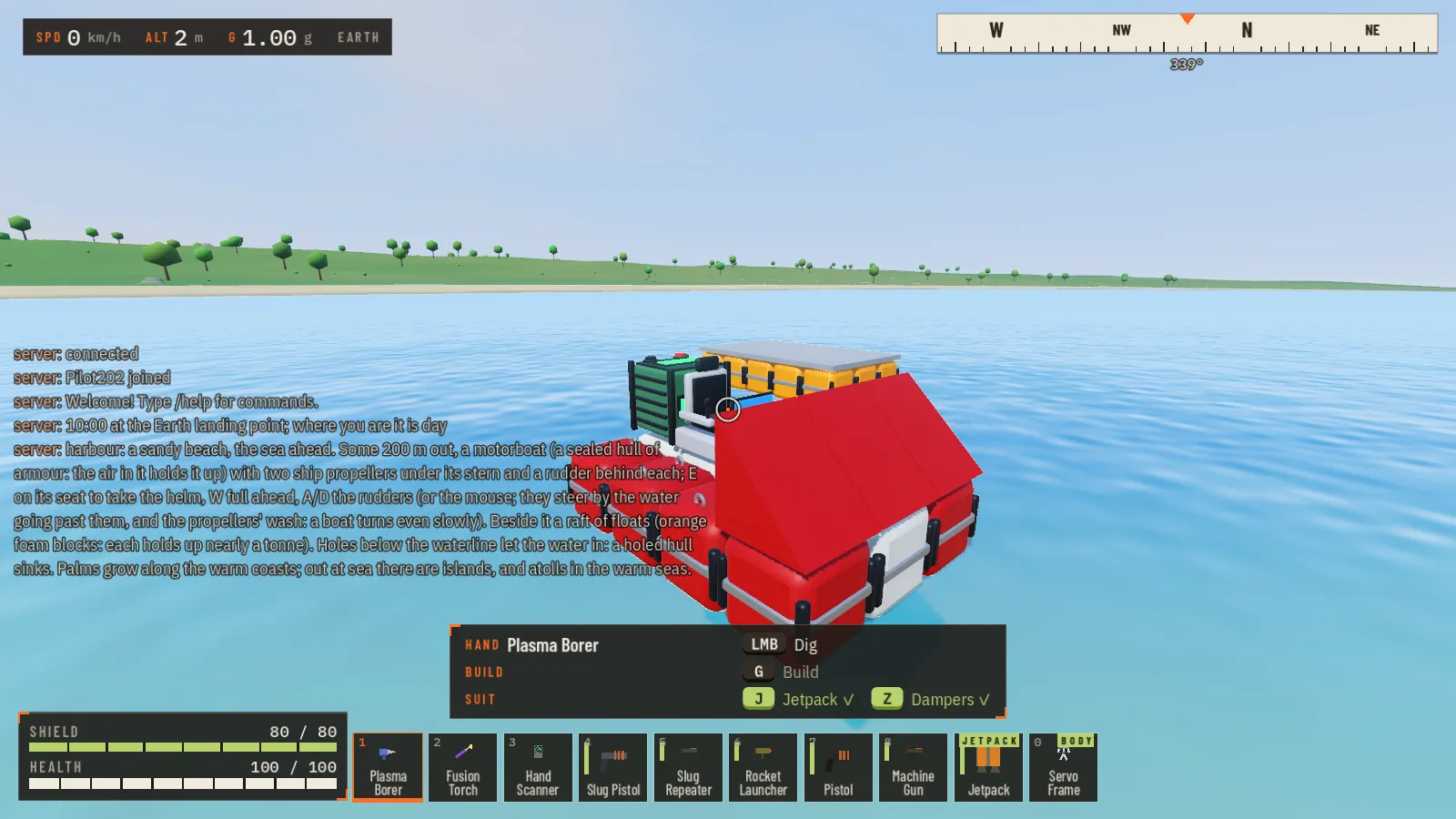
- a motorboat 200 m out (a sealed hull of armour 5 x 9 x 3, a sloped bow, an open seat, two batteries, two ship propellers under the stern, a rudder behind each; 6.4 m/s at full ahead, turning some 16 degrees a second, a circle of some 20 m);
- a raft of floats beside it;
- a catamaran (
catamaran): two sealed hulls 3 x 3 x 11, 8 m apart under a deck, the helm on it, a ship propeller and rudder under each stern; 4 m/s, 12 degrees a second, hardly rolls; - a jet ski (
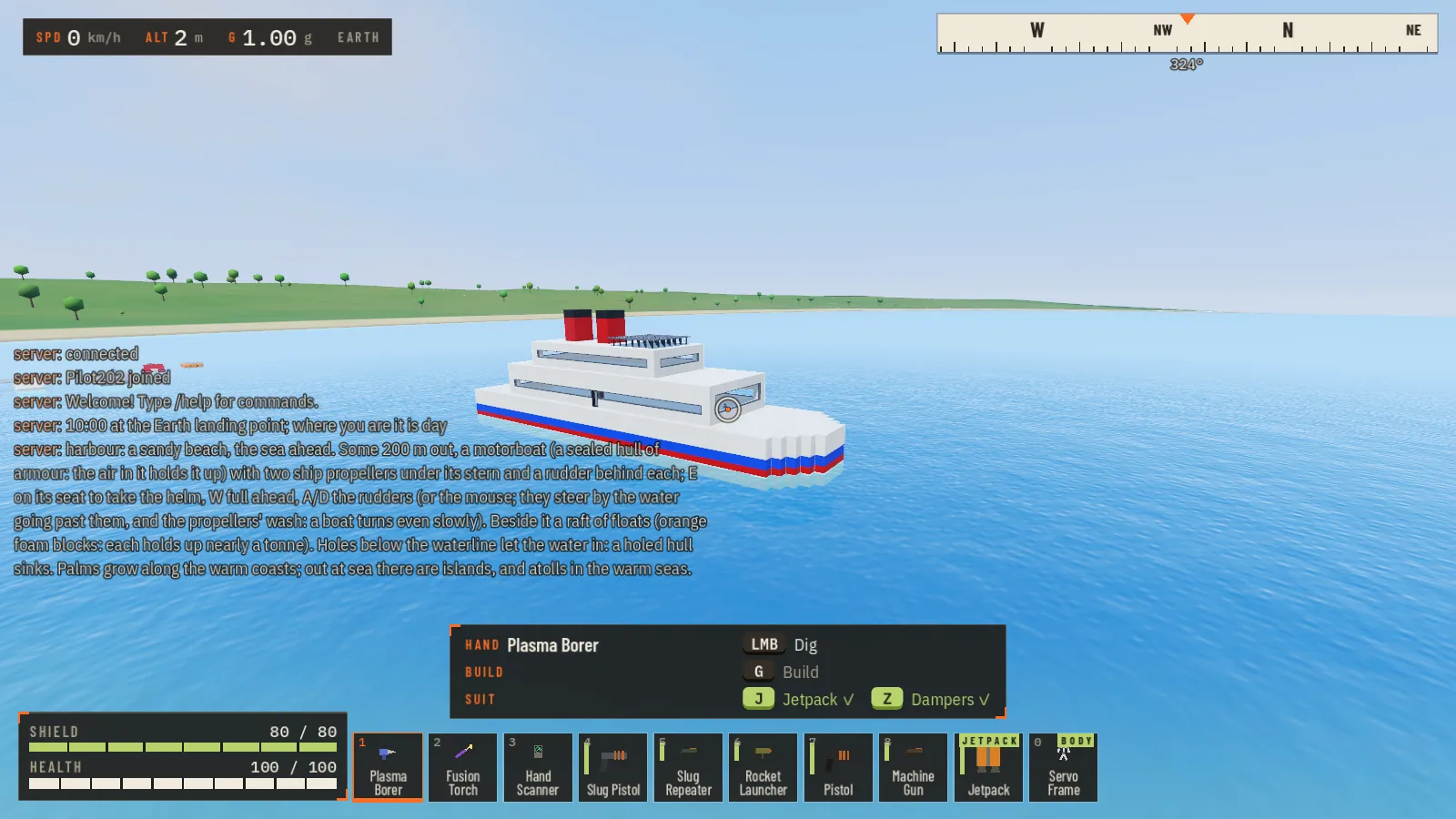
jetski): floats 3 x 4 under a sloped nose, a seat, a battery, one ship propeller and its rudder; 11 m/s, 12 degrees a second; - further out, a cruise ship: a sealed hull 13 x 5 x 51 (red under the water, a blue band, white above; the bow tapers), on its deck a deckhouse to walk about in (a door each side amidships, windows all round, the bridge with the helm at its front), an upper deckhouse with solar panels and two red funnels, four ship propellers and rudders under the stern; 5 m/s, 2 degrees a second.
Still planned: swimming, waves that rock boats, a hull's lateral resistance along its length (a hull now meets the water's side drag at one point, so it slips a little in a turn), loose water in dug ground holding boats up.
#Side wheels for vehicles, plane wheels for planes Current2026-11-20
The wheels of rovers and trucks go on the side of the chassis (named Wheel, Large Wheel, Huge Wheel): the block is the suspension's mount, a squat housing, and the wheel stands out beside it (1 m times its size, from the block's middle), on its strut, on whichever side of it has less of the construction (up to 8 cells across, the nearest counting most; the right when even). So a wheel put at the corner of a deck stands out of that corner, whichever way it was turned. It rides, drives, steers and brakes as the old wheel does, its ray starting under the wheel.
The old wheels, hung under the hull on a strut, are the plane's wheels now (Plane Wheel, Large Plane Wheel, Huge Plane Wheel; the same kinds, so old saves keep them). The planes keep them; every rover, truck and the raiders' rover, and the size park's trucks, are on side wheels.
#Engines and wheels in three sizes Current2026-11-20
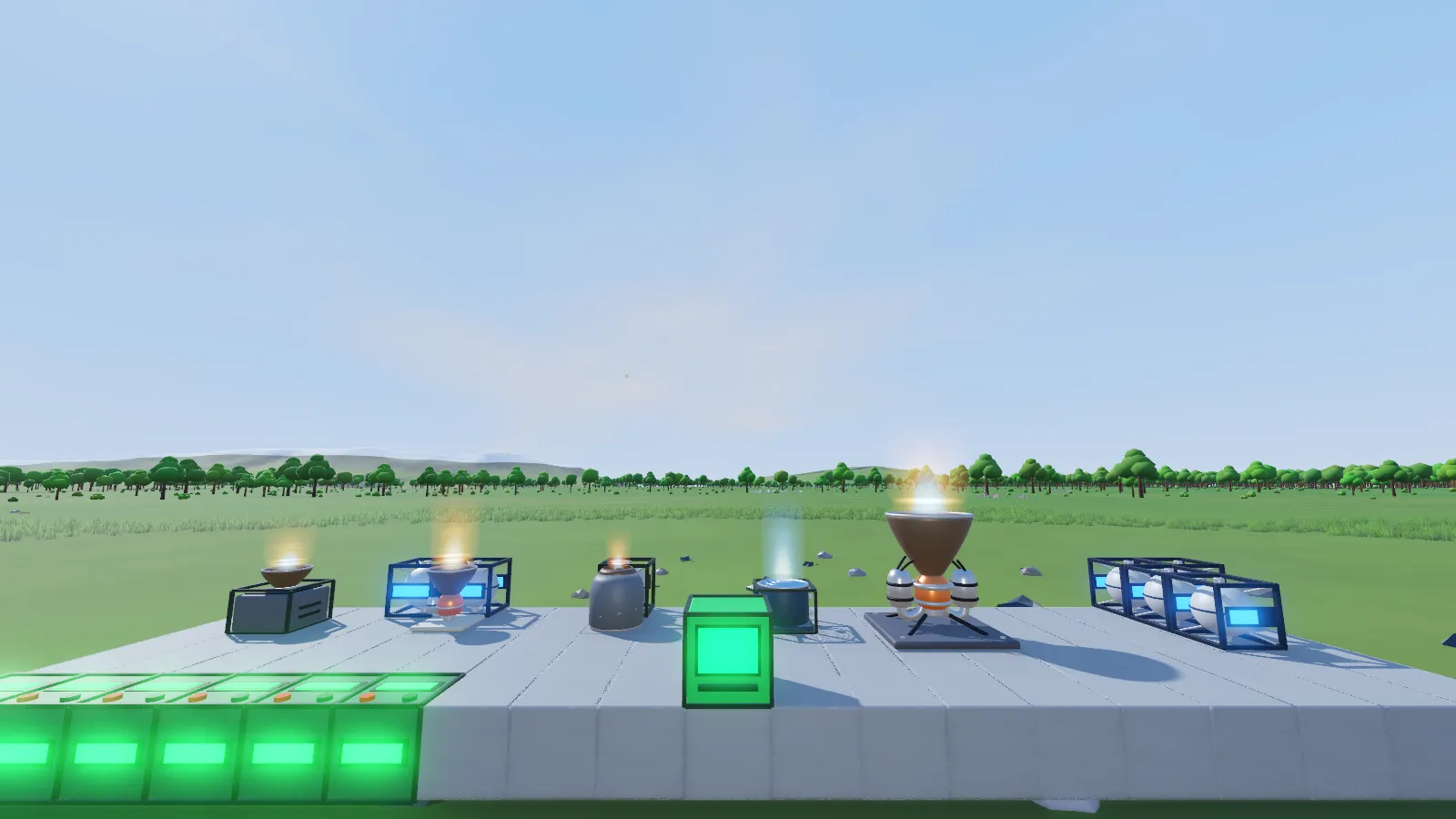
Thrusters, jet engines, propellers and wheels each come 1x1x1, 2x2x2 and 3x3x3: fewer blocks for a big craft, each about as strong as its size, none of them a strictly better buy.
| 1 | 2 | 3 | Scaled by | |
|---|---|---|---|---|
| Thruster | 30 kN, 60 kg | 2 MN, 320 kg | 7 MN, 1,100 kg | volume (as the large one was) |
| Jet engine | 60 kN, 1.5 l/s fuel | 240 kN, 6 l/s, 300 kg | 540 kN, 13.5 l/s, 900 kg | intake area; fuel by thrust |
| Propeller | 14 kN | 30 kN, 200 kg | 70 kN, 600 kg | disc area |
| Wheel | r 0.5 m, travel 0.7 | r 1.0, travel 1.4, 400 kg | r 1.5, travel 2.1, 1,200 kg | size |
Wheels: the drive and brakes go by the load each wheel carries, and the load is shared by size (a big wheel carries more), so any size moves any vehicle; a bigger one clears rocks and ditches, rides softer (springs 1.7, 1.4, 1.2 Hz), grips a little better (1.3, 1.4, 1.5) and is geared a little faster (50, 60, 70 m/s), for its weight and its motor (3, 10, 25 kW). The wheel's ray now starts at the block's middle. Scripts see every wheel as a wheel and every engine as a thruster. Recipes: the big wheels need girders, the huge thruster superalloy and strong motors as the large one, the big jets more nozzles and boards. The client draws each bigger one as the small (or large) one scaled round its middle (a wheel's moving parts in a holder scaled n times). Tested: a truck on four wheels of each size rests mid-travel on its springs, rides higher the bigger they are and drives off.