#Progression: depth and distance are the gates Planned
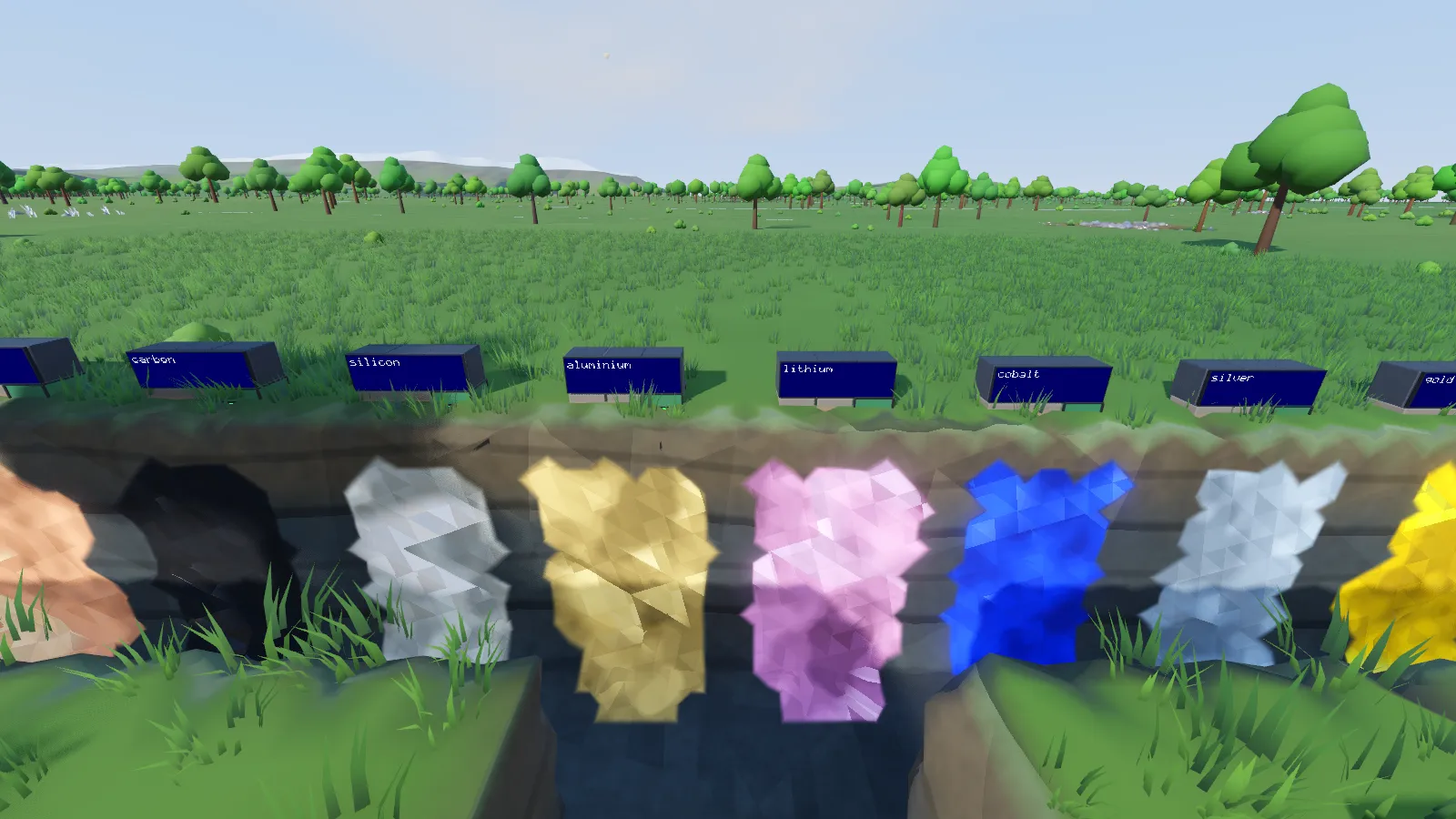
You start on Earth with little more than a Rock Borer. You find the commonest resources first, and each step gives you the tools to reach the next ones: a tool that reaches the next band of depth or the next place, and a scanner that can see what is there.
#Ores Current
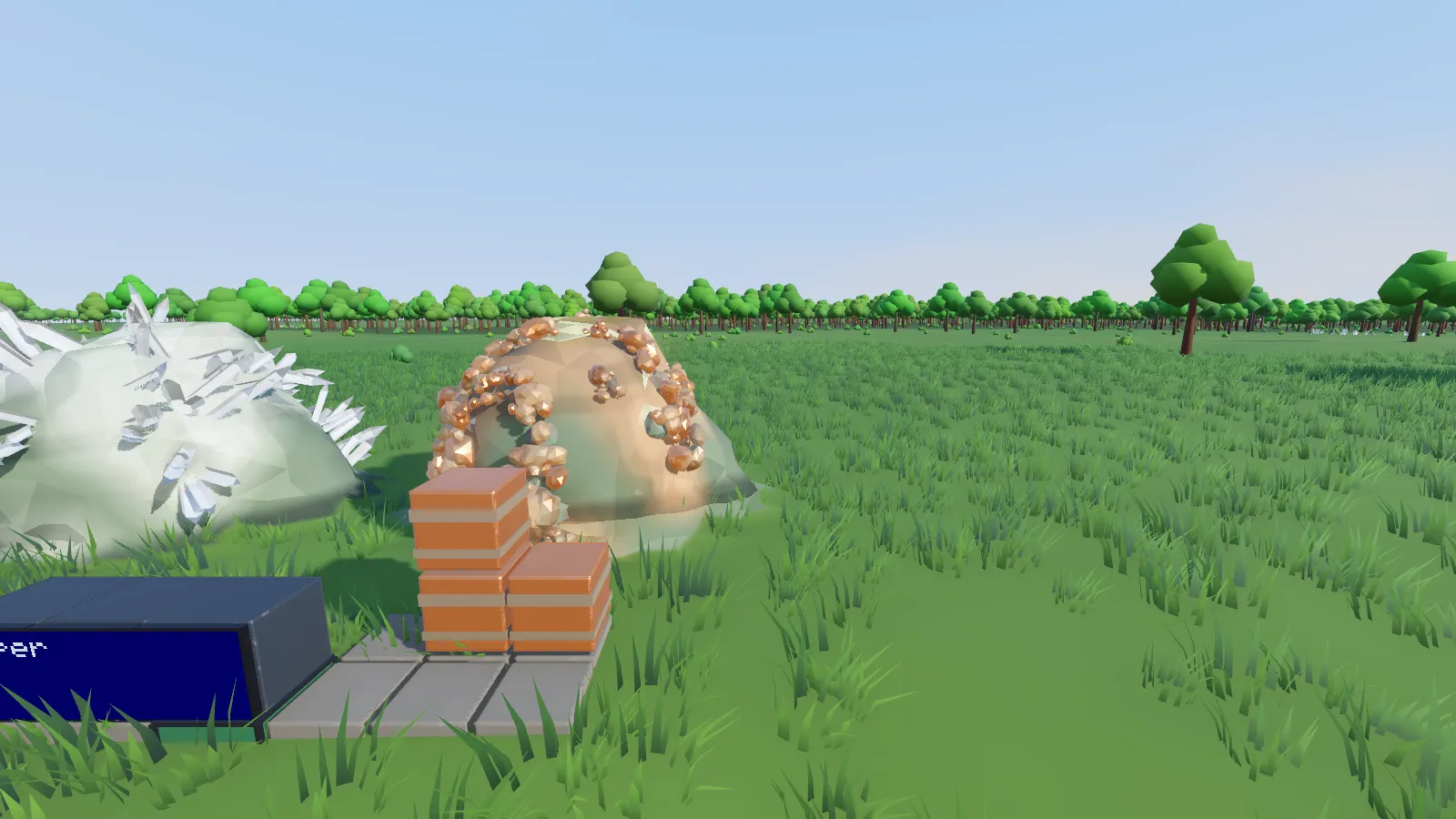
The rarer an ore, the smaller, deeper and rarer its deposits:
| Ore (cube name) | Element | Share of deposits | Buried down to | Reaches the surface | Stage |
|---|---|---|---|---|---|
| Iron Ore | Fe | 30% | 12 m | 35% of deposits | 0 |
| Coal | C | 18% | 14 m | 30% | 0 |
| Quartz | Si | 14% | 14 m | 30% | 1 |
| Copper Ore | Cu | 14% | 18 m | 20% | 0 |
| Bauxite | Al | 9% | 25 m | 10% | 1 |
| Lithium Ore | Li | 6% | 30 m | never | 2 |
| Cobalt Ore | Co | 4% | 40 m | never | 3 |
| Silver Ore | Ag | 3% | 45 m | never | 2 |
| Gold Ore | Au | 1.5% | 55 m | never | 3 |
| Neodym Ore | Nd | 1% | 60 m | never | 3 |
| Stone | — | the ground everywhere else | — | — | 0 |
The landing point has no deposit of its own (there used to be a column of iron under it): in Sandbox and Survival alike you go out and find your ores. The Sandbox drill tower by the landing point drills plain stone.
Iron ore is rust-brown (haematite), so that its dark patches in a wall are not taken for coal; coal is near black.
Each body has its own mix, on top of the shares above:
| Body | Richer in | Poorer in |
|---|---|---|
| Earth | — | cobalt, gold, neodym (0.4×) |
| Moon | bauxite 2.5×, quartz 1.5×, gold 2.5×, neodym 4× | coal 0.1×, iron 0.6× |
| Mars | iron 1.6×, cobalt 4×, lithium 1.5× | coal 0.3× |
| Mercury | iron 1.5×, silver 3×, gold 3× | coal 0.1× |
| Venus | copper, lithium, silver (2×) | — |
Ore cubes keep their mineral names (Bauxite, Coal, Quartz): "find bauxite to get aluminium" is something the player learns, and the thumbnails show the element symbol it gives.
#Tier 0: Landfall, hand tools Current
-
You start with: the Rock Borer and the Patch Torch (no jetpack), in the landing capsule (see Coming down): a seat, a Scanner (set to 50 m), the Field Workshop, an empty Coal Generator, a bed, a cargo container with its ejector and one full battery (6 MJ). No solar panels: when the battery runs down, only coal keeps it going. (Since 2026-11-22; before it the start rover, a 5×7 deck on four wheels with the same machines, and before that the static drop pod, which had solar panels and a battery at first, then nothing but the generator.)
-
The Scanner (stage 0; until 2026-11-20 the Ore Scanner): set on its panel (or by script) to look for ore deposits (the default), players, ships, or all of them; for players and ships it lists them as a sensor does, and seated in its vehicle marks each where it is. Looking for ore it finds the deposits whose edge lies within its range, 5 to 50 m (a slider on its panel); it takes 0.05 kW for every metre of range (2.5 kW at 50 m), but only while somebody sits in its vehicle or stands within 5 m of it; else it stands by. (Since 2026-11-18: before, the start rover's scanner took its 2.5 kW all the time, more than the workshop, and burnt a cube of coal every four minutes for nothing.) Its panel lists what it finds; seated in its vehicle, the HUD says how many and the deposits are marked where they lie (as one's own scanner, N, does within 120 m).
-
Seated, the figure sits on the pilot's seat (thighs forward, hands on the console), seen in third person and by others. The cockpit is drawn as an open seat now.
-
The Field Workshop: makes the stage 0 recipes that need no fluid, from a short list: steel plate, copper wire, graphite, motors, girders and concrete of stone; armour, slopes, corners, doors, buttons, wheels, the cockpit, the drill, ducts, ejectors, belts, landing gear, the coal generator, the assembler, the fabricator and the bed. It takes twice as long as an assembler or a fabricator and 1.5 kW while it works. Components come out of its back as cubes, blocks in a crate.
-
Putting cubes into a machine: E on a workshop, an assembler, a fabricator or a generator puts in what it takes from anywhere in the inventory, with nothing in hand: a generator coal; a machine what its recipe needs (with no recipe yet, any cubes). One kind: it goes in at once; several: a chooser shows them as tiles, and a click puts that kind in; none: F opens its panel. All of a kind goes in, up to what the machine holds (20 of a material). The HUD says what F will do. (Carrying cubes, F on a machine still puts those in.)
-
The Rock Borer: cuts no deeper than 15 m under the ground, and slowly (see Mining rates below). The iron, coal and quartz outcrops near the landing point (N scans for them) are enough to begin. It keeps stone too, which concrete is made of.
-
Concrete of stone: 3 stone make 1 concrete, without water, in the assembler or the workshop: how the first assembler gets built before there are pumps and tanks.
-
The cockpit is a stage 0 block now (3 steel plate, 2 copper wire, a motor): an open seat, what a first rover needs.
-
Building from a crate: in build mode, a crate of blocks in hand places what it holds, whatever block is picked on the keys. The last block out of a crate uses the crate up (since 2026-11-18: before, every crate built empty stayed in the inventory, and the playthrough bot's hotbar was soon all empty crates). A block taken apart with no crate in hand comes out in a crate of its own.
-
Stone is kept only up to 40 cubes (two stacks: enough for concrete); past that a borer lets it go. With no room left at all, ore it cuts falls at the player's feet. (The playthrough bot ended its fifth hour with 340 stone in 17 slots and no room for the ore it dug, and before that left hundreds of loose cubes round its pits.)
-
The trash: in the inventory window (Tab), pick a slot and then TRASH, and what it held is gone (all but the Rock Borer and the Patch Torch).
-
Machines put out past players: a player standing behind an assembler, a fabricator or the workshop no longer stops what it makes from coming out (the cube nudges them aside); before, the machine waited without a word.
-
First step: find coal (N scans for ore) and put it into the generator: a cube runs the workshop for 400 s.
-
Goal: a drill rover: wheels, a cockpit, a drill and a coal generator.
-
The hand scanner goes with the borer (Current, since 2026-11-19): N finds the deposits whose edge is in range and whose top lies no deeper than it looks (by the best borer one carries):
Borer Range Finds tops down to Borer digs to Rock Borer (or none) 120 m 25 m 15 m Turbo Borer 180 m 45 m 35 m Plasma Borer 250 m 80 m 60 m It sees a little deeper than the borer reaches: the next band's ores show as a promise (bauxite and lithium tops with the Rock Borer, silver with the Turbo), so the deep ores are what makes the next borer worth making. A vehicle's Scanner block sees every depth within its range.
#Tier 1: Mechanised, the first base Partly current
- Power (Current): the Coal Generator burns coal cubes that arrive at its intake (its forward face) or are put in by hand, up to 20. It gives as much as its grid uses and its batteries take, up to 10 kW; a cube of coal holds 600 kJ, a minute at full power, 400 s at the workshop's 1.5 kW. A stage 0 block: 3 steel plate, a motor, 4 copper wire.
- Build (Current): the assembler, the fabricator, belts, ejectors and ship drills, all from the workshop.
- The drill rover (Planned): reaches about 25 m, so bauxite and deeper copper. (A ship's drill has no depth limit now: what limits it is how far down it can be got.)
- Upgrades for you: the Turbo Borer and the Servo Frame (Current, see Gear), the scanner with the borer (Current, above), and the Backpack (Current, since 2026-11-20): an assembler makes one (2 aluminium frames, 2 steel plates, 2 copper wire; stage 1), and carried anywhere in the inventory it opens 15 more slots (45 in all; 30 without). Its slots show dim and shut without one; what is in them can be taken out, nothing put in; the backpack is not carried in its own slots.
- Goal: an ore → assembler → fabricator line that runs on its own.
#Tier 2: Industry, water and gas Planned
- Find: water (rivers and lakes), and quartz in bulk.
- Build: pumps, pipes, tanks, glass, aluminium frames, the electrolyser (water → hydrogen and oxygen), then hydrogen rockets.
- Reach: pistons and drill towers sink shafts to about 35 m, which reaches lithium.
- The jetpack (Current): in survival you have none to begin with. An
assembler makes one (a pressure vessel, 2 nozzles, 2
steel plates and a motor; stage 1). Picked up, it goes into the inventory
as
Stack::Jetpackwith an empty 60 l tank, and it works while it is worn (equipped; put on at once with none worn) and has hydrogen. It burns 0.4 l/s to stay up or brake, plus up to 0.6 l/s at full thrust: one to two minutes in the air. E on a tank fills it from the hydrogen of the tanks piped together (an electrolyser makes hydrogen of water). The HUD shows what is left. In Sandbox everybody flies without one, and every player is given the best tools in place of the basic ones (Plasma Borer, Fusion Torch) and all the wearables (Jetpack and Afterburner Jetpack, tanks full; Servo Frame and Titan Frame), so they wear the best of each, and the three hand weapons loaded (Slug Pistol, Slug Repeater, Rocket Launcher) with 10 Slug Boxes and 10 Rockets (topped up to that on each join, not added again). The weapons go on the hotbar after the borer and the torch (slots 3-7, the powder guns too, with 10 Cartridge Boxes; since 2026-11-20: they came last, past the hotbar, only to be had from the inventory); the wearables there move aside, worn from wherever they are. A weapon the player put elsewhere on the hotbar stays there. - Jetpack on and off (Current): J switches it by hand. In gravity, on foot, it also switches itself: Space pressed again in the air (a double jump) turns it on, and landing on a floor turns it off (touching a wall does not). In zero-g it stays as it is.
- Vehicles: a thruster hopper, then the first rocket hop to the Moon.
- Goal: leave Earth.
#Tier 3: Petrochemistry, electronics Planned
- Find: oil (pumped), and silver, which lies 40–45 m deep and needs a proper drill tower.
- Build: the refinery (fuel and plastic), circuit boards, solar cells, programmable blocks, cockpits, sensors and jet engines.
- Batteries (Current): a battery cell is lithium, graphite and copper wire; with cobalt instead of the wire it makes two.
- For you: a suit for other planets (cold, no air), and a scanner that shows lithium and silver.
- Goal: automation; scripted drill rovers mine for you.
#Tier 4: Advanced, deep and far Planned
- Find: cobalt, gold and neodym, which on Earth lie 55–60 m deep and are rare.
- Key idea (Current): other bodies are richer in them (Mars in cobalt, the Moon in gold and neodym, Mercury in silver and gold; see the table above), so space travel is how you get them.
- Build: processors, magnets, superalloy, carbon fibre, the ion drive, the large thruster, radar, connectors and merge blocks.
- Goal: a ship that carries its own factory, and mining in orbit.
#Upgrade lanes across the tiers Planned
| Lane | Steps |
|---|---|
| Borer (Current) | Rock Borer → Turbo Borer → Plasma Borer (see Gear) |
| Scanner (Current) | Range and depth grow with the borer: 120 m / 25 m, 180 m / 45 m, 250 m / 80 m (see Tier 0) |
| Suit | Jetpack → Afterburner Jetpack (Current); Servo Frame → Titan Frame (Current); then oxygen, heat and cold protection (Planned) |
| Vehicles | Rover → drill rover → hopper → rocket → shuttle → cruiser |
| Power | Coal (the only power at the start) → water turbine → solar and battery → hydrogen |