#Power in the control panel Current
Power is what sets ships apart, so the panel shows it everywhere. Every block that takes power has a POWER reading: what it takes now, as it is set (a thruster at its throttle, an ore scanner at its range, a factory working or standing by; 0 W when off), and its share of its power group's load; a producer what it gives, a battery whether it charges, gives out or idles. The list's first entry, ⚡ POWER, is the overview of the grid and all joined to it: what is made (by kind of maker: solar panels, turbines, generators, fuel cells), what is taken and by how many blocks, whether the blocks are short of power, the batteries (stored of capacity, and charging, full in so long, or draining, empty in so long at this load), and every block that takes, gives or idles, with its kW and its share (a click opens it). The client asks for it twice a second while the panel is open. E uses what one looks at, F opens its panel (seated: F leaves the seat, K the ship's panel; E rolls there).
The second entry, 💧 FLUIDS (since 2026-11-18), does the same for the fluids: the tanks (how many, what they hold of what they can), and for each fluid (water, oil, hydrogen, oxygen, fuel) what is held, made and used (litres a second), and when it runs out at this rate or the tanks are full; then every block that makes it (pumps, electrolysers, the refinery's fuel), uses it (engines that burn it, fuel cells, air vents, machines, a tank a player refuels from) or idles, with its flows. The flows are what each did in the last run of the networks (what is taken out of the tanks outside the networks is counted); the client asks while the overview is open.
#Fuel cells: the night's power, made by day Current
A fuel cell piped to tanks that hold hydrogen and oxygen gives the power its grid wants beyond what the sun and the turbines give, up to 15 kW, the way a coal generator does: 1.6 l of hydrogen and 0.8 l of oxygen a kJ, half of what the electrolyser took to make them. Solar panels and an electrolyser fill the tanks by day; the fuel cell keeps the base running at night: and a base far from water needs its hydrogen hauled in before dark.
#Shields as power sinks Current
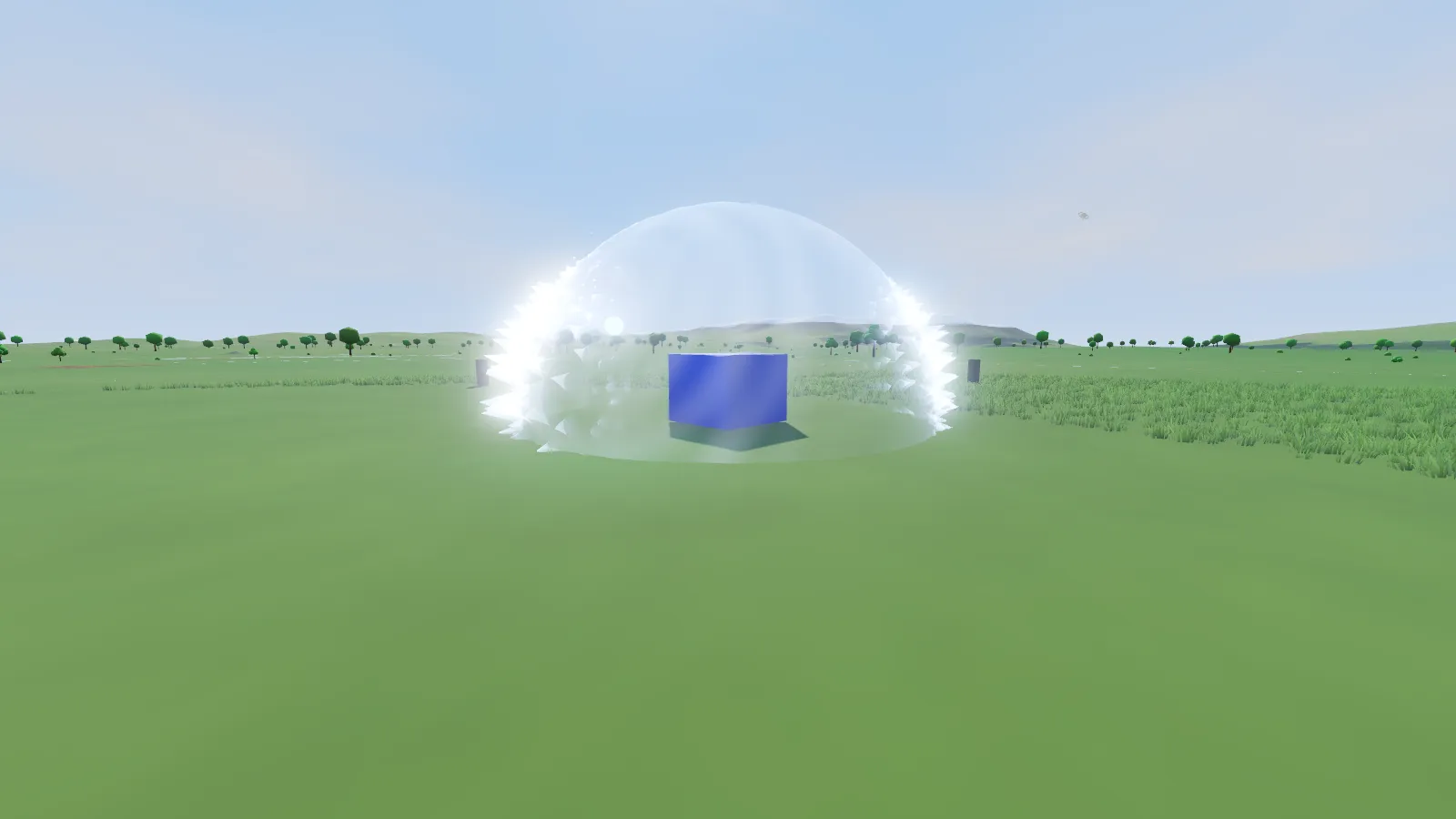
A shield generator holds up to 1500 kJ and recharges at up to 150 kW from its grid's power, which it gets last of all (40 kW before 2026-11-24; see Shield, thrust and guns pull on each other; 0.5 kW to stand by when full). Its field is an ellipsoid round it: how far it reaches along the generator's right, up and forward, each 1.5 to 80 m (6 m all round to start with: a sphere), set in its panel (WIDTH, HEIGHT, DEPTH). While it holds a charge, whatever flies into the field from outside is stopped where it meets it, its energy paid from the charge (a blue flash on the field). What is fired from inside goes out freely; anything inside is safe, whoever's construction it is. A shot with more energy than is left breaks the shield: the rest of it goes on, and the shield is down (no field) while it recharges (at its full rate, from its grid's power), until it holds half of what it can; then it rises again with that (a default generator: 750 kJ, 5 s at 150 kW, longer while the guns and thrusters take the power; no power, it stays down). That is the opening to press the attack. (Since 2026-11-20; before, it stood down a fixed while by its energy and size, no recharge, and rose empty.)
/shield (and Demo parks) shows it: two bunkers alike 70 m downrange, a
heavy autocannon (4 kg shots, one a second, 200 kW) firing at each, seen
from between the lanes. The shielded one (blue; a generator charged full
and batteries behind its wall, its field drawn out round the whole bunker)
stops every shot in a blue flash for some 37 s (its one battery refills
it at 60 kW, less than the cannon puts in), until its charge is spent and
it breaks; down some 12 s, it rises again and is soon broken again. The
bare one takes the shots from the first.
How a field looks (since 2026-11-20): a shell in its generator's
colour, faint at rest (since 2026-11-24: a third as bright as before,
mostly its rim; for a while not drawn at all): it shows in full only for a
moment where a hit's rings run over it (what is seen through a ring bent
1.5 times as much as at first, the shell pushed out and in by the rings
and dented by the hit 4 times as far, since 2026-11-24; in its own colour, no white; what
is seen through a ring tinted by it, as through coloured glass), the shell's glow and bands shown in
a band round each ring as it passes, fading with it; the rings dimmer and
sharper than before, the colour pushed further from grey. (Before: a
glowing shell always, brighter the fuller.) under a third full it grows
ferrofluid spikes (their tips glowing): a field about to fail. They stand
as the Rosensweig (normal-field) instability stands them (since
2026-11-24): a fixed hexagonal lattice of touching cones over the shell
(a subdivided icosahedron, the spikes some 1.4 m apart, as a real fluid's
critical wavelength fixes theirs), each a hexagonal pyramid with hollow
sides meeting its six neighbours halfway, on a low mound. What moves is
the field under them: three patches, as magnets under the shell, their
middles wandering in a slow noise, each swelling and ebbing; where the
field passes a threshold the spikes stand, their height growing as
sqrt(H^2/Hc^2 - 1) (Gailitis 1977; Friedrichs & Engel 2001): a dome of
spikes, tallest in the middle, still tall near its rim, then none. A cone
never moves; it grows and shrinks whole (the tallest some 1.7 times the
spacing). Not too orderly: each spike pushed off its lattice point by up
to a fifth of the spacing, each its own height (0.7 to 1.2) breathing a
little on its own beat, the patches each their own size with ragged,
shifting edges; and each spike leans toward its patch's magnet, which
stands outside the shell over the patch's middle, each at its own height
drifting between 0.3 and 1.5 radii out (nearer: a stronger, tighter patch,
its spikes leaning harder; further: weaker, wider, more upright): upright
under it, tilting in toward it at the rim, with a little sway of its own
(the tip moves over, the foot stays). Seen from outside, the spikes on the near
side show only their faces toward the viewer (their hollow insides behind
them not drawn), so they read as solid cones; the far side stays smooth
(its spikes sink away as it turns from the viewer, standing whole again
round the outline), and from inside the shell everything is drawn and
every spike stands. Breaking: a flash, and spikes erupt all over it (the
same lattice, tallest in the patches),
then a wave runs from where it was struck to the far side, a bright crest,
and behind it they sink and the shell is gone, in some 1.1 s; for 2 s more
a thin red lattice pulses where it was (the gap is open), fading in 1 s.
Rising again: a bright band sweeps up over it from the bottom (0.7 s). A shot it stops: a white-hot flare that
pops and spreads into a blue halo in a quarter of a second, lighting what
is round it, a spray of blue-white sparks thrown off the shell, and
ripples: two rings running out over the whole shell from where it
struck, the faster, further, wider and deeper the harder the hit (by its
energy on a log scale: a 3 kJ slug's small and short, a 600 kJ cannon
round's sweeping the whole shell); what is seen through the shell is bent
along them, as through a heat haze (a second pass, drawn only where a ring
runs); stirring its bands as they
pass, gone in 1.6 s (the last 8 hits on a field at once; in the field's
shader). The shell itself waves with them: each ring pushes it out and in
as it passes (0.25 m and 2 cm a metre of its radius), so its outline
bulges where a ring runs over its edge, and where a shot struck it dents
and springs back (in the shader's vertex stage: some 18,000 vertices a
field, nothing to speak of). Seated in a ship with a shield, the vitals panel shows a SHIP
SHIELD bar: how full (per cent and kJ), red under a quarter, and while it
is down "SHIP SHIELD DOWN" blinking with the seconds till it is back.
--autotest --demoshots /shield --times... takes pictures (--ui: with
the HUD). (The field is drawn on a sphere of 384 x 192 segments, for its
spikes and waves to be shapes.)
The shield range (/spawn shieldring; Esc, Demo parks, "Shield
range"): a bunker 45 m ahead under a field 12 m round
(six generators, 9 MJ, a third full to start with, recharging at what its
six batteries give as a bank, some 270 kW),
shot at from four sides at once by harmless posts (L shows their names):
light slugs (5 kJ, five a second), an autocannon (90 kJ, every 1.5 s), a
cannon (676 kJ, every 5 s) and a rail gun (605 kJ, every 8 s), so their
ripples are seen side by side; they spend more than it recharges, so in
about a minute it breaks, recharges while down, and rises half full (and
so on). 80 m to the right, a second shielded bunker (two generators, full)
for one's own shooting, with the gunnery range's six gun towers 40 m in
front of it, aimed at it, each started and stopped with E on the button
at the back of its base. --autotest --shieldring [--down S] takes
pictures.
#The power card Current2026-11-20
Seated, a POWER card over the weapons card (top right) shows where the ship's power goes now, as one bar split by DRIVE (thrusters, gyroscopes, wheels, the cockpit), SHIELDS, GUNS (breeches charging) and OTHER, laid against what the supply could give now (panels, turbines, generators, and each battery up as its charge holds); and the batteries, how full and how long they last at this draw. Past the supply the bar runs over in red and it says SHORT: everything at n% (every block gets the same share and works slower). So boosting, a shield recharging and a rail gun charging visibly compete for one supply. The old "Power:" text line is not shown while the card is.