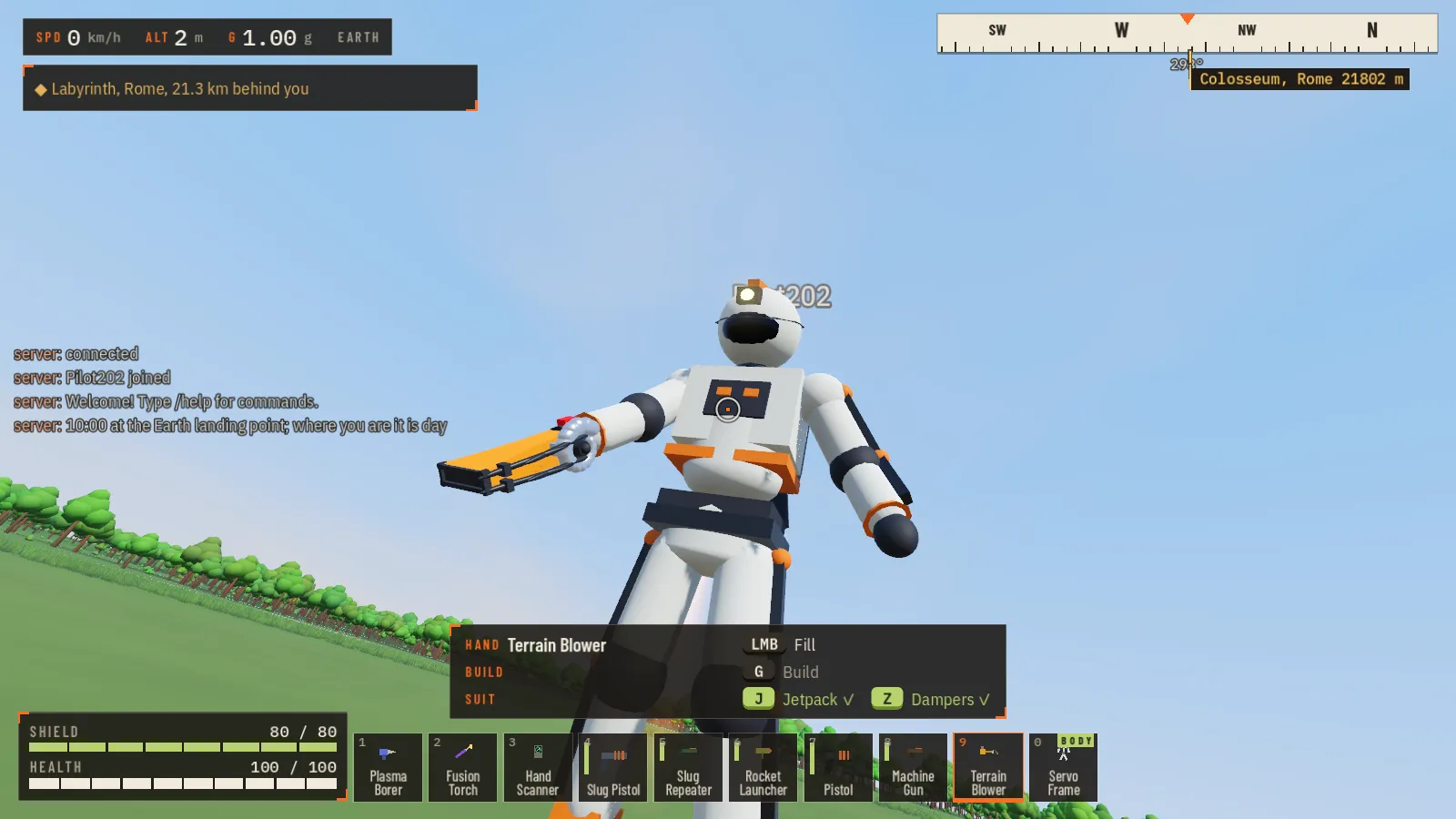
#On foot: walking and running Currentsince 2026-11-18
One walks (2.6 m/s) and, Shift held, runs (6.5 m/s), both times what the frame one wears gives. (bots and tests run.) In
third person on foot, Alt held swings the camera round the figure (it was
Shift). Standing, the body turns only once the look has gone about 50°
round (the head follows the look at once); since 2026-11-22 the arm holding
a tool or weapon does too: it points where one looks before the body turns
(up to 70° outward, 45° across the chest). The figure's gait follows the speed: walking, a stride of 1.75 m
(two steps) with the knee bending most early in the swing and giving a
little as the heel takes the weight, the toes pushing off, the arms
hanging and swinging a little, the body highest as the legs pass; running,
a stride of 3.3 m, the knee folding up high behind, the arms bent and
pumping, a lean forward, the body lowest as it lands and highest as it
flies; blended between from about 3.2 m/s. The strides are as long as the
legs' swing covers, so the feet do not slide. --gaitshots takes frames.
C (or Ctrl) held on the ground, not on the jetpack, crouches (1.3 m/s): the eyes go down half a metre, the figure squats (thighs forward, shins back to the feet under the hips, leaning forward) and takes short steps; others see it crouch. The first-person tool sways with the steps only on the ground: not while flying on the jetpack.
#Gear Current
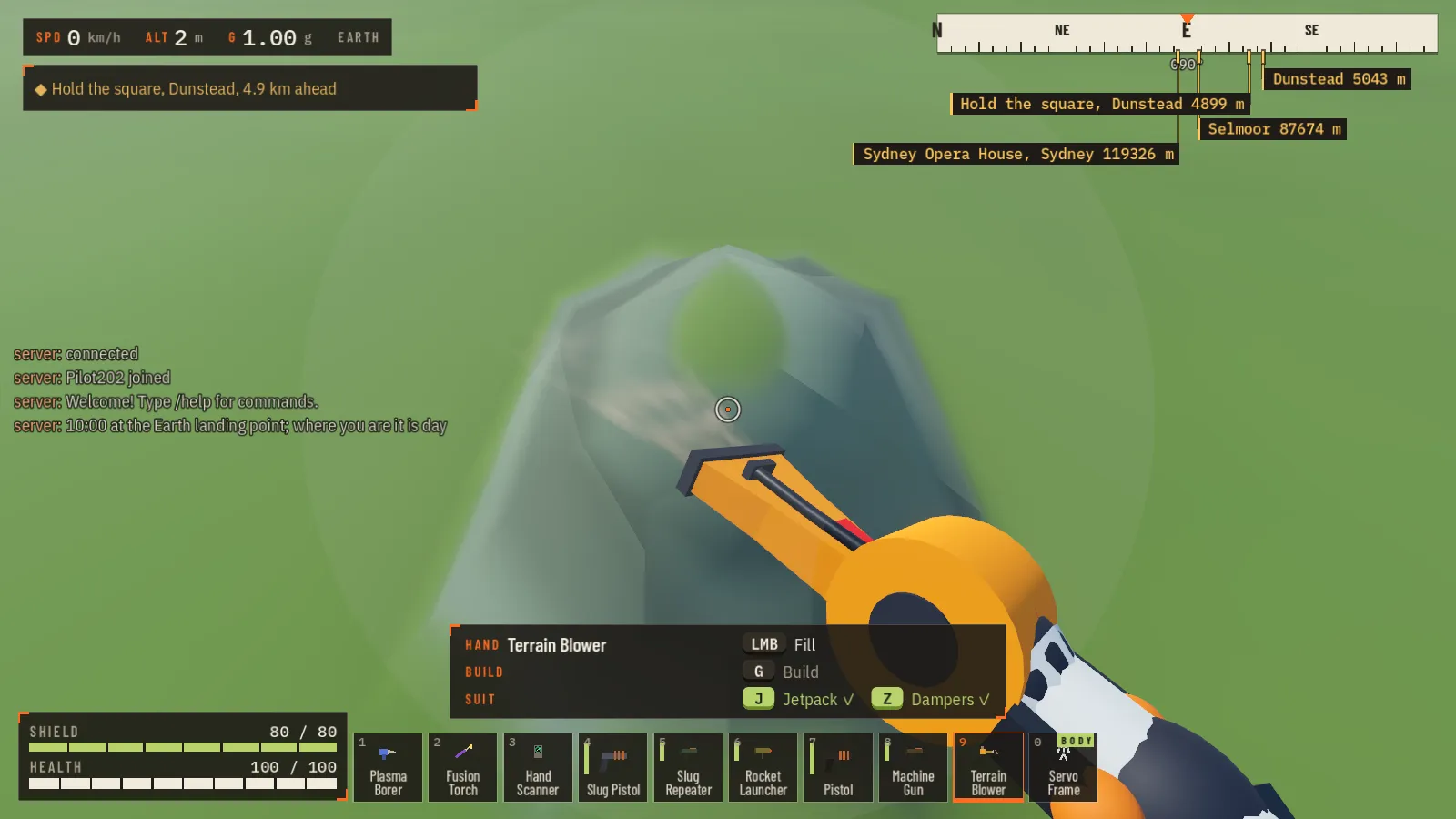
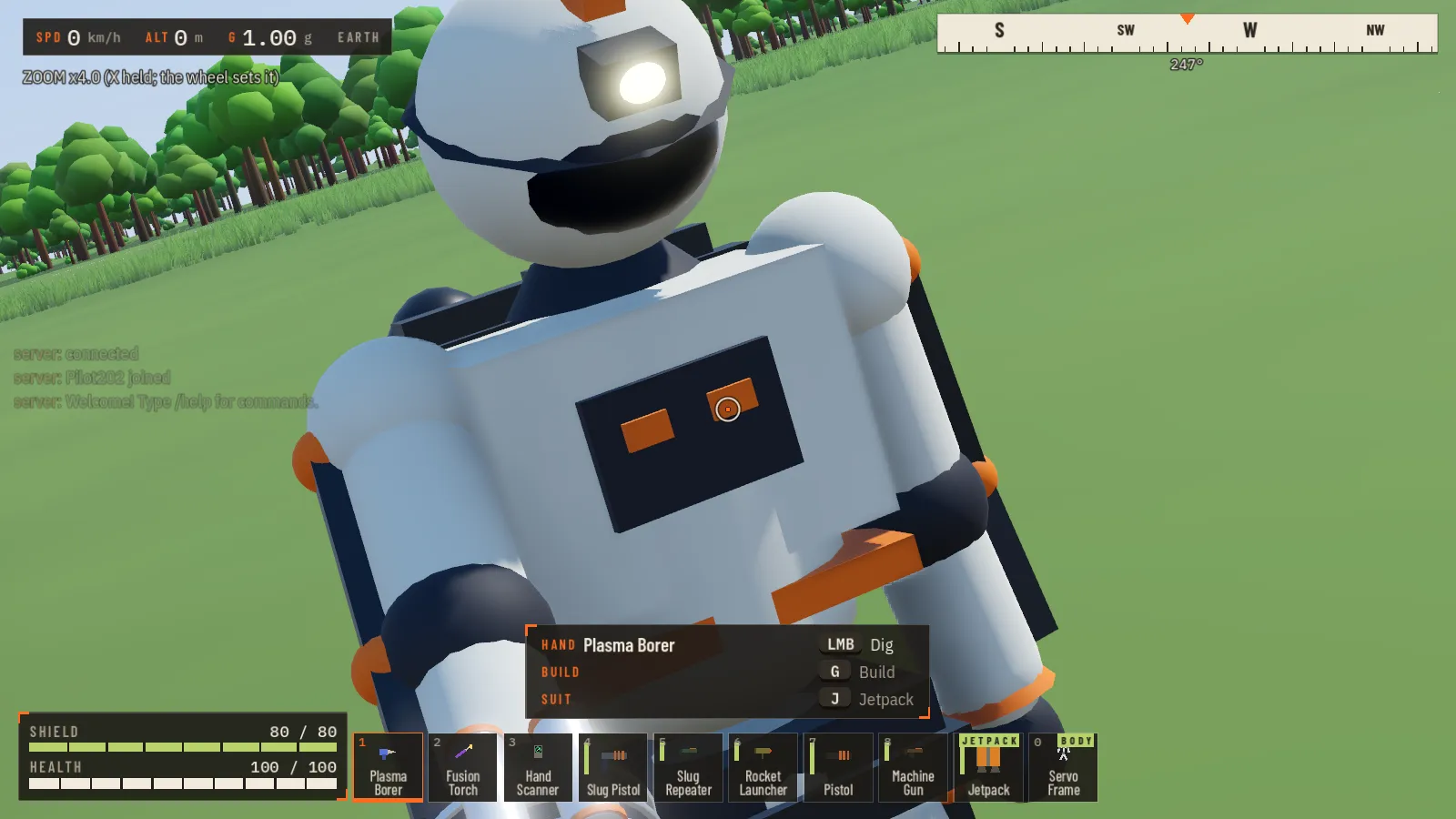
Tools and what one wears come in tiers; every tier's name says it is the better one, and every one shows on the figure (and the tool in first person). Defined; an assembler makes each, and picked up it goes into the inventory. Tools work in hand; what is worn is equipped (since 2026-11-19): out of the inventory, into one of four equipment slots, the jetpack, the body (a frame or armour: one or the other), the shield and the head (the Head Lamp or the Zoom Lens). In the inventory window the WORN row shows them above the slots. Click gear to wear: EQUIP → its slot, saying what it swaps with; what was worn there comes back into the slot it came from. Click a worn one (or drag it out): TAKE OFF, into the first free slot. Gear to wear coming into the inventory with nothing worn in its slot is put on at once (one's first jetpack, a frame, a shield). Changing a frame or armour takes a few seconds. Each slot's gear shows on the figure: the lamp is a band with a lamp on the brow, the lens a big camera lens over the right eye. A world saved before moves what each player wore into the slots on loading. In the inventory a piece of gear to wear has its slot's name in its corner.
The suit's energy (since 2026-11-19, survival): a 180 kJ battery in the suit that drains slowly, 30 W (and 10 W more with the Head Lamp worn, 5 W with the Zoom Lens): about an hour and a half from full. Standing on a grid (or sitting in one) whose batteries hold charge fills it again, 2 kW drawn from those batteries (full in a minute and a half; a battery block's 6 MJ fill it over thirty times). Flat, the lamp goes out and the shield does not fill again. The vitals show SUIT ENERGY (CHARGING, FLAT), the character its per cent; a sandbox's stays full. Since 2026-11-20 a player's health, suit air and suit energy are kept while they are away and in the save: before, a load or leaving and coming back made everyone whole.
Hydrogen flasks (since 2026-11-19): an assembler makes empty flasks (a steel plate and a pipe fitting: two; stage 1). E on a tank of hydrogen fills the jetpack worn first, then the empty flasks carried, 30 l each (half a Jetpack's tank, a fifth of an Afterburner's), as far as the tanks hold whole flasks. In flight, once the jetpack's tank has room for a whole flask, it drains one carried into it, and the empty one is kept, to fill again. The vitals' JET H2 row shows the tank's litres and the flasks carried.
The Zoom Lens (since 2026-11-19): a big camera lens worn on the head instead of the lamp (an assembler: 2 glass, a steel plate, copper wire; stage 1). Only with it on does X zoom (the wheel sets how far, 1.5 to 10 times; the key bar shows X Zoom while it is worn).
The kit everyone carries (since 2026-11-19): besides the Rock Borer and the Patch Torch, a Hand Scanner (hotbar 3) and a Head Lamp (worn on the head). They take the place of the old N (scanner) and H (flashlight) keys. The scanner is a tool held in the hand like the borer (a sensor globe whose lens and sensor points pulse while it looks, on the figure and in first person): only while it is in hand does it look, as far and as deep as one's best borer lets it, and mark what it finds through the ground and on the compass. It runs on its own battery: 60 kJ, drawing 100 W in hand (ten minutes of scanning; a sandbox's runs free). It charges by induction: within 8 m of any battery that holds charge, at 1 kW (from flat in a minute), drawn from that battery; a battery block's 6 MJ fill it a hundred times over, so a base hardly notices. The key bar shows what it has found, or that it is flat; its name in the inventory its charge. The lamp is worn on the head (it starts there; take it off or wear the Zoom Lens instead), and its beam comes on by itself where it is dark: the sun down, or more than 1.5 m below the ground (it reaches 45 m). Besides it the helmet gives only a faint glow of its own (14 m): below the ground, and fainter near it at night; by day none. Neither is made or can be thrown away; a player saved before they existed gets them on joining. Since 2026-11-22 the Hand Scanner looks for what the Scanner block can: ore (the start), players, ships or all; R in hand switches it (the key bar says which), and players and ships are marked where they are within its ore range. (Its two antenna stubs are gone from its model.)
| Kind | Tier 1 (start) | Tier 2 | Tier 3 |
|---|---|---|---|
| Borer (drill) | Rock Borer: ball 0.6 m, a cut every 0.5 s, 0.08 cube/m³ ore, 15 m deep | Turbo Borer (stage 1): 0.8 m, 0.35 s, 0.12, 35 m | Plasma Borer (stage 3): 1.0 m, 0.25 s, 0.16, 60 m |
| Torch (welder) | Patch Torch: mends 25 kJ/s | Fusion Torch (stage 2): 70 kJ/s | — |
| Jetpack | Jetpack (stage 1): 60 l of H2, thrust ×1 | Afterburner Jetpack (stage 3): 150 l, thrust ×1.6 | — |
| Frame (exoskeleton) | none: walk ×1, carry 250 kg | Servo Frame (stage 1): ×1.4, 500 kg | Titan Frame (stage 3): ×1.8, 1000 kg |
| Feet | none: jump ×1 | Spring Legs (stage 1): jump ×1.6; or Mag Boots (stage 2): stay on what one stands on | — |
| Terrain Blower (filler) | Terrain Blower (stage 1, sandbox hotbar 9): packs a 1.2 m ball of earth every 0.3 s; survival: a cube of stone a blast | — | — |
| Weapon (in hand) | Slug Pistol (stage 0) | Slug Repeater (stage 1) | Rocket Launcher (stage 2); Pistol, Machine Gun (powder, stage 2) |
| Armour (instead of a frame) | none | Plate Armour (stage 1, 10 steel plates): takes 30% off a hit, walk ×0.9 | Composite Armour (stage 3, superalloy, carbon, strong motors): 50% off, walk ×0.95, a Servo Frame's strength |
| Shield emitter | none | Shield Emitter (stage 2): 40 points, fills 12/s 4 s after the last hit | Aegis Emitter (stage 3): 80 points, 25/s after 3 s |
On the feet (since 2026-11-20): Spring Legs or Mag Boots, a fifth equipment slot (Feet; saves before it keep the four and gain an empty one). Spring Legs jump higher (the jump the frames once gave). Mag Boots: standing on a construction that moves (and in no ship's frame, so on a planet; in space the frame carries one already), one is carried by it as by a frame: its acceleration at one's feet (up to 50 m/s², about 5 g) and its velocity there are what one walks and stands against, and one is pulled down onto its floor (6 m/s²). So one walks about a driving truck or a taxiing plane, and a jump leaves at its speed: unless it changes speed meanwhile, one lands on it again. Without them (since 2026-11-21) one walks and stands against the deck too, carried by the friction of one's feet on it (some 0.8 g): ordinary driving carries one; stopping, speeding up or turning harder, one slides on (a hard stop at 25 m/s²: 2 m along the deck, in Mag Boots not at all); and on an open deck the air going by pushes on one (on a plane's wing at 55 m/s some 10 m/s²: without boots it blows one off). (Before, the legs held one still against the world, harder than that friction: the deck went from under one as soon as it moved, at 20 m/s it slid by at up to 10 m/s, with yanks where one's feet caught.) In space, where there is no gravity to say which way is up (under 0.05 m/s²), Mag Boots make their own: what one stands on is down (a hull's side or underside too; within 60 degrees of the floor one had, never a wall met on the way). One stands, walks along it and is pulled onto it as the ship speeds up, turns and brakes (on a shuttle flying about, within 0.1 m of one's spot; without boots one floats about on it, 2-7 m), is pulled back onto it when bumped up to a metre off, does not step off its edge into space, and a jump lets go of it (for half a second the boots take hold of nothing, not the wall one brushes going). The client is told that up and stands the figure, the camera and its walking by it. (Still: in a hard roll, 70 degrees a second kept up, one creeps along the deck, some 2 m in 3 s.) The figure walks only as one walks on what one stands on (its velocity less that of the grid underfoot, for everyone), so riding a truck it stands still on the deck, its legs not running at the truck's speed. And the client is told the construction the boots hold one to as its frame (as a ship's in space), so it predicts one on it: before, it predicted one standing still in the world and was pulled after the truck every snapshot (2.9 m behind at 9 m/s; now within 0.6 m). Recipes: Spring Legs 2 aluminium frames, 2 motors, 2 steel plates; Mag Boots 4 steel plates, 8 copper wire, a battery cell.
In a moving construction (since 2026-11-22). In the hull of a construction flying through the air, under its roof (a jet's cabin, not its wing nor a truck's open bed), the air goes with it: no wind. Before, a passenger of a jet at 220 m/s was blown down the aisle into its tail wall (7 m in half a second) and pinned there. Jumping in such a cabin one stays in its frame (carried by it as in space) until one lands or leaves its box: one comes down where one jumped. A player pressed against a ship's hull as it turns or speeds up (or flying into it) stays out of it: before, the frame's carrying undid the physics pushing one out of the wall a little each step, and one sank through the hull and fell out of the ship (a player at its wall in a 0.4 rad/s turn was out in 3 s). The client keeps a player who leaves a ship's frame drawn and predicted against that ship while within 300 m of it (as though it went on at the speed last heard of): flying out of a ship at 200 m/s and back no longer shows a 20 m jump and metres of correction each snapshot. And it predicts one meeting the ship's walls, floor and roof in its frame, as the server does. All measured.
One's own player online, in step with the server (since 2026-11-26).
On foot the client predicts a tick at a time (1/60 s, as the server
steps), draws one between the last two ticks, and sends each tick's input
with the two before it (one lost on the way is in the next); the server
keeps them in a short queue (up to 3) and takes one a tick. Only the movement waits its turn: firing, what
one holds, where one aims from and the turning keys are the newest heard,
as before; seated or dead, the newest input holds, as always (a seat's
inputs still go every frame, at most 60 a second, its remainder kept).
Before, predicted frame by frame and taken newest-first, the two did not
meet: running, a correction of 10 cm at every snapshot on a LAN, 20 to
80 cm at 150 ms. The prediction also jumps as the server does, lands
(the impact's friction too: landing from a running jump the server took
6 of 10.5 m/s off at once), and meets static grids' blocks (a base's
floor and walls, steps) out of any ship's frame: walking into a base's
wall at 150 ms it was pulled back up to 2.5 m. And it walks as the
server's body does: one's footing worked out tick by tick from the
server's own count of ticks off the floor (touching: a quarter second's grace walking off an edge, no more); the
ground met as the server's collision triangles of it (surface nets a
metre apart), not the smooth surface they come from, what goes into its
face taken off as the contact does (running into a rise hops one up off
it), and no pulling down onto it while one is off it; the floor's
friction (0.85 g: the server's walker goes 0.84 m/s under the pace asked
on the Earth); a ledge stepped up as the server steps one up (its rays
meeting blocks by their walk shapes: a half block is no metre-high
wall); and other players met as upright capsules where they were last
heard of. Measured (15 scenarios on foot, links
from LAN to 150 ms with loss): running about a base at 150 ms, the
corrections came to 0.29 m RMS and 2.5 m at worst; now 0.025 and 0.3.
Strength, armour or an exoskeleton (since 2026-11-19). The exoskeleton is strength: the heavy tools of the later game take a frame to hold in hand (one can carry them without, not use them): the Turbo Borer, the Fusion Torch and the Rocket Launcher a Servo Frame's strength, the Plasma Borer a Titan Frame's. Armour goes on the same body as a frame, so one chooses protection or strength; Composite Armour's own servos give a Servo Frame's strength (not its speed), so an armoured fighter still carries a Rocket Launcher, but the Plasma Borer and 1000 kg loads are the exoskeleton's. Changing what one wears on the body takes 4 s, slowly meanwhile: not a click between a fight and a mine. Carrying follows strength too (250, 500, 1000 kg). Holding something too heavy, the slot is in hand but nothing is held, and the HUD says what it takes.
Hits: the energy shield takes them first; armour takes its share off
what gets through (it does not wear out); the rest is health. Running out
of air goes to health alone. The shield fills again a while after the
last hit; a new one is full. /hurt [n] takes a hit, to try it.
The vitals HUD (bottom left, since 2026-11-19): a compact stack in the game's cyan, monospace style, after Halo's and Apex's shield over health, Starfield's fuel bar over health, and segmented bars that read at a glance: the jetpack's hydrogen (thin, when one wears a jetpack that needs it), the shield (cyan, 10-point segments; "SHIELD DOWN" blinks when broken, the fill pulses as it fills again), the armour (amber: the share it takes off), health (white, amber, then red and pulsing) and the suit's air when it is not full. A hit flashes its row and leaves a pale trail of what it took, which drains after half a second. Over the panel, in amber, what is in hand if it is too heavy to hold.
(Since 2026-11-18, from the playthrough bot: the borers keep a third more ore (they kept 0.06, 0.08 and 0.1 a m³), the Turbo Borer reaches 35 m (it reached 25: lithium and the silver of stage 2 lay out of hand reach) and the Plasma Borer 60 m. The weapons are not tiers of one tool but three tools: see Hand weapons.)
A bare jump leaves the ground at 4.5 m/s (about 1.03 m up on Earth; 4.2, 0.9 m, till 2026-11-26), times the legs' jump (Spring Legs ×1.6, about 2.6 m; the frames' jump moved to them, 2026-11-20).
Slopes (since 2026-11-26). On a floor up to 45 degrees steep (a slope
block, a hillside; a degree over for the blocks'
exact 45) one walks along it, not level into it: before, walking level
into a 45-degree slope pressed the feet to it, and their friction held one
half a metre up a ramp of slope blocks (running, 1.3 m). Steeper is no way
up, as before. Off the top of a slope one walked up (not jumping, not
stepping up a ledge), one goes on along the floor under one's feet: running
up a ramp, 8 m/s upward, one no longer flies 2.4 m over its top. Walking
down a hillside follows it too. The client predicts it alike (the floor's
face and the climb, slope blocks met as their own faces,
not their cubes): ramp, ramp-run. Once it jumps, the footing ends at once (no walking on
air against a floor left behind). It is taken only from footing under the feet (a contact
facing up within 60° of vertical), never off a wall, and it sets the upward
speed rather than adding to it.
Equipping (the inventory, Tab): clicking a slot offers EQUIP (or UNEQUIP), MOVE (then click where to) and TRASH. A jetpack or a frame is then worn (or none of its kind); with no choice made the best one is, as before (kept with the inventory and in the save). Anything else equipped is taken into hand (from the window: swapped into the hotbar slot in hand). What is worn is marked WORN.
Hands free (since 2026-11-22): N on foot puts away what is in hand (a carried cube or crate goes back into its slot): no hotbar slot is selected, until 1-0 or the wheel take one again (the wheel from the first slot or the last). Seated, N is still the cockpit's third action key.
Getting up from a seat (since 2026-11-22): behind the seat if there is floor there and room to stand (in a cabin the roof over the seat is too low to climb out over it), else over it, as before.
The suit's colour: chosen in the settings (Suit colour: a paint, white by default), kept in the player's settings, told to the server on joining and shown on everybody's screen; the first-person arm takes it too.
Lying in a bed: E on a bed (it is where one wakes up after dying) also lays one down in it: the figure lies down from beside it, curled up on its side (the bed is one block long: the knees drawn up, the back rounded, the arms folded, the head on the pillow), and pulls a sheet (the blanket's blue) up over itself from its feet (the figure's own: the bed is as it is); in first person one looks up from the pillow; V turns between that and a camera close by (lying down, getting up, and lying in third person, the camera holds still beside the bed, level, and eases back to one's view after). E or F gets up: the figure rolls a full half turn, still curled up, over its front to the bed's edge, drops off it to the floor, uncurls there turning face down, pushes itself up onto its knees and stands (2.5 s; one stands still meanwhile, the jetpack off, and watches it from behind, then sees as before), where the server puts one: on the floor beside the bed. The bed is a seat that steers nothing, one sleeper at a time.
The script editor's language server (since 2026-11-20): luau-lsp (open
source, run beside the game) checks a script as
it is typed (problems on their lines, listed, click to go there; Luau's
usual non-strict mode, the callbacks the game calls not "unused"),
completes (the ship's block names in grid:block(", a block's own members
once its kind is known by its name), shows signatures and documentation.
The API is described once, the ship's
blocks filled in for each script.
The script library (since 2026-11-20): modules saved with the world
that any programmable block can require("@lib/name"), written in the
editor (FILES: the block's script, the modules, a new one); saving one
compiles its users again.
Block names and scripts as one (since 2026-11-20): a block renamed on its panel is renamed in the scripts of its ship that name it; a name changed in a script (F2, or by hand: one name gone, one the ship lacks come) renames the block on Compile & Run.
The Glass Display (since 2026-11-20; stage 1: 3 glass, 4 copper wire, a
circuit board): a display of clear glass, a thin pane on its forward face,
its picture glowing and black see-through: for a cockpit's own HUD, a
crosshair, a sign in a window. Otherwise a display (screens of the same
make side by side, scripts, the panel's text and camera). /hud (Demo
parks: Glass HUD) sets up a seat behind one with a HUD script.
The character, in the inventory window (Tab or I; since 2026-11-19 no window of its own): beside the slots, what one is: the suit (health, air, what one breathes), what each piece worn does (the jetpack's hydrogen and thrust, a frame's speed, jump and load or armour's protection, the shield, the lamp or lens), the best borer and torch and every weapon carried (what each does), and how one moves with it all (walking, running, crouching, flying).
On the figure: no jetpack shows without one worn; the Jetpack is the orange
pack, the Afterburner two black tanks with nozzles and longer
flames (the exhaust is the thrusters' plume, as on the blocks: a hot core
in a flame, turbulent, narrow in air and wide in vacuum; the Afterburner's
a rocket's longer orange flame); the Servo Frame bright alloy struts along the limbs, a spine and a
belt, the Titan Frame black ones with orange joints; the borer's bit is
white, steel or glowing blue, the Fusion Torch silver with a blue flare.
Screenshots: (taken with
--autotest --host --survival --gearshots --shots DIR).
Names stay clear of other games' item names. /give <gear> puts gear into
the inventory (a jetpack full).
#Hand weapons Current
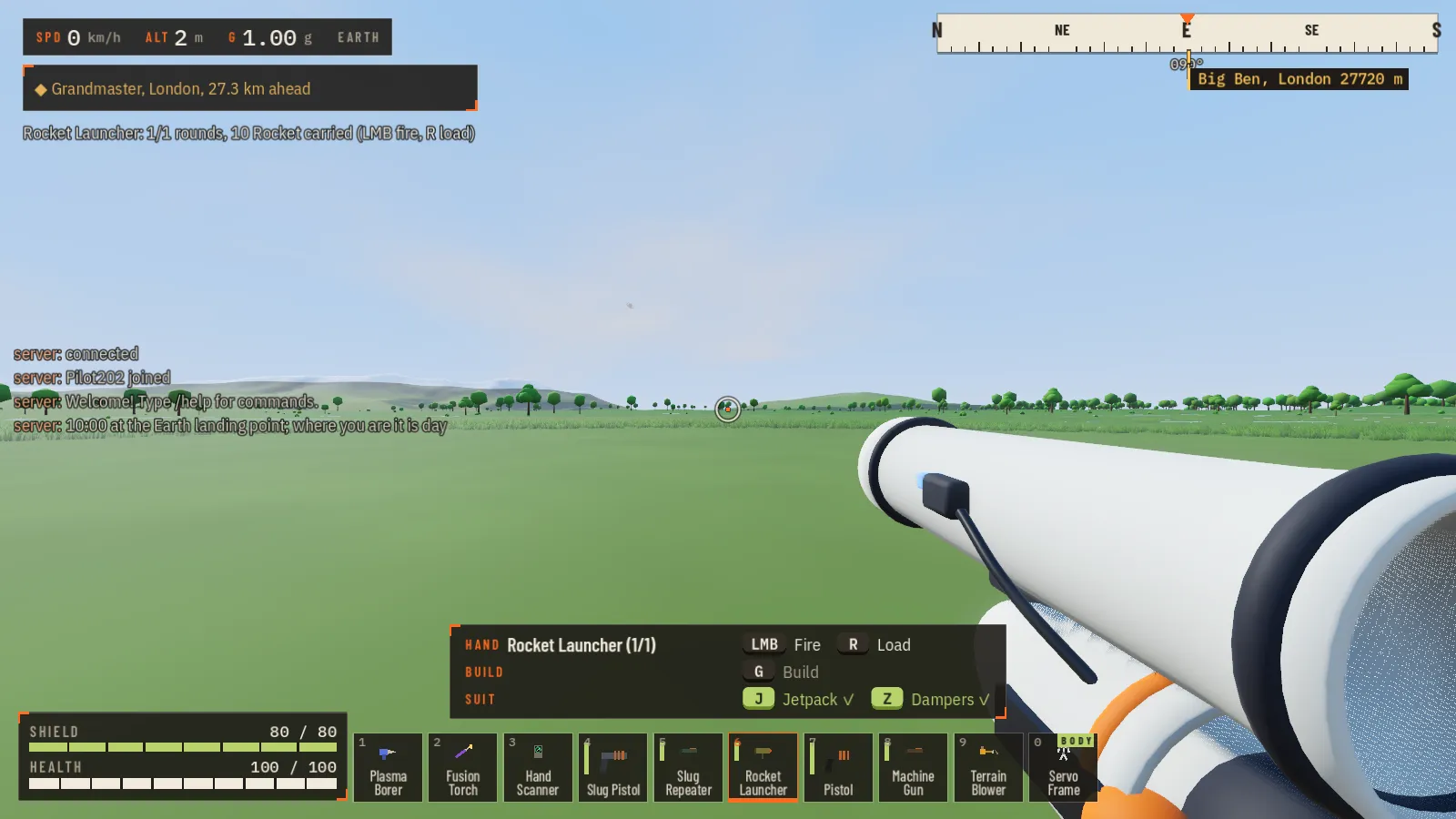
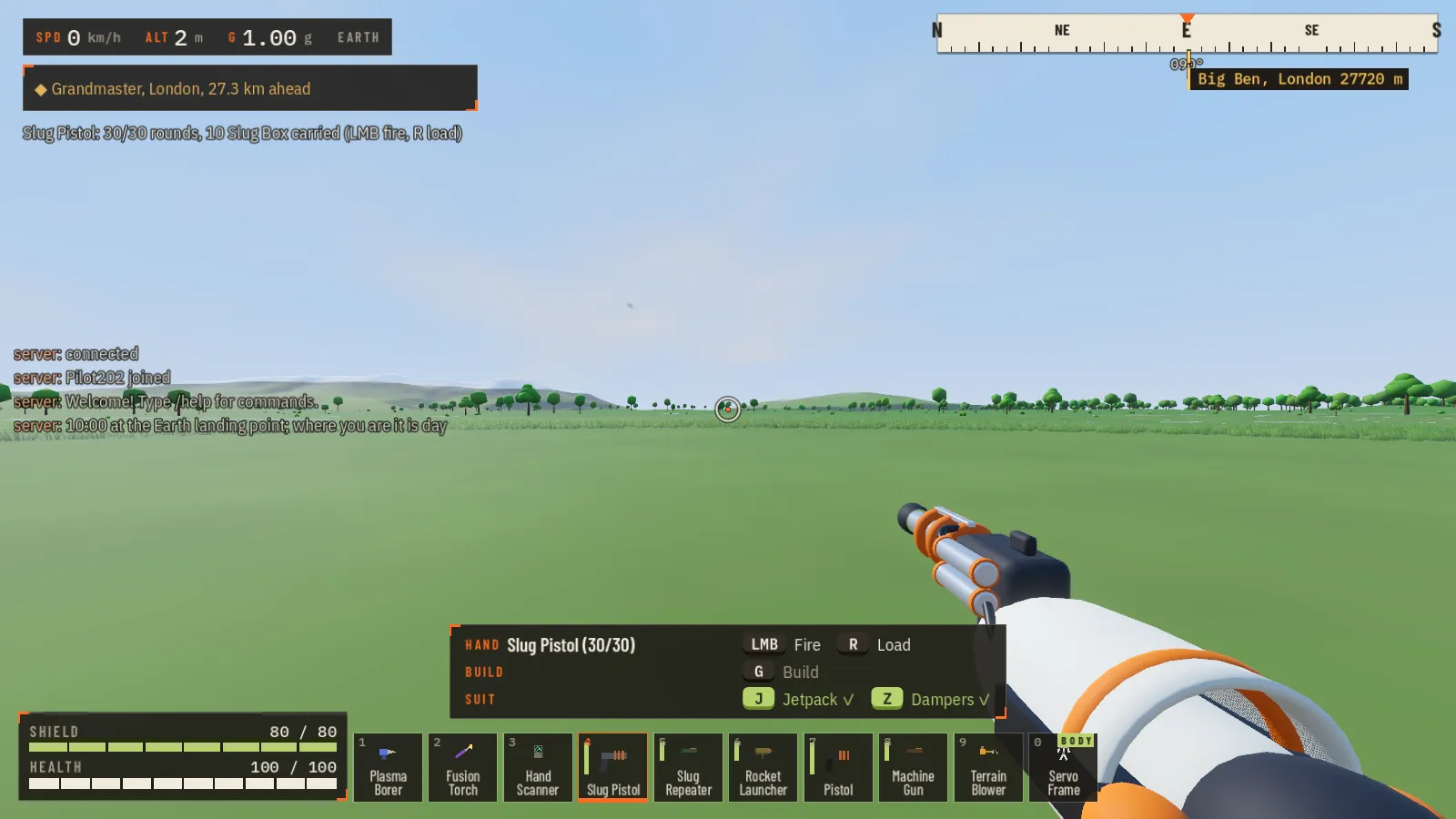
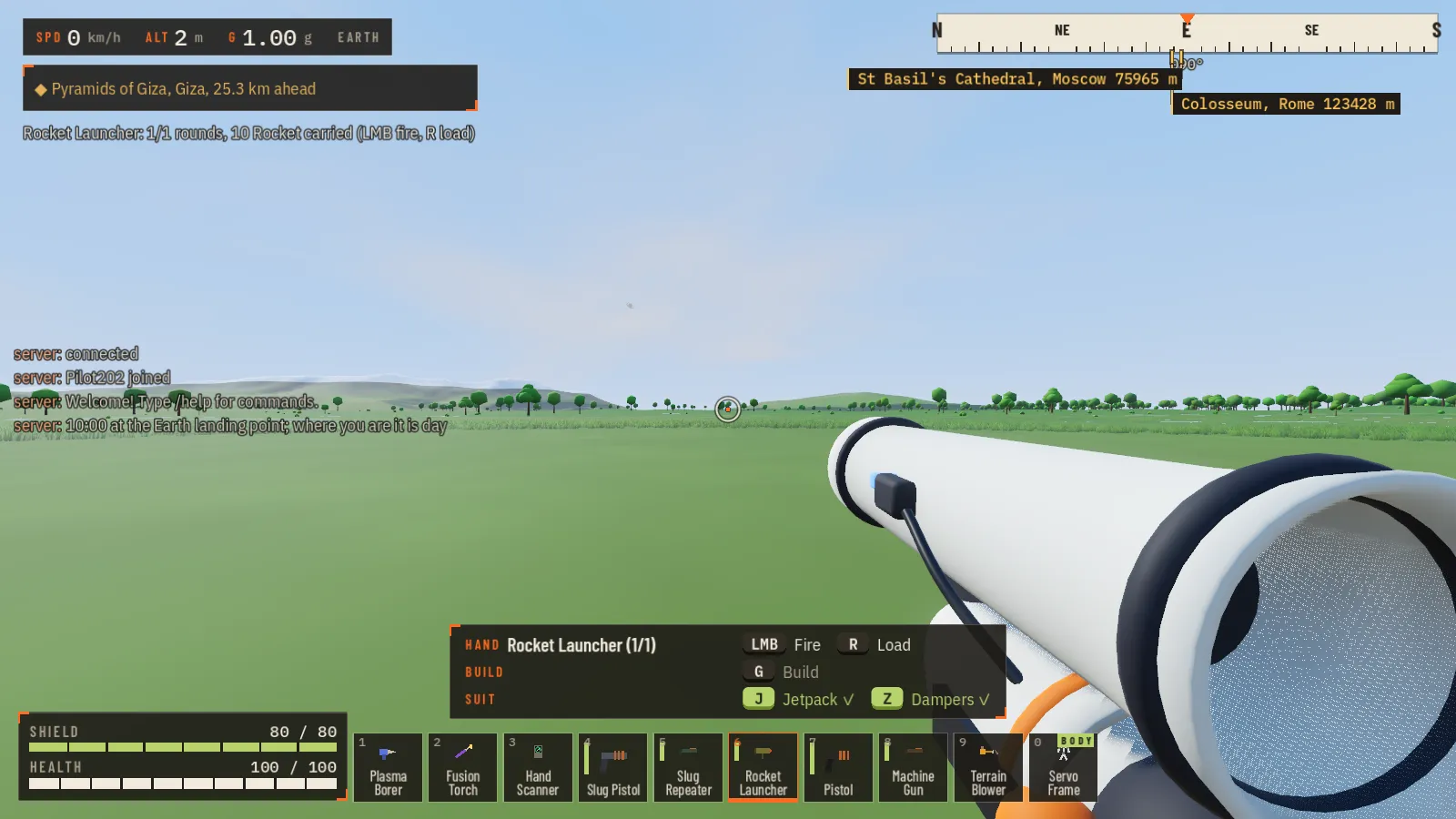
Three weapons a player carries and fires on foot (left button; R loads). (A round is fired from a point ahead of the eye, where the first-person arm holds the gun; it is drawn as leaving the mouth of the weapon held, the figure's in third person, easing into its true way over its first 20 m.) Like the ship's mass drivers they throw real balls of iron, the same shots: what they do is their energy, against a block's and its health, and on a player 8 health a kJ. A rocket is a heavier shot that bursts where it strikes. Rounds go where the crosshair is (aimed from the camera, as the ship's guns are); they kick the shooter back by their momentum. Since 2026-11-19 a round is aimed so that it gets to what the crosshair is on: over its fall under gravity on the way (a slug drops about a metre over 200 m) and less what one's own motion carries it (not a rocket: the launcher fires it straight along the line of sight, uncorrected); and the spreads are less than half what they were (the launcher ±0.05°).
| Weapon | Stage, made in | Round | Rate | Magazine, loading | What it is for |
|---|---|---|---|---|---|
| Slug Pistol | 0, workshop or assembler: 3 steel plate, a motor, 6 copper wire | 50 g at 450 m/s, 5 kJ (41 health), ±0.1° | 200 rpm | 30 (a Slug Box), 1.2 s | guard drones (8 hits on a sensor), machinery |
| Slug Repeater | 1, assembler: 6 steel plate, 2 motors, 16 copper wire, 2 glass, an aluminium frame | 30 g at 480 m/s, 3.5 kJ, ±0.4° | 600 rpm (35 kJ/s) | 90 (3 boxes), 2.4 s | several drones, light hulls |
| Rocket Launcher | 2, assembler: a pressure vessel, a nozzle, 4 steel plate, a circuit board | a 4 kg rocket at 110 m/s; bursts 5 m wide, 260 kJ at the middle | 40 rpm | 1, 1.6 s | armour, turrets, rock |
| Pistol (powder) | 2, assembler: 3 steel plate, a pipe fitting, a plastic | 40 g at 500 m/s, 5 kJ, ±0.12° | 300 rpm | 20 (a Cartridge Box), 1.3 s | as the Slug Pistol, faster |
| Machine Gun (powder) | 2, assembler: 6 steel plate, 2 pipe fittings, 2 plastic, a motor (needs a frame's strength) | 30 g at 650 m/s, 6.3 kJ, ±0.35° | 750 rpm (79 kJ/s) | 100 (5 boxes), 3.0 s | drones, light hulls, fast |
-
The powder guns (since 2026-11-20; tiers 4 and 5 of the hand weapons): the burning charge of a cartridge drives the bullet, no coils; the muzzle flashes orange and puts out a wisp of the shell guns' smoke (red-hot, then black) and a few sparks, and the bullet flies as a shell gun's round, an orange tracer. A Cartridge Box is 20 cartridges: an iron ore (the bullets), a copper ore (the brass) and a propellant (assembler, 2.5 s). In a sandbox both are on the hotbar (slots 6 and 7) with 10 boxes.
--autotest --powdergunstakes pictures. -
Rounds: a Slug Box is 1 iron ore (workshop or assembler, 2 s): 30 slugs. A Rocket is a steel plate, 3 graphite and a nozzle (the assembler makes two). Empty, a weapon loads itself from the inventory when the trigger is pulled; R loads it before then.
-
Neither slug gets through armour (30 kJ threshold): armour wants rockets or a ship's guns. A rocket bursts on what it meets, or after 4 s.
-
In hand: the figure holds it (first and third person), the muzzle flashes as it fires; a rocket trails smoke (from 6 m out, thickening over the next 6 m, so it does not cloud the view of whoever fired it). In first person the weapon lies along the line of fire (aimed at a point 20 m down the line of sight), and its rounds leave from its muzzle (0.29 m right, 0.28 m below and 0.9 m ahead of the eye) toward what the crosshair is on. Seen from outside, the figure holds its arm out straight, raised as far as it looks up or down. The weapons are worn on the forearm: a sleeve over its end (the hand inside) runs on into the weapon, which rides on top of the forearm as a gauntlet's (since 2026-11-19 a hand's breadth above its axis: from behind, as one sees it oneself, the sleeve no longer hides it; the launcher's tube higher still), so the weapon is the arm's continuation; in first person the arm is held straight along the line of fire, the wrist well out and to the right so the weapon's body shows. Each shows what it holds and runs on: the coil guns their capacitors along the inner side cabled to the coils and into the sleeve and their slugs (a magazine tube, the repeater's drum); the launcher a rocket's nose in its mouth and a spare strapped along its side; the pistol its magazine and spare rounds in loops on the sleeve; the machine gun a box of cartridges, its belt of brass rounds running into the feed. The tools too are models (since 2026-11-19): the borer a finned motor housing with two cells cabled to its collar and its spiral bit; the torch a gas bottle along its top with a hose to the nozzle; the scanner a sensor globe on a grip (since 2026-11-19 no handset): a bright globe with an orange band round its middle in a dark gimbal ring, a lens to the front ringed with sensor points that light up while it looks, two antenna stubs on top, a cell under the grip. (Models:
--handshotsshows them all, held.) The HUD shows the rounds in it and the boxes carried; the hotbar tile its magazine. -
/give slug_pistolgives one loaded.
#The bore rig Current
A block (stage 0: 4 girders, 3 motors, 6 steel plate, 8 copper wire, in the fabricator) for the ores the borers cannot reach. Built on a station over a deposit the scanner shows, with power (12 kW while it bores: a coal generator), switched on (E) it sinks a shaft 3 m wide straight down, 0.25 m a second, to 60 m under it, and keeps the ore the shaft goes through: 0.12 cube for every m³ of ore (stone hardly at all). A shaft through the middle of a deposit 10 m thick brings up some 10-15 cubes in a few minutes. Ducts take what it holds to an ejector or a container; with no way out it puts the cubes out on top of itself, for the player to pick up. It stops when it holds 20 cubes and at the bottom; taken apart (it goes back into a crate) and built again a few metres on, it sinks a new shaft. Its panel shows how deep it is and what it holds. Its head starts 3.5 m down: the ground over the shaft stays whole (the playthrough bot fell down an open shaft and died). It takes more than a coal generator gives (12 kW against 10): about a cube of coal a minute while it bores.
Why: most bauxite, all lithium, silver, cobalt, gold and neodym lie deeper than a Rock Borer reaches, and a drill tower (pistons stacked 5 m each) is a big build for the first hour. The rig is the step between: the first thing made in the fabricator that opens the next stage. Its shaft is also a way down for the player (it is a long fall).