#Day and night Current
A day lasts 40 minutes:
about 20 minutes of daylight and 20 of night, the same everywhere (the sun
goes round the whole solar system). An hour of the game's clock is 100 s.
/time <hour> sets the clock. Until 2026-11-16 a day lasted 10 minutes,
which made nights come too often for a start that runs on coal and digging
by hand. (A saved world keeps its clock in seconds, so after the change it
wakes up at a different hour.)
#Asteroids Currentsince 2026-11-21
Asteroids are voxel ground, like the Earth's and the Moon's: small bodies of it floating in space, each its own terrain body numbered after the planets. Everything that works on the ground works on them unchanged: the borer digs them, drills and bore rigs mine them, the scanner finds their deposits, landing gear holds on them, ships collide with them through mesh cells built near them, and what is dug is saved and sent to the players near by. (Voxels, not blocks: nothing is sent but what is dug, the clients deal the same rocks from the same seeds; they cost nothing until something comes near; and they are mined the way the ground is.)
- Shape (since 2026-11-21, second pass: they were all lumpy balls): one of three bodies, turned any way: a potato (an ellipsoid, long one way, flat another), a peanut (two lobes stuck together, a waist between) or a shard (a broken piece: 7 to 13 flat faces and edges). Over it knobbly ridged lumps (12-28% of its radius), bent about so that the outline wanders, grit, and two to seven craters with raised rims. No boulders, no plants, no water, no air, and no pull of their own.
- Ore: richer than a planet's ground and nearer the surface (a lattice of 20 m cells, a deposit in 22% of them, half of them showing at the surface, half the size of a planet's), and much richer in the scarce ores: cobalt x4, silver x3, gold x4, neodym x5; little coal (x0.3) and quartz (x0.5). Some 18 deposits to a rock, a third of them scarce ores.
- Fields (dealt from fixed seeds):
- Near-Earth rocks: 18 rocks, 10 to 240 m across (most of them small, spread evenly over the scale), and one giant 460 m across near the middle; 30 km over the ground some 40 km off the landing point, spread over 8 km. In the Earth's pull (0.46 g): things fall past them toward the Earth; one stands on their side away from it.
- Arena rocks: 12 rocks, 16 to 280 m across, round the arena (beyond the Earth's pull, 0 g), spread over 5.5 km: cover for the fights. Kept clear of the middle and of where the ships go out (the Battle Royale rings and the Team Fight lines of every class).
- Survival: the first time a player is 8 km up, their suit picks up the asteroid field (an "Asteroid field" place on the compass, shown however far off); it is found within 3 km of its middle.
- Seeing them: the client draws the asteroids within 25 km (each its own octree of chunks, as the planet's ground), beside the nearest planet. By the giant: some 480 meshes, 0.9 million triangles, 42-51 fps.
- Collision warning (all flying, since 2026-11-21): seated in a ship
moving faster than 25 m/s, the client looks ahead 8 s along its course
ten times a second: the ground of the nearest planet and of the
asteroids (marched along the course, a few dozen steps from kilometres
off; dug holes left out), and every other grid of 6 blocks or more
(where the bounding spheres come together at the speed one closes on
it, five rays through its blocks to be sure; grids touching the ship
left out). On course to hit: a red card ("COLLISION COURSE: an asteroid
in 4.4 s at 274 m/s: turn or brake"), an "IMPACT 4.4 s" mark where it
would be, and a low beep, quicker the nearer it is.
/asteroids run: a fighter 2 km off an arena rock, flying at it at 300 m/s. /asteroids(Demo parks: Asteroid field) takes one out over the biggest rock near the middle of the field in Earth orbit;/asteroids arenato the arena's.
#Mining rates Current
Mining is slow on purpose: each better tool is a real step up. Constants (the borers) and (ship's drill).
| Tool | Cuts | What one cut keeps | In solid ore | In plain stone |
|---|---|---|---|---|
| Rock Borer (the better borers: see Gear) | every 0.5 s (the server allows no faster), a ball 0.6 m in radius (0.9 m³), within 4 m | 0.06 cube per m³ of ore, 0.03 per m³ of stone | a cube every ~9 s (fresh ground; cutting where it has cut already gives less) | a cube every ~18 s |
| Ship's drill (block) | 10 a second, a ball 1.6 m in radius in front of it, 8 kW | 0.02 cube | a cube every 5 s | a cube every 5 s |
| Rock Borer on an ore block (the ore wall) | as the Rock Borer | 20 kJ off the block's 120 | a cube every 3 s (6 cuts) | — |
No crumbs left hanging (since 2026-11-24; the user: "very low volume pieces left... make sure those disappear with their last bigger chunk they attach to"): every dig (borer, ship's drill, blast) clears away the ground it leaves cut off near it (, so the server and every client do the same). Round what the brush reaches (4 m) further, the solid ground next to the hole is followed face to face on the 1 m lattice; what reaches the edge of that box is still on the ground, what does not is a piece on its own (a sliver, a crumb, a pillar cut at its foot) and becomes air with the dig. It gives no ore: there is next to nothing in it. Pieces bigger than that box (some 20 m across for the biggest brush) are not looked at.
A ship's drill holds 3 cubes until ducts take them to an ejector; full, it keeps ore and lets stone go.
What that means early in a survival game: the first assembler (2 concrete, 2 steel plate, a motor, 2 copper wire) takes 4 iron, 2 coal, 2 copper and 6 stone, about 3 minutes of hand drilling; the first fabricator (4 concrete, 4 girders, 4 motors, 8 copper wire) about 20 iron, 10 coal, 8 copper and 12 stone, about 9 minutes. Changed on 2026-11-16: the hand drill used to cut 8 times a second and keep about 7 cubes a second in solid ore; the ship's drill gave 0.5 cubes a second.
#Survival milestones Current
A survival game is played along a ladder of 25 milestones in four chapters
(checked by the world every 2 s). They
are goals, not locks: nothing is withheld until one is reached. The HUD shows
the next one and how to reach it (GOAL n/25, its chapter, a hint), chat
announces each one reached to everybody, and /progress lists them all with
what each costs in ore. The world keeps them (saved); everybody in it shares
them. /progress set <key|all> marks some reached (for tests).
| # | Milestone | Reached when | Ore it takes (about) |
|---|---|---|---|
| Landfall (stage 0) | |||
| 1 | Spark | a generator burns coal | 4 coal |
| 2 | First steel | a steel plate is made | 2 iron, 1 coal |
| 3 | Sidearm | a Slug Pistol is made | 8 iron, 4 copper, 3 coal (and 3 iron of slugs) |
| 4 | Assembler | an assembler stands | 4 iron, 2 copper, 2 coal, 6 stone |
| 5 | Fabricator | a fabricator stands | 20 iron, 8 copper, 10 coal, 12 stone |
| 6 | Drill rover | a vehicle with wheels, a seat and a drill | 45 iron, 13 copper, 23 coal |
| 7 | Drone down | a guard drone shot down | 3 iron of slugs |
| 8 | Salvage | something taken out of a wreck's hold | — |
| 9 | Deep bore | a bore rig sunk 10 m | 30 iron, 10 copper, 15 coal |
| Industry (stage 1) | |||
| 10 | Glass and aluminium | glass and an aluminium frame made | 8 quartz, 8 bauxite |
| 11 | Turbo Borer | made | 7 iron, 3 copper, 6 coal, 2 bauxite |
| 12 | Water works | water pumped into a tank | 14 iron, 8 copper, 7 coal, 4 bauxite |
| 13 | Hydrogen | an electrolyser fills a tank with hydrogen | 14 iron, 5 copper, 11 coal, 6 bauxite |
| 14 | Jetpack | a jetpack with hydrogen in it | 11 iron, 2 copper, 10 coal, 2 bauxite |
| 15 | Slug Repeater | made | 16 iron, 8 copper, 5 coal, 4 quartz, 2 bauxite |
| 16 | Hopper | a craft with thrusters or rockets flown 50 m up, its pilot in it | 61 iron, 38 copper, 31 coal |
| Petrochemistry (stage 2) | |||
| 17 | Plastic | plastic out of a refinery | 22 iron, 13 copper, 11 coal, 6 bauxite, 6 stone |
| 18 | Circuit boards | made (with a refinery standing) | 3 copper, 4 silver, 80 l oil |
| 19 | Solar base | solar panels and a battery on a station | 36 quartz, 12 silver, 12 bauxite, 8 lithium (6 panels, 2 batteries) |
| 20 | Rocket Launcher | made | 18 iron, 26 coal, 2 bauxite, 1 silver, 20 l oil |
| Space (stage 3) | |||
| 21 | Space | a player 10 km above the Earth | the hopper will do (electric thrusters work in vacuum), and 40 coal for its generators |
| 22 | The Moon | a player standing on the Moon | — |
| 23 | Rare ore | cobalt, gold or neodym in hand | — |
| 24 | Plasma Borer | made | 2 cobalt, 1 gold, 2 neodym, 1 silver... |
| 25 | Ion ship | a player seated in a ship with an ion drive | one drive: 2 neodym, a gold; a real ion ship (6 drives, batteries, panels): 54 quartz, 24 lithium, 22 silver, 12 neodym, 6 gold... |
All of it together is some 1000 ore cubes (330 iron, 230 coal, 150 copper,
100 quartz, 70 bauxite, 40 silver, 30 lithium, a few of the rare ores) and
240 l of oil, and some 30 minutes of machine time: the costs are worked out
from the recipes (cargo test -p shared print_milestone_costs -- --ignored --nocapture prints the table). Coal to
burn comes on top: a cube runs the workshop 400 s, an assembler 200 s.
How long it should take (a first game, one player): Landfall about an hour and a half to two, Industry about an hour and a half, Petrochemistry an hour and a half to two, Space two hours: some seven hours in all (the bot's run below took 7 h 33 min). What a player does most is find and dig ore, so each chapter brings what makes the next one's ore come faster:
| What speeds it up | When | What it does |
|---|---|---|
| The assembler | milestone 4 | makes components twice as fast as the workshop, and all of them |
| A drill rover | 6 | a ship's drill on wheels: surface ore four times as fast as the borer |
| Salvage | 8 | plates, motors and circuit boards out of the wrecks (a stage early) |
| The bore rig | 9 | the deep ores (bauxite, then lithium, silver, the rare ones) without a drill tower |
| The Turbo Borer | 11 | half again as fast a cut, half again as much kept, 35 m deep |
| The Servo Frame | after 11 | walks 40% faster, carries twice as much |
| The jetpack | 14 | over the land in a straight line, out of pits |
| Belts, ejectors, cargo | any time | the rig's ore straight to the assembler |
The playthrough bot. cargo run -p sim --release --bin playthrough -- --out DIR plays a survival game the way a player does (it scans for ore
within 120 m, walks there, digs at the borer's own rate, carries what it
digs, puts it into the machines, picks up what they make, builds from
crates, fights the drones) and logs the game time at which it reaches each
milestone; DIR gets a save at each one. tools/record_episodes.sh DIR OUT
loads every save in the real game (off-screen, muted) and records a short
clip of it. Its runs are what the numbers above were set by (see below).
#The build tree Current
O opens the build tree: every ore, component and block (by each one's usual recipe), in columns from the ore on the left through the components (by how many steps they are from the ore) to the ends on the right: blocks, and gear nothing else is made of, by stage (Landfall, Industry, Petrochemistry, Space). A line runs from each input to what it goes into. Each tile shows how many you hold and, along its bottom, how far along one of it is: the share of its raw ore already in hand, as ore or made into its parts (what you hold is used from the top down: a motor in hand is not made again). Green: held, or all its ore is; amber: part of the way. Click a tile: its whole chain lights up (down to the ore and up to what is made of it), and the side panel shows its recipe, where it is made, what it goes into, and what making one takes from what you hold, step by step, ending in what is still to be mined. It counts the inventory only, not what lies in containers. A search box finds a tile.
#The bot's playthrough (2026-11-18)
One unbroken run of the playthrough bot (seed 7, --out), game time at
each milestone (episodes of each):
| # | Milestone | At | # | Milestone | At | |
|---|---|---|---|---|---|---|
| 1 | Spark | 0:01 | 14 | Jetpack | 3:02 | |
| 2 | First steel | 0:06 | 15 | Slug Repeater | 3:12 | |
| 3 | Sidearm | 0:10 | 16 | Hopper | 3:43 | |
| 4 | Assembler | 0:20 | 17 | Plastic | 4:14 | |
| 5 | Fabricator | 0:50 | 18 | Circuit boards | 4:06 (salvage's boards, once the refinery stood) | |
| 6 | Drill rover | 1:36 | 19 | Solar base | 5:24 | |
| 7 | Drone down | 1:49 (10 pistol rounds) | 20 | Rocket Launcher | 5:34 | |
| 8 | Salvage | 1:50 | 21 | Space | 6:34 | |
| 9 | Deep bore | 2:16 | 22 | The Moon | 6:39 | |
| 10 | Glass and aluminium | 2:25 | 23 | Rare ore | 6:44 | |
| 11 | Turbo Borer | 2:30 | 24 | Plasma Borer | 7:17 | |
| 12 | Water works | 2:49 | 25 | Ion ship | 7:33 | |
| 13 | Hydrogen | 2:49 |
Chapters: Landfall 2:16, Industry 1:27, Petrochemistry 1:50, Space 2:00: 7 h 33 min in all. Of that it walked 232 min, dug 138, waited on bore rigs 33, on machines 25 and flew 24. It walks everywhere (it never drives the rover or flies the jetpack across country), so a player should be faster where the bot walks; it also knows where every deposit lies within reach of the scanners, so a player new to the game will be slower where the bot digs. It was shot dead once by the second guard drone of the wreck it salvaged.
What its runs found, and what was changed for it (all in the sections above): the start rover's scanner burnt coal for nothing; guard drones ran their batteries flat and fell; a player standing behind a machine stopped its output without a word; empty crates filled the inventory; stone filled it the rest of the way (the bot ended one run with 340 stone and nowhere to put the iron it dug) and could not be thrown away; the deep ores (most bauxite, lithium, silver, the rare ores) had no way up short of a tower of stacked pistons (now the bore rig), whose open shaft the bot then fell down; a solar panel took four silver; on the Moon the suit's air could only be had back in a seat. The bot also showed the space chapter needs care, not a rocket: the hopper (four thrusters, two coal generators) climbs out of the air under 150 m/s, crosses to the Moon at 1.5 km/s in five minutes, and comes home steeply and slowly enough not to burn.
#The bot's playthrough (2026-11-20)
Seed 7 again, on the build of 2026-11-20 (the walk shapes, the capsule, strength for heavy tools, the scanner with the borer, radar), all 25 in 6 h 59 min (7 h 33 min the day before):
| # | Milestone | At | # | Milestone | At | |
|---|---|---|---|---|---|---|
| 1 | Spark | 0:01 | 14 | Jetpack | 2:42 | |
| 2 | First steel | 0:06 | 15 | Slug Repeater | 2:47 | |
| 3 | Sidearm | 0:11 | 16 | Hopper | 3:06 | |
| 4 | Assembler | 0:20 | 17 | Plastic | 3:28 | |
| 5 | Fabricator | 0:47 | 18 | Circuit boards | 3:24 | |
| 6 | Drill rover | 1:27 | 19 | Solar base | 4:11 | |
| 7 | Drone down | 1:37 | 20 | Rocket Launcher | 4:16 | |
| 8 | Salvage | 1:37 | 21 | Space | 4:59 | |
| 9 | Deep bore | 2:00 | 22 | The Moon | 5:04 | |
| 10 | Glass and aluminium | 2:08 | 23 | Rare ore | 5:09 | |
| 11 | Turbo Borer | 2:13 | 24 | Plasma Borer | 5:46 | |
| 12 | Water works | 2:31 | 25 | Ion ship | 7:00 | |
| 13 | Hydrogen | 2:31 |
Chapters: Landfall 2:00, Industry 1:06, Petrochemistry 1:10, Space 2:49. It walked 164 min, dug 146, bored 53, waited on machines 30 and flew 27. Industry and Petrochemistry came quicker than the day before (the Turbo Borer's scanner finds the deep ores at once); Space took longer, all of it the last milestone: neodym for the ion drives, bored out of three deposits on the Moon (the nearest within 1.5 km ran out).
Seed 11 played all 25 as well, in 7 h 43 min (Space at 5:24, the Moon 5:30, the Ion ship 7:43): its start lies on the far side of the Earth from the Moon, and the flight there goes up and over the curve of the planet.
What the runs found and what was changed (the bot, not the game): it called a walk done standing 30 m down its own pit under the machine (arrival now wants the height too); building a bore rig sent it to bore for the rig's own copper, round and round with no time passing; it held the Turbo Borer before it had the Servo Frame's strength to; it gave up a deposit bored out short instead of going on to the next; what a machine put out was pushed out of its reach; with the Moon behind the Earth it flew straight at it, through the planet (now over the curve, at some 20 km), and came home faster than a hopper brakes in air. And one bug in the game: a craft on coal generators alone, its load once at nought, had a power share of nought, so its thrusters asked for nothing and never started again: it fell (lit generators count as supply). Seen once and not again: a pump that stayed dry at a lake shore (the next run's pumped at once).
#Wrecks and guard drones in survival Current
A new survival world has three wrecks 250 to 700 m from the start in different directions: a shuttle, a ship and a drone as they lie after a crash, each with a hold of salvage (10-30 steel plates, 2-8 motors, 1-6 circuit boards, a crate of thrusters) and a projector with its blueprint, and two guard drones circling over it. The HUD tells how far the nearest one is and which way, until a drone is down and a hold salvaged. The guard drones go for whoever comes within 70 m (16 health a hit). Near their wreck (within 150 m) they draw on its power core and never run down; a sensor shot out (40 kJ: 8 pistol slugs) blinds one, and it counts as down.
#Survival threats Currentsince 2026-11-20
What the world sends against its players now and then:
each is told ahead in chat and on the HUD's warning card (what, when, how
far and which way), marked on the compass, and each is something the
tools answer. The level is per world: /threats off|calm|normal|hard
(calm: half as often; hard: 1.6 times as often, bigger), and each kind on
or off: /threats <storms|lightning|meteors|air|ground|space> <on|off>.
New survival worlds are on normal. /threats now <kind> [near] brings one
at once (tests, showing it).
| Threat | From | Every (normal) | What answers it |
|---|---|---|---|
| Storm | always (weather) | a third of the Earth's rain spells | land, lock landing gear: wind (20 m/s, gusting) pushes what flies and stands loose |
| Lightning | in a storm | 8-25 s near each player out in it | a lightning rod takes it (and charges the batteries); shields take a strike (400 kJ); indoors one is safe |
| Meteor | Assembler | 22-40 min | told 60 s ahead with the place; shot to pieces in the air nothing lands |
| Raider drones | Drill rover | 28-45 min | guns, turrets; told 45 s ahead |
| Armed rovers | Bore rig | 35-55 min | guns, walls, turrets |
| Alien ships | Space | 25-40 min | ship guns, rockets; only for a player 3 km or more over a body |
- Storms: in survival a share of the Earth's rain is a storm (calm a fifth, normal a third, hard half): heavy rain, the sky grey and dark, wind from one quarter (with gusts, as the air is thick). The wind presses on a hull's side as on a wall; a light craft is blown off.
- Lightning strikes the highest thing near a player (the higher, the likelier), else the ground some way off (150 m - 1.2 km). A block struck takes 120 kJ (its neighbours a fifth). A lightning rod (a block: Power; a steel plate and six copper wire) within 120 m of where it would strike takes it instead (the highest rod): nothing is hurt, and the batteries of the rod's construction take 1.5 MJ (the emptiest first). A rod up over a base protects it, and a storm charges it. A player out in the open struck takes 30 health (only once the Assembler stands, and not on calm: a new player has no roof yet).
- Meteors come down near the base (normal 150-270 m off; hard 70-190 m), burning, at 260 m/s, and burst. They come in four sizes: small (crater 4 m across its rim's radius, 2 m deep, 4 cubes of meteorite), medium (7 m, 3.5 m deep, 7), large (12 m, 5.5 m, 12), huge (18 m, 8 m, 20); mostly small or medium, larger the further the world and the harder. The crater is dug into the ground: a bowl, deepest in the middle, with a rim of what was thrown out. The meteorite is ore strewn round the crater: plain ores early, then silver and lithium, then cobalt and gold, then neodym. The crater is on the compass until somebody has been there.
- Raids come for a player's base (the biggest station within 250 m of them; with none, the player) from 0.9-1.3 km off: drones fly in 25 m up and attack players first, then big constructions (40 blocks or more), then the base; rovers (light armour) drive in and do the same from 30 m off; alien fighters (the arena's bot pilots) go for every craft near their target. How many grows with the chapters reached (drones 1 + the chapter, rovers 1 + half of it; hard one more, at most 6). A raider brought down drops salvage (plates, motors, circuit boards; alien ships rare ores) and, one in four, a paint store. After 6 minutes those left go home.
- Nothing comes before the Assembler but weather; each kind's first time comes after half its usual wait.
#Places worth going to; paints as rewards Currentsince 2026-11-20
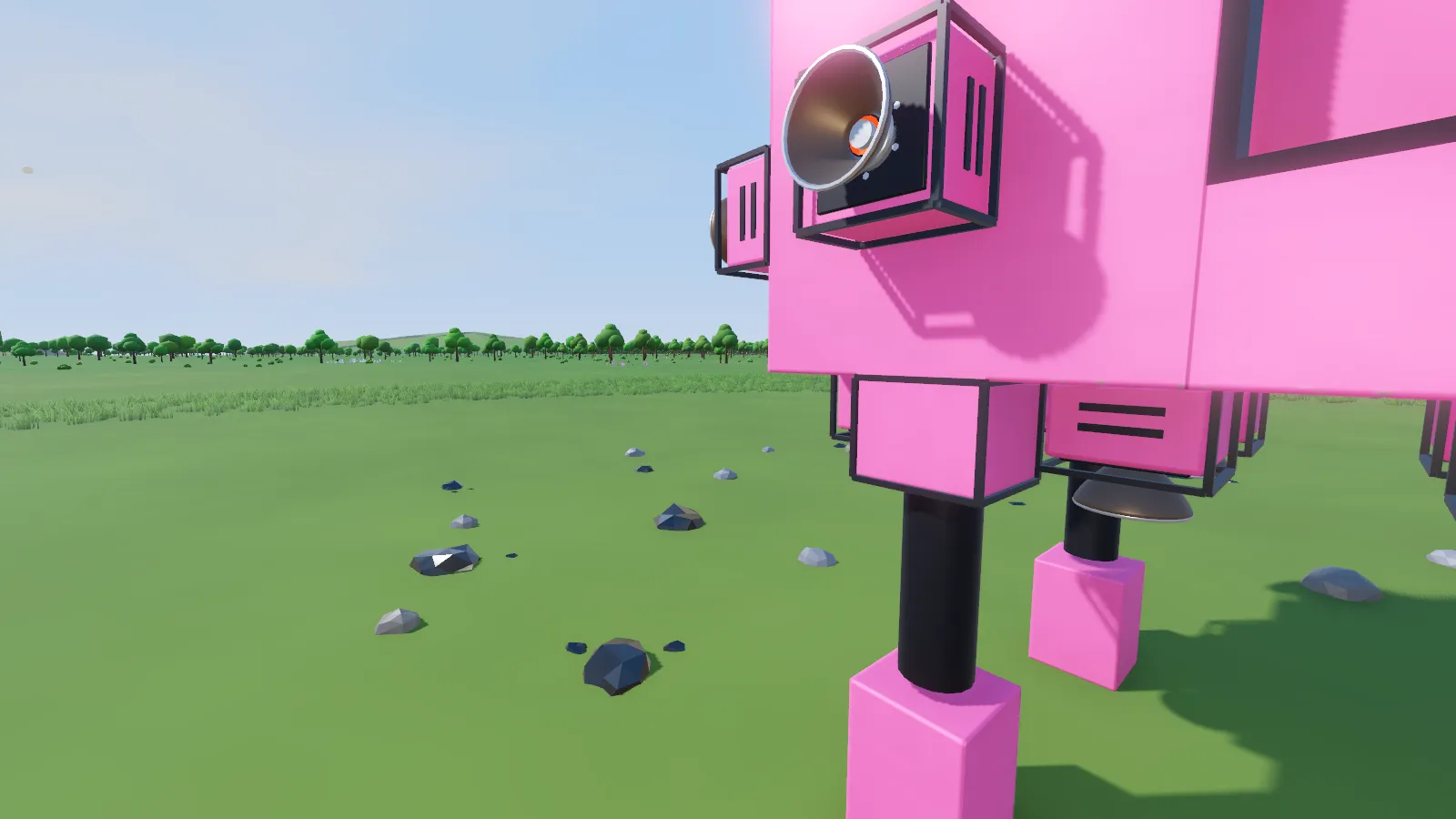
. A new survival world has, further out than its wrecks, an alien wreck (1.1-2.2 km: a raider scout down, guarded by two drones; its hold has circuit boards, gold and neodym) and two supply caches (0.8-2.4 km: plates, motors, circuit boards, solar panels). Every 30-50 minutes a player's suit picks up a new signal: another wreck or cache 1.2-3 km off. Meteor craters and the paint stores raiders leave are places too. All show on the compass (amber) and the nearest on the HUD.
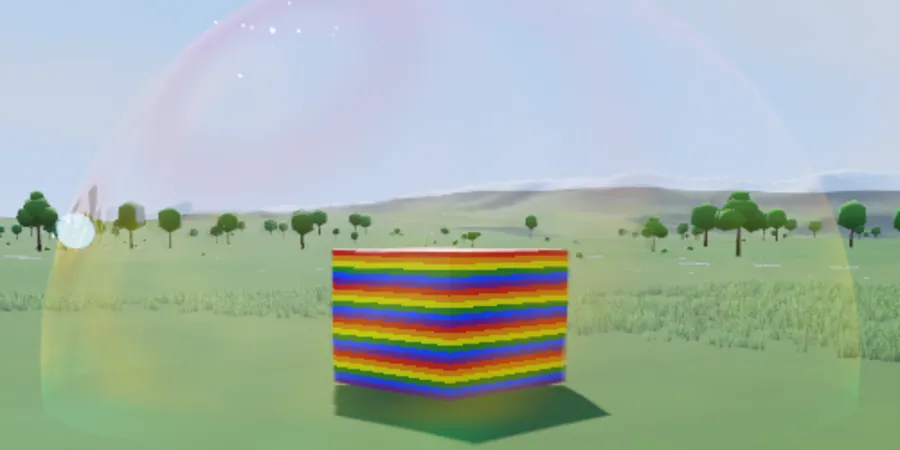
Paints are the reward. In survival the plain colours (white to pink) are there from the start; the metals and finishes (sparkly, silver, gold, chrome, pearl, chameleon, holographic, galaxy, carbon, neon grid... 21 of them) are found: one at each alien wreck, cache and paint store, the first time a player comes within 10 m of it. Found, a paint is the world's for good (saved); Y in build mode cycles through those found only. The raiders wear chameleon. Rainbow (since 2026-11-24; findable so, the last paint in the list but not a challenge's): the six stripes of the rainbow (pride) flag, red over orange, yellow, green, blue and violet, the whole flag on every block, front (red) to back (violet) along its own depth; a shield generator painted it shows the flag's six bands over its field, red at the top to violet at the bottom. Planned: challenges in towns that give paints, locked recipes and trophy blocks (see "Places that belong, streets, and challenges").
#The teleporter: the way home Planned2026-11-22
The end of a survival game: the robot goes home by a teleporter (the lore: the machines left the Earth for a home of their own; Headquarters cannot send a ship). Proctor names it only once the robot sees far (an antenna, a radar, a scanner built); before, the way home is left open.
- Made of what lies on the Earth and on Mars: the last chapters' gathering takes the robot to Mars.
- It has to be charged for the jump: an enormous amount of energy, which the robot builds the power for (generators, solar fields, fuel cells), stored up and fed in over time; when it is full, the jump.
- Not built yet: no block, no recipe, no milestones for it. The ladder's last goal is still the ion ship; when every goal is reached Proctor says what is left is the teleporter and the power to charge it.
#Derelicts and guard drones Current
/derelicts (and the demo parks): three wrecks ahead of you, ships as
they lie after a crash (a quarter of their blocks gone, the rest battered,
their computers dead), each with a hold of salvage on top (steel plates,
motors, circuit boards, a crate of thrusters), and two guard drones over
the nearest ore deposit 150 m off or more: they circle 10 m over it; whoever
comes within 70 m of them (and stays within 110 m of the deposit) they go
for, keep 20 m off level with them, face and shoot (0.1 kg at 200 m/s, 30
rpm: some 16 of a player's 100 health a hit). Each wreck has a blueprint
projector with the ship as it was built (see Blueprints).
#Ore runs out Current
A deposit is ore in the ground, so digging it takes it away. The scanners
now say how much is left: the hand scanner's markers ("230 m³ left (64%)"),
the ore scanner block's panel (a bar for each deposit), and scripts
(scanner.deposits: ore, position, distance, depth, had, left
in m³). A drill site therefore has a lifetime: it is worth what is left
under it (counts it on a 1 m lattice, again only when the
ground round it was dug since).