#Artificial gravity Currentsince 2026-11-20
A gravity generator (block, Control) gives its ship a floor: down is the block's own down (turn it to choose which way the floor is), 1 g, over its ship's box and 3 m round it, while it runs and has power (30 kW).
- It holds a player only once their feet are on something in its field (or as they get out of a seat on its ship with the jetpack off), and lets go while they fly with the jetpack (or leave the field): one flies freely by a ship, and lands on it to walk. Held, one stands up along its up and walks, jumps and falls on its floor, inside and out on the hull; a fall onto it hurts as a fall does.
- Landing on its floor: coming down on the jetpack onto a floor that faces the generator's up (in its field), the jetpack switches off and one walks there (only as one comes down on it: taking off from it with J, the jetpack stays on).
- With the ship frames (below), one keeps one's feet as the ship speeds up or turns: the Voyager under full thrust to 225 m/s, its crew stands where they stood.
- Walking is against the ship's frame (as the dampeners are).
- The client predicts with it and turns the camera to its up.
- One's view turns with the ship (in its frame or its gravity): as it
turns, so does the way one looks, so the ship does not seem to turn at
all; only the mouse turns one about on it (
--autotest --viewtest: the ship turning at 20°/s, one's view on it moves 0.0°). - Out of a seat, the camera's swing round the ship (Shift) is gone; V (into or out of third person) always puts the view back behind one, at the distance last chosen (on foot and in a seat each its own).
/spin <degrees a second>: the ship one is in or by turns about its up (its gyroscopes; 0 lets go).- The warships carry one (down their deck's down). The Voyager
(
/testspawn voyager,/testspawn voyager space seated) is a small ship to walk in: a cabin 5 by 3 by 13 m with a flat floor, the bridge at the bow behind windows, a bunk, lamps, a hatch (two doors) in the stern wall, the gravity generator, gyroscopes and batteries under the floor, solar panels on the roof, two large engines at the stern and small thrusters all round.--autotest --gravitytest(with the renderer): out of its seat, aft along its cabin, and standing still under thrust.
#Moving with one's ship Currentsince 2026-11-20
Out of the pilot's seat in space, a player close to their ship moves with it: it speeds up, slows or turns, and they keep their place by it, as if it carried them; they fly about it with the jetpack, and the dampeners stop them by it, not in space. So one can get out to mend something while it flies on, and get back into the seat.
- The frame: the nearest moving ship (10 blocks or more) whose box comes within 12 m of the player, kept until they are 25 m off; out of a seat, that ship at once. Only in space (gravity under 1 m/s², or, since 2026-11-26, over the air, where nothing hovers: a station in orbit, falling round the Earth with one): by a planet in its air a hovering ship's thrust holds it up, and a player would float beside it; there its floor carries one, as before.
- The jetpack's dampeners hold one at the frame's velocity as it will be after the step, against the pull one feels against the frame (gravity less the frame's own acceleration). (Since 2026-11-26: they held one at its velocity before the step, against all of gravity; by the ISS, 7 m/s² pulling both, one lagged a step behind and drifted off at 0.24 m/s.)
- How: the ship's acceleration at the player's place (its turning too) is a push on the player before the physics step, so that a floor under them does not push twice; after the step the ship's move (as it really went) carries the point the player was at, and their own motion against the ship is turned with it. Under 41 m/s² of thrust, and round a ship turning a radian a second, a player keeps their place to the millimetre.
- Players have no speed cap (see the moon elevator); the HUD's speed is the speed in the world.
- The client is told the frame (the ship, one's place
in its frame, one's velocity against it) and predicts the player in it,
and draws them where the ship is drawn: no shaking against the ship.
--autotest --frametest(with the renderer): out of a Warden's seat as it speeds up hard (600 m in 6 s), one's place against its bridge as drawn moves not a millimetre from frame to frame. /thrust <0..1>: the main engines of the ship one is in or by (its gyroscopes holding it straight; 0 lets go)./testspawn <class> space seatedputs one in its cockpit. F gets one out.- The frame shown (since 2026-11-24): on foot in a
ship's frame (by it in space, or held by its gravity), a line under the
readouts, "⌖ IN BASTION'S FRAME · 3 km/h against it" (the ship named
after its cockpit), and thin pale-blue corner brackets round the ship as
seen, held inside the screen (a ship one is in or against, filling the
view, puts them at the view's corners). Coming into a frame both are
bright for a moment, then settle quiet; leaving it, the line says "LEFT
BASTION'S FRAME" and fades. In a seat, nothing (the readouts are the
ship's).
--autotest --frameshotsphotographs it.
#Orbits Current
Gravity is the strongest body's, falling off with the square of the distance out to six radii: round a planet an orbit is a two-body problem, and it works. It needs speed (round the Earth 20 km up some 690 m/s: an orbit takes 13 minutes), which grids have: see below.
- Scripts:
orbit()(the body, its mu and radius, altitude, speed, radial and level speed, eccentricity, semi-major axis, periapsis and apoapsis heights, period, the round orbit's speed, the change of velocity that makes it round here,up,ahead; vectors in the grid frame),orbit_map(n)(points round the orbit and where the grid is, in the orbit's plane, to draw),hohmann(alt1, alt2)(the two burns and the time between them). /orbit [body](and the demo parks): a satellite going round 20 km up, the player in its seat. Its computer keeps the orbit round and moves it to another height when told ("alt 30000"): a burn onto the transfer orbit, a coast to its far end, a burn to make it round there. The screen in front of the seat draws the planet, the orbit, the target height and where the satellite is.
#No cruise mode: speed without a limit to speak of Current
There is no cruise mode any more. Grids go as fast as their engines take them, up to 10 km/s (the physics engine's own limit of 400 m/s is raised to it); players have no cap (the air's drag holds them in air: see the moon elevator). Continuous collision detection, which keeps a fast grid from passing through what it meets between two steps (and costs), is on for a grid faster than 20 m/s only while something could be met within the next 10 steps: another body, the ground or a planet within as far as it goes in that time and its own size. Far out in space at 3 km/s it is off; skimming the ground it is on. (X no longer does anything; old saves load, their cruise flags ignored.)
#Atmosphere: drag, heat, parachutes Current
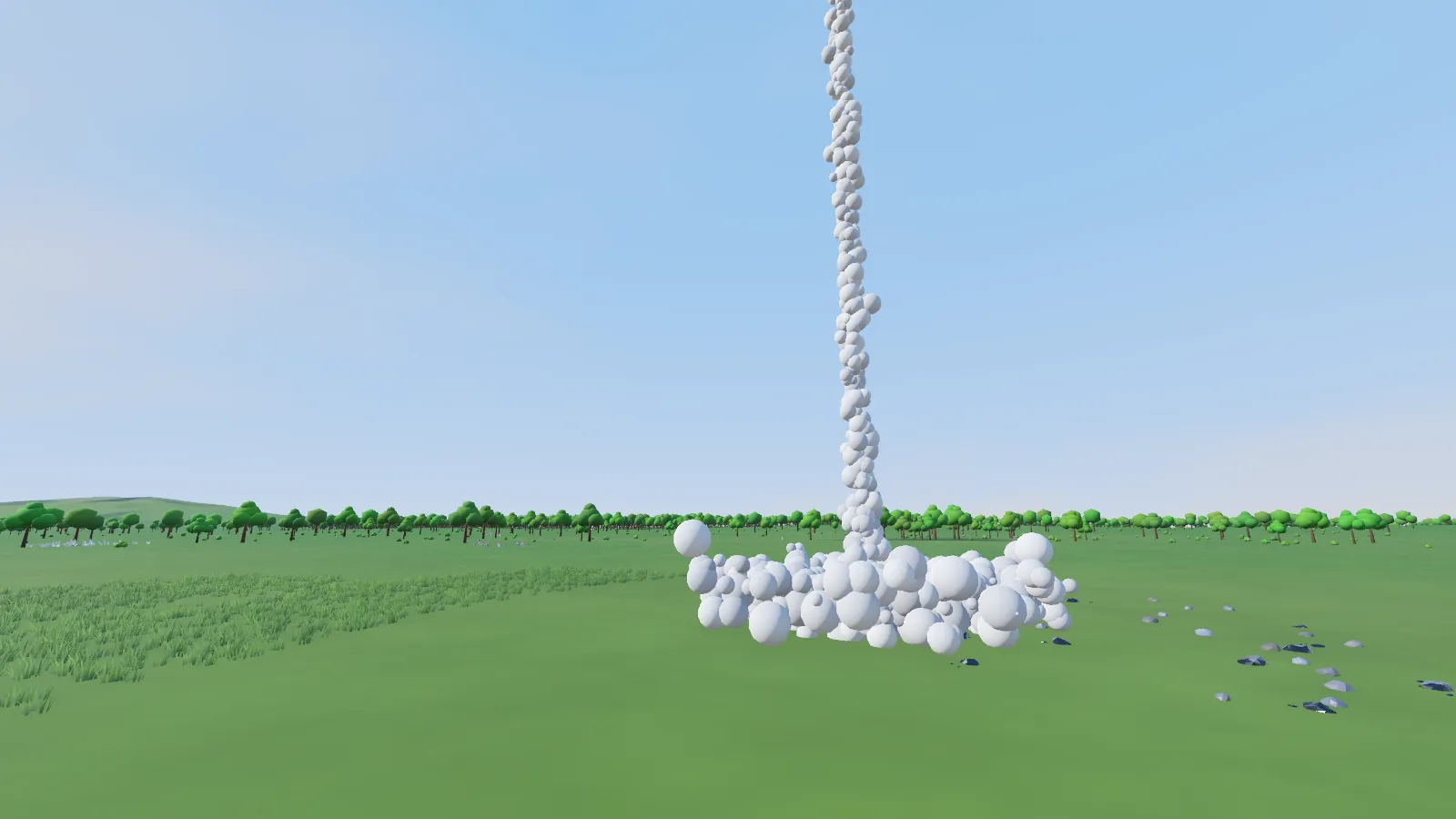
- Drag: in air a grid feels ½ρv² times its size (its block count to the two thirds, m²) times 0.3, against the way it goes (ρ: 1.2 kg/m³ at the Earth's ground, thinning to nothing 6.4 km up). Slow it hardly matters; a small craft falling from 2 km reaches some 100 m/s.
- Heat: going fast through air a grid heats (2.5e-8 ρv³ a second) and
cools (half its heat a second); over 1 the blocks at its front, the way
it goes, burn (60 kJ a second for each 1 over, with sparks). Flying at
150 m/s near the ground it stays at a fifth of that; coming in from orbit
at 700 m/s into thick air it burns: come in shallow and slow down high up.
Scripts read
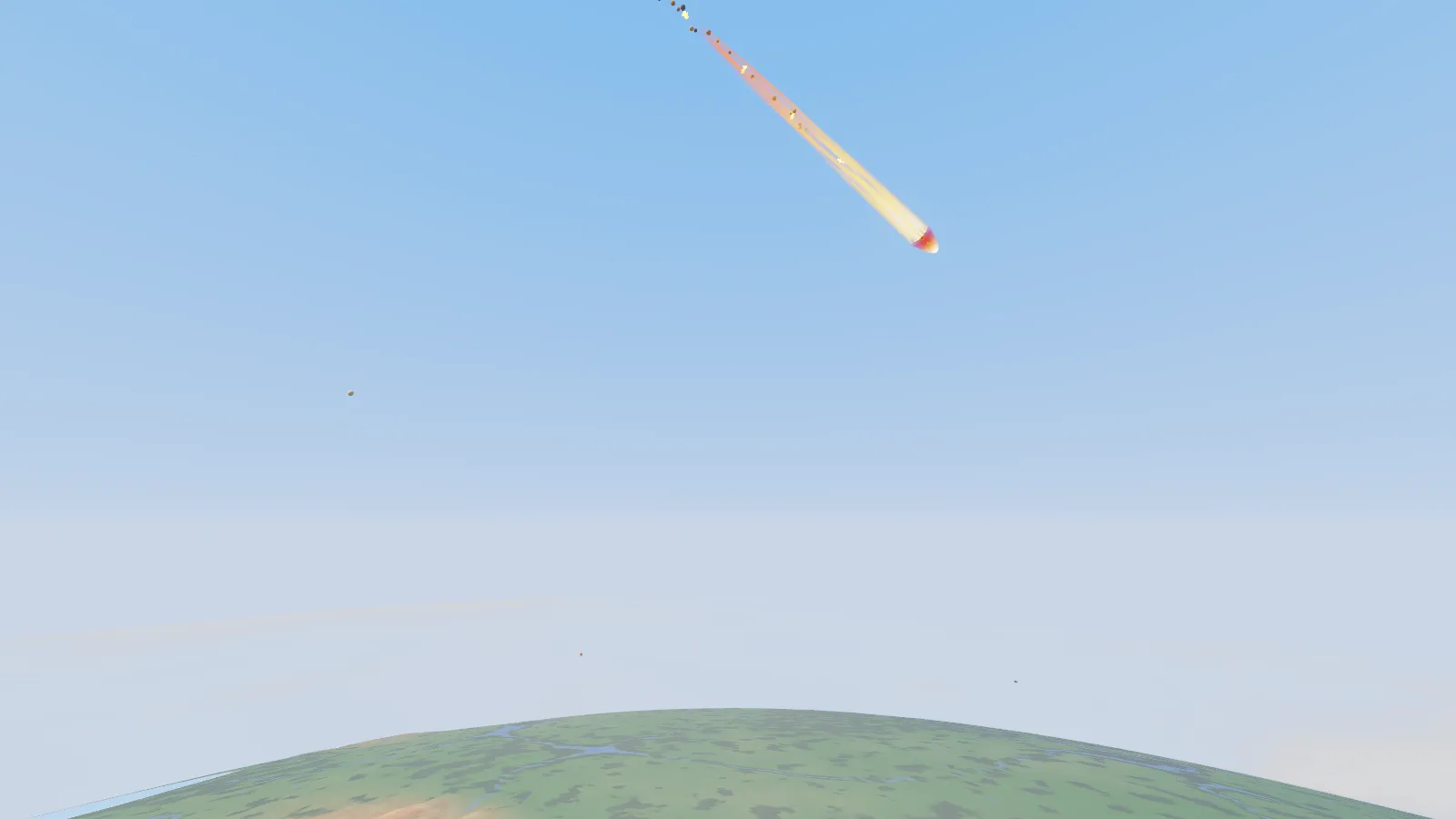
grid.heat. Something burning trails fire and smoke (a fireball at its front, the bigger the hotter, every sixth of a second). Hot from the air it wears plasma, a soft glow rather than fire: a sheath hugging its front, salmon-pink with a hot white nose and a violet rim, shimmering; a faint wake behind fading from pink through violet to blue; and, burning hard, a few glowing embers shed behind it. - Heat shield tiles (carbon fibre and superalloy, light, weak against
shots) burn twenty times slower than other blocks. The air burns only
the front of a grid, so a ship tiled on the side it comes in on burns
only its tiles, slowly, and the blocks behind them not at all: fly in
shield-first. Burnt through, what is behind burns.
/reentry(and Demo parks) shows it from a deck 3 km up: five runs let go one after another (some 9 s apart, each named in chat as it is let go, coming at the deck from far ahead and high up, passing 200 m to its left 5 s later): a ship at 220 m/s passes unharmed; a 5 m lump of armour at 900 m/s burns to nothing; a ship at 800 m/s burns up; the same ship at the same speed, its nose tiled with two layers of heat shield, comes through whole (and, its engines off, falls on); and a dreadnought at 800 m/s (some 5000 blocks) burns down to a last few blocks before it reaches the ground. Anything hot from the air is tagged with its speed and heat (orange, BURNING, over 1). Seen from the outside, anything the air heats glows: a cone of plasma at its front and a trail tapering behind it, orange to white-hot, the longer and brighter the hotter (from a little under burning heat), and drawn bigger far off, so that something burning up shows from kilometres away. - Seen from space the Earth shows land and sea where they are on the ground (from a map baked from the terrain when the game starts; see Oceans): its continents, islands and seas, deserts, ranges and polar ice, green land and forests, turquoise shallows, the seas glinting in the sun. A body with air has a glowing rim (blue, reddening where day meets night) and a faint tint over its disc; the Earth has clouds (half its sky, drifting slowly; 2.5 km up, seen from below too), Venus is all cloud.
- The other bodies from space (since 2026-11-21) look as they do in
photographs of the real ones (NASA/ESA pictures as the references):
- The Moon keeps its near side toward the Earth: from the Earth one sees the real near side, its seas (Imbrium, Serenitatis, Tranquillitatis, Crisium, Fecunditatis, Nectaris, Nubium, Humorum, Oceanus Procellarum, the thin Mare Frigoris) dark on the bright highlands, the rays of Tycho, Copernicus, Kepler and Aristarchus, and craters all over (fewer on the seas). It is lit as airless dust is: a full moon is bright out to its edge.
- Its ground has the craters too (the ground one walks and lands on, the same on every machine): the seas are low level plains of old lava (some 30 m below the highlands) with low wrinkle ridges and few craters; the highlands are crowded with craters from 4 km across down to a few metres, small ones deep bowls, big ones shallower with level floors, terraced walls and central peaks, old ones worn shallow, young ones bright round about. Its great craters are where they are on the real Moon, a hundredth of their real size (Tycho 850 m across and some 90 m deep, terraced, with its central peak; Copernicus, Kepler, Aristarchus, Plato's dark flooded floor, old Clavius, Ptolemaeus, Alphonsus, Arzachel, Theophilus, Langrenus, Petavius, Grimaldi and some 30 more). The hills and mesas the bodies share are half as high there. (Worlds saved before 2026-11-21 keep their digging on the Moon against the new ground.)
- Mercury: grey, crowded with craters, darker bluish regions, the paler Caloris basin, long bright rays.
- Mars: rust red, its dark lands (Syrtis Major, the band of Sabaeus and Meridiani, Erythraeum, Acidalia...), the bright basins Hellas and Argyre, the Tharsis volcanoes and Olympus Mons, Valles Marineris, and its ice caps where they lie on the ground.
- Jupiter: cream zones and brown belts in turbulent streaks, the Great Red Spot, white ovals; Saturn in faint butterscotch bands, with its rings (C, B, the Cassini division, A with the Encke gap, F), the planet's shadow on the rings and theirs on the planet; Uranus pale cyan and plain; Neptune deep blue with its Great Dark Spot and bright streaks of high cloud. Their bands lie round their real tilted poles (Uranus on its side), and they show no glowing rim.
- The bodies are lit by the sun wherever one looks from, so the full moon shines over the Earth's night side; the Moon in the Earth's shadow goes dark (an eclipse).
- The ground of the Moon, Mercury and Mars takes its colours from the same map: standing on a mare one stands on dark ground.
- The night sky (and space) has faint nebulae among the stars: violet, teal and rose clouds, thickest along a band across the sky (the galaxy's plane), with darker lanes of dust; daylight hides them as it hides the stars.
- Parachute (block): packed until deployed (its panel, in scripts); open in air it adds 250 m² of canopy (drag 1.3): two bring a 4 t lander down at some 8 m/s. Opened faster than 100 m/s it tears (pack it again to mend it).
- How an open parachute looks (since 2026-11-22; before, a grey squashed ball that never showed: the block's node was dropped): a cluster of three ringsail canopies as Orion's main parachutes are (a dome of eight rings of 24 gores, a vent in the crown, slots between some rings, white rings with orange stripes at the crown and orange and white checks below, a few dark blue panels), 11 m across, each on 16 lines 18 m long to a 3 m riser on the canister, splayed apart. Opening (1.8 s): the lines pay out as streamers, then the canopies bloom, a little past full and back. Open, they breathe and sway, and trail the way the air goes past (straight up when slow). Torn: small and flapping. Packed again (the capsule standing), they fall in and lie over sideways (1.6 s).
#Wings, propellers and steering by weight Current
A wing block is a thin aerofoil (its chord along the block's forward axis, its lift toward its up), 1 m². In air it lifts square to the air going over it: 0.5 ρ v² A CL, CL 5 a rad of angle of attack up to the stall (16 degrees), past which it lifts much less (0.9 sin 2a); and drags (0.02, the drag of its lift, and 1.2 sin² a when the air strikes it flat). Wing blocks joined (side by side along their span, through a fuselage of up to 3 blocks between them; one behind another along their chord; facing alike) are one wing: drawn as one aerofoil as deep as they are together, and the drag of its lift goes as CL² / (pi 0.8 A), A its aspect (span over chord): a long slender wing makes its lift for little drag, a lone block for much. Each wing pushes where it is, by the air there (the craft's turning counts), so a tailplane behind the centre of mass steadies it. Wings are not counted in the hull's drag. A propeller pushes forward in air (14 kN at a standstill at the ground, less in thinner air), the less the faster the air comes at it (none from 140 m/s); it takes 0.5 W a newton.
A craft with wings flies on them: its dampeners do not brake it (the air
does), and on its wheels the pilot still pitches and rolls it, to lift off.
Steering, its wings are control surfaces (see the flight mode below),
free, but only with airspeed. So the
runway a plane needs follows from its weight, wing and thrust (the Skylark:
see below; with a 9 m wing it barely gets off a kilometre of runway, and
cannot climb). /airfield (and
Demo parks) puts a Skylark at the start of a 1200 m runway.
The cockpit's flight mode (its panel, FLIGHT) says how it flies what it is on: SPACESHIP (thrusters every way, dampeners, gyroscopes and the cockpit's own steering; Q/E roll), GROUND (it drives on its wheels; nothing turns it in the air), PLANE (it flies on its wings: the mouse pitches (elevators) and rolls (ailerons), A/D yaw (rudder), Q/E do nothing; thrust only forward and back; no dampeners and no hold; the cockpit has no steering of its own: its control surfaces turn it, and its gyroscopes if it has any; on the ground A/D also turn its nose wheel (the wheels ahead of the middle of its wheels), so it steers while taxiing, too slow for the rudder, and Space brakes) or ROCKET (thrust only along it, W/S; the mouse and Q/E steer with its gyroscopes). Each wing serves the one axis its lift turns the craft about most (an aileron rolls, an elevator pitches, a rudder yaws); its control surface changes its camber (up to 0.5 more or less lift coefficient, without bringing the stall nearer), and is seen to move. A main wing (an aileron) is cambered: it lifts as if set 4 degrees nose up, so a plane flying level holds itself up; tailplanes and fins are symmetric. Flown hands off, the Skylark rides a gentle swell (down a few degrees and up again) and climbs on at full power; a second's full stick lifts its nose some 15 degrees, or banks it some 40.
In a plane the mouse moves a stick that stays where it is put (so a climb or a bank can be held) and eases back to the middle while the mouse rests; the HUD shows where it is. The controls are soft round the middle (x 0.3 + x³ 0.7): small moves of the stick make small corrections, all the way out the surfaces turn fully.
A plane flies with a stability assist on its control surfaces (free, but it needs airspeed like them): it damps its turning (pitch and yaw at 2 stick per rad/s, roll at half that, so the ailerons stay brisk); while the stick does not roll it rolls the wings back level (1.2 stick per rad of bank), and while it does not pitch it eases the nose to stop it climbing or sinking (0.04 stick per m/s). The pilot's stick comes first. Hands off, the Skylark settles into level flight; a second's full stick lifts the nose some 10 degrees or banks it some 23, and let go it comes back level. The Skylark (13 m of wing, a tailplane of 6 blocks) leaves the runway after some 230 m at 35 m/s; with 9 m of wing, some 370 m at 40 m/s.
The planes (since 2026-11-21: the Kestrel and the Pelican are gone; /airfield [skylark|swift|condor|albatross], or /spawn).
/airfield (Demo parks: Airfield) lays a 1200 m runway (600 m before 2026-11-22) with the trees felled
32 m either side of it (room for the Albatross's wing) and puts the plane
named at its start; the others stand parked in a row on the grass 60 m to
its right, facing down it, each with a boarding stair.
| Plane | What | Mass | Engines | Off the runway |
|---|---|---|---|---|
| Skylark | a little trainer, white and blue: a 13 m straight wing | 1.7 t | a propeller in the nose | ~120 m at 36 m/s |
| Swift | a business jet, white with a red stripe: a low swept wing 18 m across, a T-tail | 12 t | 2 jets on the rear fuselage | ~170 m at 53 m/s |
| Condor | a cargo plane in the shape of a C-17, grey: a fat hold with a ramp under an upswept tail, a high wing 40 m across, a T-tail | 41 t | 4 jets in pods under the wing | ~340 m at 53 m/s |
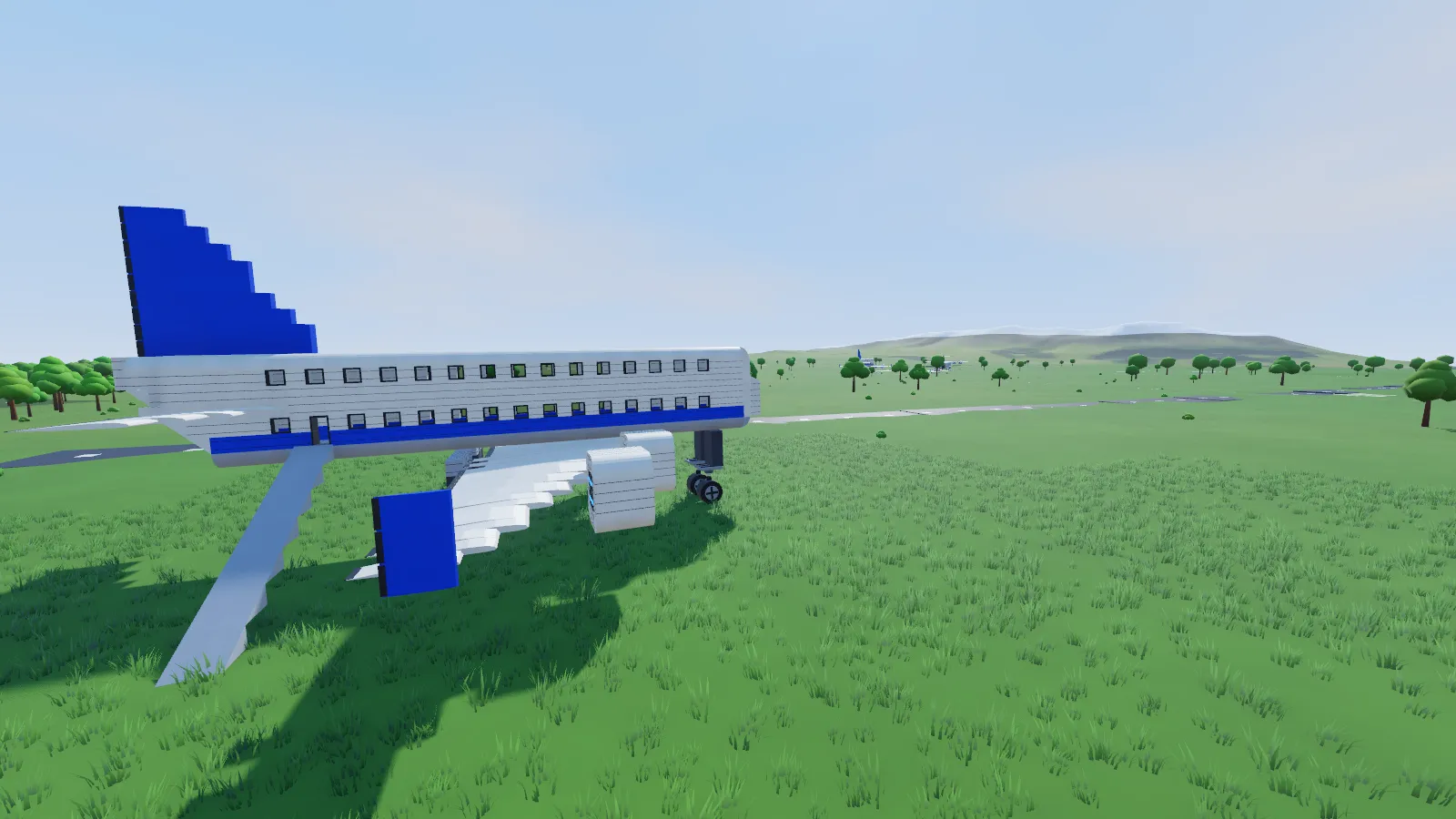
| Albatross | a double-deck airliner in the shape of an A380, white with a blue tail: two decks of windows, a low swept wing 52 m across with winglets, a tall fin | 72 t | 4 pods, a large jet (2 m) in each (since 2026-11-22; before, 2 small jets each) | ~90 m at 47 m/s; settles at ~153 m/s level at full power (was ~110) |
(2026-11-22: a big block's neighbours are found round all its cells, not only its corner (fuel, ore, pipes). A large jet's tanks touch it behind, away from its corner: it was in their network or not by the order the blocks were looked at, so engines dropped out at random. And a boarding stair goes one step further down than the ground seems to need: a foot sunk in the ground is walked onto, one a little over it is a wall.)
How the jets are built:
- Jet pods. A jet engine 1 x 1 x 1 in a cowling of light armour 3 across, so that it looks the size of an airliner's engine. The fuel is in the fuselage (since 2026-11-23: before, the tanks sat behind each jet in its pod): the Albatross has 16 tanks in its lower deck's floor over the wing root, the Condor 8 in its hold's floor; the jets burn from them through the wing their pods hang on (see "Fluid goes through the hull"). Small jets in pods rather than large jets: four large jets (960 kN) gave the Albatross more thrust than it weighs and, hung 4 m under its centre of mass, tipped it onto its tail; the Swift's thrust is about its weight, the Condor's 0.6 of it, the Albatross's 0.7 (it drags a lot).
- The wing's place balances it. A swept wing lifts behind where it starts; each wing is set so far forward that, hands off at full power, the plane holds its height (the stability assist does the rest): 4 to 5 m forward of where it first was, all three had sunk 5 to 10 m/s, nose down.
- The main wheels are put from the centre of mass once the rest is built: 1 m behind it on the Swift, 1.5 m on the Condor, 5 m on the Albatross. Nearer, the Albatross, with little weight on its nose wheels and a big tailplane, rotated at 20 m/s under the test pilot's full stick, struck its tail and slewed off the runway; at 5 m it keeps its nose down until 45 m/s, as an airliner does. Its nose wheels are large ones too: small ones under the nose's load left it sitting nose down.
- Getting in (since 2026-11-21): each jet has a door either side, two high, behind its wing (the Albatross's on the lower deck, the Condor's into the hold, the Swift's behind its engines; the Swift's fuselage is 4 high for an aisle 2 m high), and an aisle clear to the cockpit (batteries in the floor; the Albatross's pilot sits on the lower deck behind windows in the nose). At the airfield each gets a boarding stair: a static grid of its own up to its right-hand door, which is opened: one in two (a slope tip and a half slope a metre: a ramp of whole slopes, one in one, is a wall one cannot walk up), two wide, its top at the sill, its foot on the ground (as far down as the ground is there). Behind the wing, the plane rolls away from it; only its tailplane, high over it, passes it. The planes are spawned at the height they rest at (measured), the one on the runway on the runway piece's top, so the stair fitted at once meets the sill. Tested: up the stair, through the door, along the aisle, into the cockpit, and off past the stair and the parked planes. The parked row stands 60 m to the runway's right (at 46 the Albatross's wing tip met the Condor's).
- Nothing hangs on nothing: the main wheels had been put behind the wing, where nothing was over them; they stayed on until the first block taken off anywhere made the grid look for its pieces, and fell away. Where nothing is over a strut, a beam now runs in to the fuselage (a belly fairing).
- Flown: a second of full stick back lifts the nose 7 degrees (Swift 8), a second of full stick right banks it 14 degrees (Swift 28), and each comes back level by itself. Tested: (ignored) prints how each flies.
Their main wheels stand behind their centre of mass, so that they rotate on
them; an elevator works twice as hard as an aileron (it has the whole plane
to turn).
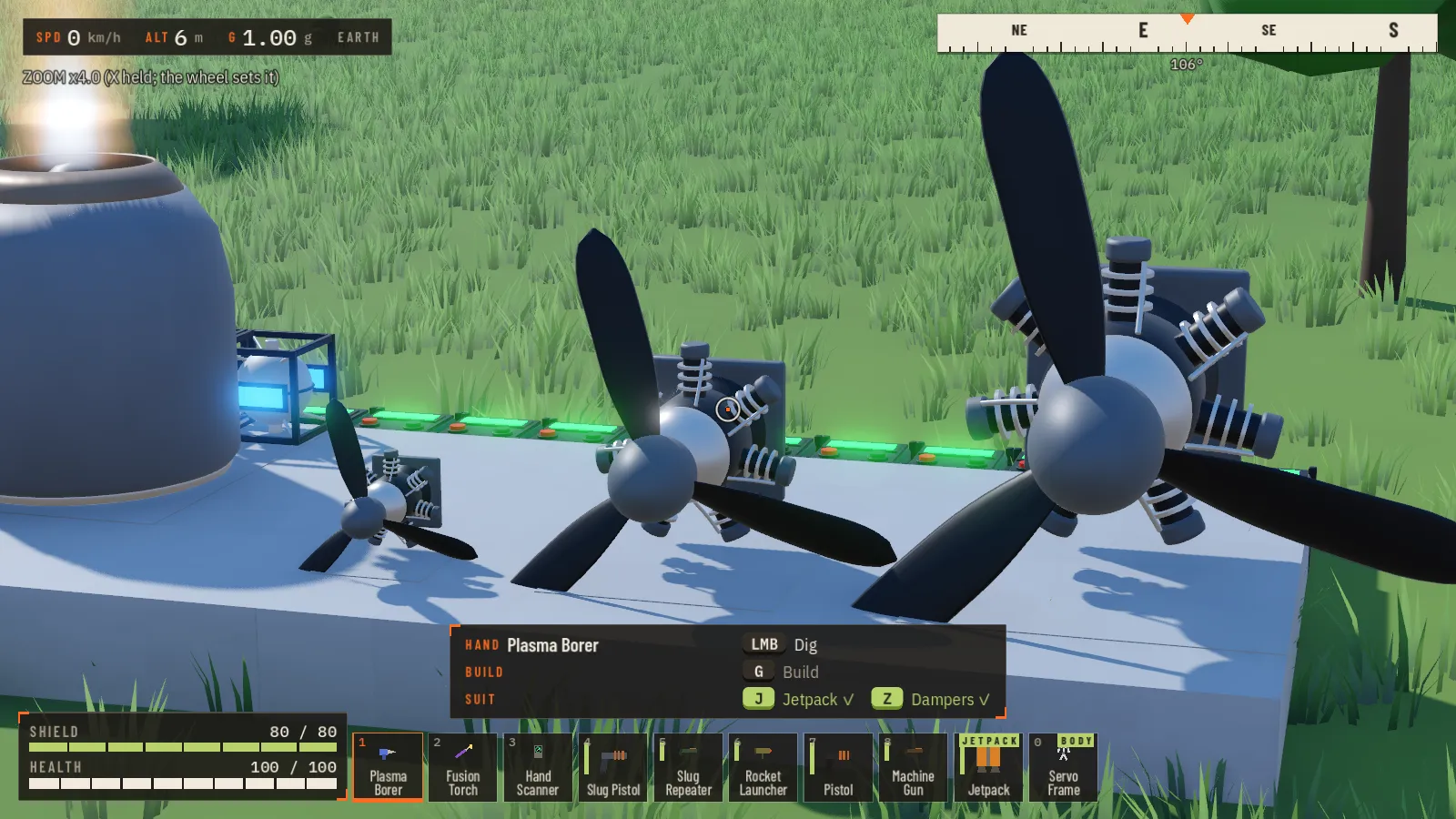
A propeller gives 14 kN (fading out at 140 m/s), a large propeller
(2 blocks on a side) 30 kN. Since 2026-11-22 a propeller's block is drawn as a
radial engine, kept plain (propeller): a mounting plate, a
round crankcase, seven finned cylinders with their heads in the block's
paint and a pushrod to each, a polished bolted dome in front with the
shaft to the spinner; every size the same, scaled.
Steering is torque. A gyroscope gives 2 000 000 N m, the cockpit's own 20 000 N m; how fast a craft turns follows from its inertia (its blocks' masses and how far they are from its centre of mass), so heavy and long craft turn slowly and want more gyroscopes. A gyroscope takes power as hard as it works (4 kW at full torque, 0.1 kW idle). (The cruiser and the dreadnought carry 44 each, the gunship 2.)
#Seeing ships in space Current2026-11-20
In space the sun lights one side of a ship and leaves the rest black, and a dark ship is lost against the starfield. Four things help:
- Fill light: out of the air the ambient light is brighter (+1.0) and tinted as the starfield and its nebulae (a cool blue-violet), so a shadowed side reads dark grey, not black.
- Rim light: every block glows softly where
its surface turns away from the eye (a fresnel term cubed), cool as
starlight, outlining a ship against the black; its strength is the global (
project.godot), which the client sets from the air round the camera (0.3 in space, none under a thick sky). - Running light: a ship (a grid that moves, with a cockpit, 12 blocks or more) carries a small white strobe on its top, as big on the screen however far, blinking a tenth of a second every 1.6 s (each ship its own beat): it shows a ship far off before its hull does. (Red and green ones at its ends, and the Hornet's coloured wingtip lamps, were too strong: taken off.)
- Tracked: a ship one's radar tracks has its rim in the radar's red,
stronger (the instance uniform
tracked, set on its parts as the radar's picture changes), so the target stands out among ships.
#The Hornet: a fighter that flies by its thrusters Current2026-11-20
. With the dampeners the ship's own thrusters, the stock fighter is lopsided: its two large engines push it ahead at 182 m/s², while it brakes, slides and dives at 2.7 (from 100 m/s it takes 36 s to stop, and a turn runs on 0.65 s after the stick is let go). The Hornet has small thrusters every way and its weight close in:
| Stock fighter | Hornet | |
|---|---|---|
| Blocks, mass | 177, 22.3 t | 184, 19.7 t |
| Thrust ahead / astern / sideways / up / down (m/s²) | 182 / 2.7 / 2.7 / 16 / 2.7 | 15 / 9 / 6 / 9 / 9 |
| Full turn rate (69°/s) from rest, and stopped again | 0.13 s, 0.65 s | 0.13 s, 0.08 s |
| From 100 m/s to a stop on the dampeners | 36 s | 11 s |
Its cockpit sits forward on a low rounded nose with nothing ahead of it or beside it at eye height (the stock fighter's canopy is a window block, painted, that fills the first-person view); its guns (4 light, 2 heavy, as the stock fighter's) are in the wings, 2 m under the eye: lower, and a pilot aiming with the crosshair shoots under what it is on (with them 3 m under, a hand-aimed burst hit half as often). Rounded edges and half slopes for its nose and spine, beams at the wingtips; pearl, brushed steel, red bands, gunmetal edges (the classic paints where those are not in the build). In bot duels against the 22 fighter builds it wins about as often as the stock fighter (28 of 80).
First person (arena_lab fpv: a pilot steering as a mouse does, the turn
asked for growing with how far off the aim is, a tenth of a second late;
fighters adrift 250 to 650 m off): onto a target 28° off in 0.58 s in
either ship; held within 0.5° of the lead 84% of the time by a hand that
only answers the error, 99% by one that also leads a target drifting off,
and 88 to 99% with the lock (T) and the nose assist. The controls are
quick; what is slow is the light guns' damage on armour (some 1,600 rounds
in 90 s took 10 to 30 blocks off). The HUD's lead ring is worked out from
the guns' muzzles (between them), not the eye.
#A ship's dampeners are its thrusters Current2026-11-20
A ship's dampeners brake only as hard as its own thrusters pointing
against the drift can push it: on the axes the pilot does not steer they
fire to take the speed off (and to hold it up against gravity), and that
is all. Before, they also took off at least 60 m/s² by themselves
(kept for testing): a ship with nothing pointing
backwards stopped as fast as one with a wall of retro engines. Now a ship
with little thrust backwards takes long to stop, unless the pilot turns it
round and brakes with the main engines. The jetpack keeps its hard brake
(a player on foot has no thrusters to speak of).
The arena's bots fly by it (pilot): no faster than they can stop in a
quarter of the room they fight in (the turn round, some 3 s, and the burn
on their main engines), and back toward the middle as soon as where they
would come to a stop is past the zone's edge. (Before that, with the
dampeners as they were, ships flew out of the closing zone: deaths to it
went from 11 to 52 in 248 duels.)
#Space dust Current2026-11-20
What one flies through in space, so that speed shows where nothing else is near and space feels like a place. Two layers, each in a cube that wraps round the camera (one never flies out of them):
- Motes (up to 520 in a 90 m cube): soft glowing streaks (a Gaussian across, added onto what is behind) as long as 0.07 s of the way (up to 26 m, and never more than about half their distance, so that one close by does not cross the whole screen), fading to the tail; slow, round specks that twinkle; fast, brighter and a little bluer, a tunnel of streaks from the point one flies at. They catch the sun: bright looking toward it (dust scatters light forward), some looking away, little across; in a planet's shadow only starlight. Each has its own size (a few flakes three times as wide) and tint: most a cool white, a fifth warm (rock dust), the rest blue (ice).
- Debris (64 chips in a 170 m cube): real faceted chips of rock (grey to brown) and ice (pale blue-white), 7 cm to most of a metre, tumbling, lit by the scene's sun like everything else, whipping past with parallax; they grow in from nothing at the cube's edge and shrink away again (no pop at the wrap).
Thickest within a few radii of a planet or moon, down to a third in deep
space. They hang still in the locked target's frame while one is locked
(closing on it shows; matched, they stand still), else in space's. Full in
space, gone in air from a quarter of the ground's density down, and under
water. One mesh of motes rebuilt each frame (some 3,000 vertices) and one
multimesh of chips: cheap. Settings → Graphics → Space dust.
/spawn flightpark [speed] [sun] (each a few km from the last) shows it.
#Dampeners hold the attitude Current
With the dampeners on and the pilot not steering, the cockpit's built-in gyroscope holds the attitude the ship had when the pilot let go (or sat down), not only stops its spin. Damping the spin alone left a ship whose weight is off the middle of its lift (the thrust is shared evenly among thrusters facing one way) turning on slowly until it fell over.
- What else tells weapons apart, all of it physics: a heavy shot at the
same energy carries more momentum (
sqrt(2mE)) and shoves its target; the recoil averagessqrt(2·P·ṁ); fast shots need less lead on a moving target; many shots cover an area where one has to be aimed; a machine gun needs a belt feeding it, a cannon a small stock.